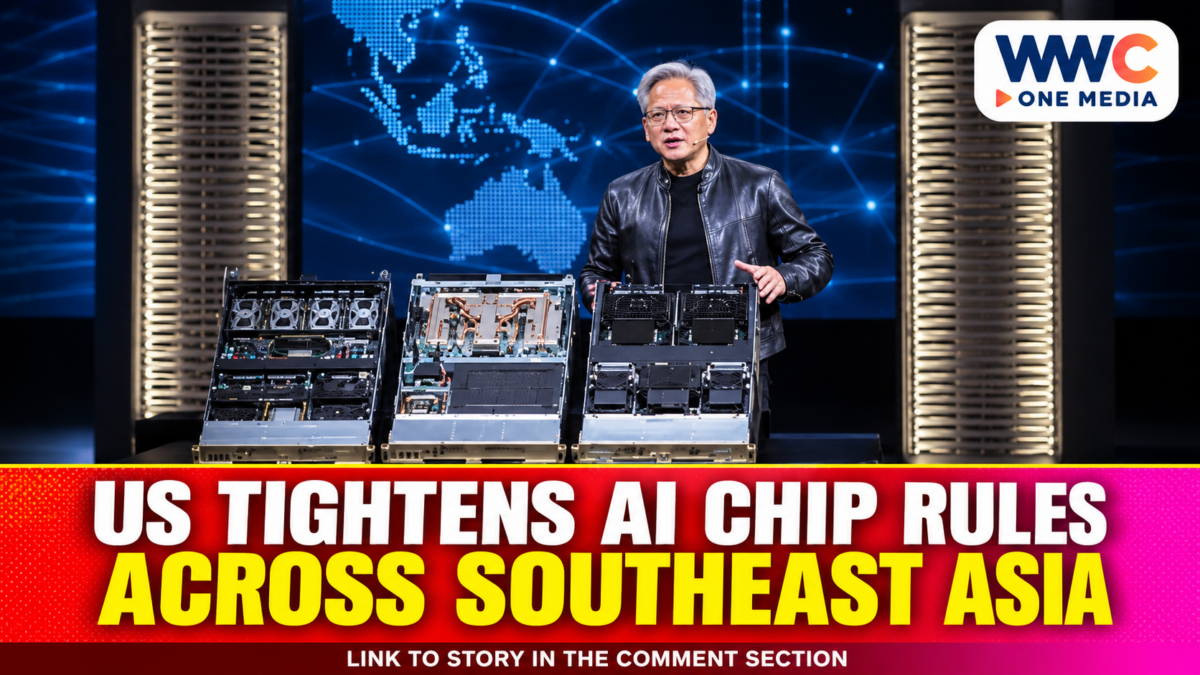
The United States is preparing a tougher set of AI chip rules aimed at preventing companies in China and other restricted markets from accessing advanced American computing power through overseas data centres. The measures specifically identify Indonesia, Malaysia, Singapore and Thailand among five countries where exports of certain advanced semiconductors will require additional licences, putting Southeast Asia’s expanding technology infrastructure under closer scrutiny. Bureau of Industry and Security+1
The US Commerce Department’s Bureau of Industry and Security (BIS) released the interim final rule on Nov. 16, 2026. It is scheduled for publication in the Federal Register on Nov. 19, with the rule’s effective date tied to that publication. Bureau of Industry and Security+1
The implications extend beyond chip manufacturers. Data-centre operators, cloud-service providers, semiconductor suppliers and companies that rent computing capacity may face new compliance obligations. For the Philippines, the important distinction is that the country is not among the five named destinations for the additional location-based licensing requirement—but Philippine facilities are not automatically exempt from restrictions on remote access by Chinese customers.
The new AI chip rules target computing access, not just physical shipments
The regulation addresses a problem that conventional export controls can struggle to capture: a restricted customer does not necessarily need to import a physical processor to use its computing power.
A company headquartered in China, for example, could potentially obtain access to advanced processors installed in a data centre located in another country. The equipment remains overseas, but the customer can use its computing capacity remotely.
The new rule seeks to restrict that arrangement when an overseas data centre provides significant computing resources directly or indirectly to companies headquartered in China, Macau or other destinations classified under Country Group D:5.
The rule establishes a licensing requirement when the relevant data-centre capacity exceeds 12 million in aggregate total processing performance, including capacity across linked data centres. It also requires due diligence into customers’ direct and indirect ownership or control. Bureau of Industry and Security
That last provision is particularly important. A business cannot necessarily avoid scrutiny simply by placing an intermediary company between the data-centre operator and the ultimate customer.
The regulation also makes clear that linked facilities can be considered together when they share computing resources through network infrastructure. In other words, the regulatory focus is not limited to the address of one server building.
There is an exception for qualifying commercial recommendation systems, such as systems used by online retailers or social media companies. The rule distinguishes these functions from advanced computing applications that it considers relevant to national-security concerns. Bureau of Industry and Security
Why Indonesia, Malaysia, Singapore and Thailand are on the list
The rule identifies five destinations for additional licensing requirements covering certain advanced semiconductor exports, re-exports and transfers: Indonesia, Malaysia, Singapore, Thailand and Brazil.
The BIS document describes these destinations as presenting a higher-than-normal risk of diversion. Applications involving the specified transactions will be reviewed case by case. The regulation also provides an exception for shipments to qualifying US-headquartered companies, subject to reporting requirements. Bureau of Industry and Security
For Southeast Asia, the change is significant because the region has become an important location for semiconductor manufacturing, electronics production, cloud infrastructure and data-centre investment.
Malaysia and Singapore, in particular, have attracted attention over the movement of advanced computing equipment across borders. Malaysia’s ongoing scrutiny of chip-related transactions illustrates the regulatory challenge, as explored in WWC ONE MEDIA’s report on the country’s continuing checks into possible chip re-exports.
The new US rule does not establish that every company operating in these countries has violated export controls. Rather, it creates additional licensing and compliance requirements for specified transactions.
That distinction matters for legitimate businesses. Data-centre operators may serve customers from several countries, and a company’s location alone does not establish whether a transaction is prohibited. The identity of the customer, the ultimate parent, the intended use and the computing capacity involved can all become relevant.
What this means for Nvidia and the China market
Nvidia is one of the companies exposed to the wider debate because its advanced processors are central to many large-scale artificial intelligence systems.
The company’s quarterly filing with the US Securities and Exchange Commission, covering the period ended July 26, 2026, described the commercial difficulties created by restrictions on sales to China.
Nvidia disclosed that the US government had granted licences allowing limited H200 shipments to specific China-based customers. However, the company said sales were restricted by the Chinese government and that it had been unable to sell all the products covered by those licences. SEC
The filing also disclosed a US$400 million charge during the first half of fiscal 2027 associated with H200 excess inventory and purchase obligations. Nvidia said shipments under the licensing programme represented less than 1% of Data Centre revenue in its most recent quarter. SEC
These disclosures show why a licensing decision does not automatically translate into a successful commercial transaction. A company may satisfy one country’s requirements but still encounter restrictions, customer limitations or other obstacles in the destination market.
The new November rule adds another layer. It addresses not only the movement of processors but also the ability of restricted customers to obtain substantial computing capacity through overseas infrastructure.
It is not a finding that Nvidia or any particular data-centre operator has violated the new requirements. The rule establishes a regulatory framework; individual transactions must be assessed against its provisions.
Is the Philippines outside the new restrictions?
The Philippines is not included in the five destinations specifically named for the additional location-based licensing requirement in the interim final rule.
That could matter as the country seeks to attract investment in data centres, cloud services and AI infrastructure. However, it would be misleading to interpret the omission as a blanket exemption for Philippine facilities.
The separate remote-access provision applies to overseas data centres wherever they are located when they provide significant computing capacity to companies headquartered in China, Macau or other specified restricted destinations.
A Philippine data centre serving ordinary domestic businesses or customers in other permitted markets is not automatically caught by that provision simply because it uses American technology. But a facility providing the specified level of computing capacity to a restricted customer could face licensing obligations regardless of its location. Bureau of Industry and Security
The distinction makes customer screening and ownership checks central to the business of operating data centres.
The Philippines is already developing infrastructure intended to support higher computing demand. WWC previously examined Converge’s expansion of domestic data centres and connectivity, including the company’s plans for AI-ready facilities.
Energy supply is another part of that investment equation. The proposed collaboration between Meralco PowerGen and VITRO to study renewable-powered data centres, covered in WWC’s report on their feasibility initiative, illustrates how power availability and digital infrastructure are increasingly connected.
For Philippine operators, the new US rules add a compliance consideration to decisions about customers, technology suppliers and international service arrangements. The country may not be on the five-country list, but its facilities could still fall within the global remote-access provisions.
The rule also changes the wider US export-control framework
The interim final rule does more than introduce restrictions on remote computing. It also formally rescinds regulations implementing the Biden-era AI Diffusion Rule, which the Commerce Department says had never been enforced. Bureau of Industry and Security
This is a significant policy change because it replaces part of the previous framework with a more focused combination of destination-based licensing and restrictions on particular end uses.
The new approach places greater emphasis on where advanced computing equipment is sent, who ultimately controls the customer and how the resulting computing power is used.
For technology companies, that could mean more extensive compliance work involving ownership structures, customer verification and data-centre capacity. For governments, it creates another reason to coordinate export-control enforcement with customs, trade and technology regulators.
The rule is also an interim final measure rather than an indication that every implementation question has been settled. Its publication and comment process will provide an opportunity for affected parties to respond to the regulatory changes.
What happens next?
The interim final rule is scheduled for publication in the Federal Register on Nov. 19, 2026. The document provides for a 60-day period for public comments after publication. Federal Register Public Inspection+1
Existing overseas data centres that were already providing significant computing capacity to restricted customers before publication will have 90 days from the rule’s effective date to obtain the required licence if they intend to continue those services. Bureau of Industry and Security
For businesses in Southeast Asia, the immediate priority will be understanding which products and transactions fall within the regulation, reviewing customer ownership and control, and determining whether their facilities provide computing capacity covered by the new requirements.
For the Philippines, the opportunity to attract data-centre investment remains, but regulatory compliance will be part of the competitive equation. The country’s absence from the five named destinations does not remove the need to verify who ultimately uses the computing infrastructure.
The bigger question is whether Southeast Asia can continue expanding its role in the global AI economy while meeting increasingly complex rules governing access to advanced American technology.