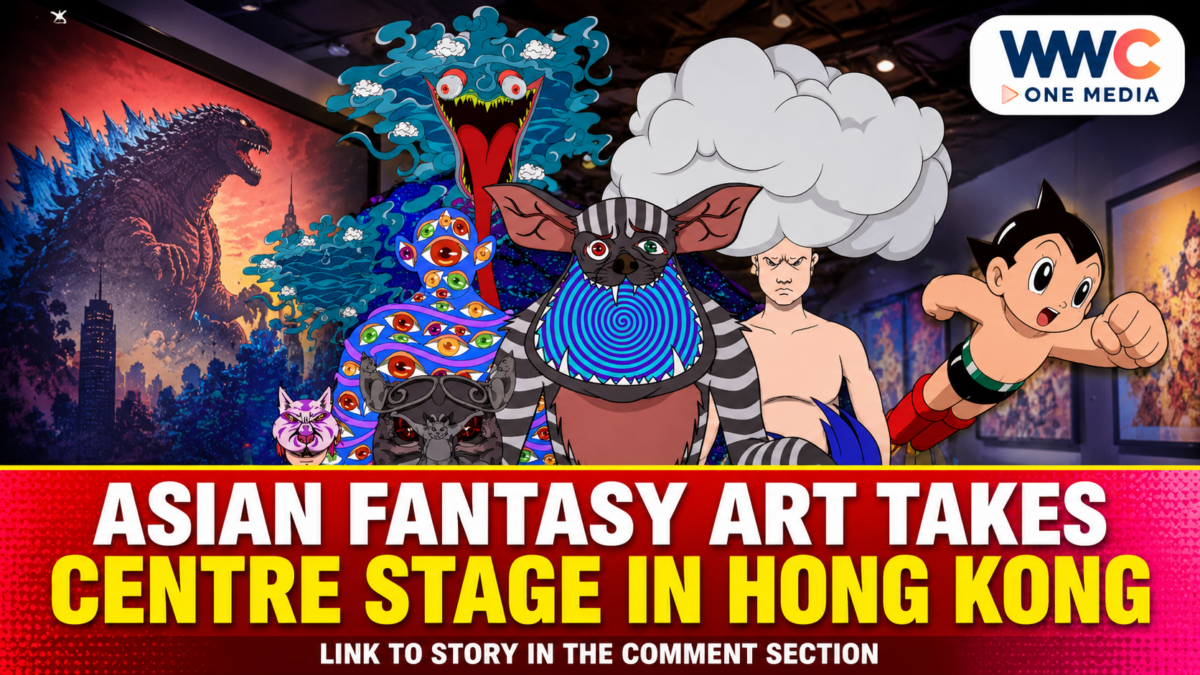
A major exhibition at Hong Kong’s M+ museum is bringing together more than 400 works to examine how Asian artists have used mythology, supernatural creatures and imagined worlds to explore the societies around them. Running from Oct. 17, 2026, to April 4, 2027, Myths and Monsters: The Art of Fantasy in Asia places Japanese icons such as Godzilla and Astro Boy alongside historical artworks and contemporary creations from across the region.
The exhibition offers a broader view of Asian fantasy art, tracing its development from traditional religious and folklore imagery to manga, anime, film, fashion, architecture and digital culture. Its central idea is that imaginary creatures and fictional worlds can do more than entertain: they can help artists express anxieties, question social conditions and reconsider cultural identity.
Asian fantasy art connects folklore with contemporary culture
Presented at the West Gallery of M+ in the West Kowloon Cultural District, the exhibition covers artistic developments from the 19th century to the present.
Its more than 400 works are organised into four sections, allowing visitors to follow connections between older storytelling traditions and modern visual culture. The selection includes art, architecture, fashion, video games, film and other creative forms.
The museum’s approach is significant because it does not treat fantasy as a category limited to children’s stories, monsters or entertainment. Instead, it considers how artists have used supernatural and speculative imagery to respond to the political, cultural and social realities of their time.
This perspective also places Asian creative traditions within a wider international conversation. Rather than presenting Japanese manga and anime as isolated pop-culture phenomena, the exhibition connects them with older forms of visual storytelling from different parts of Asia.
From traditional spirits to supernatural protectors
The first section, Spirits Among Us: Fantasy in the 1800s, explores the place of supernatural beings in Asian folklore and spiritual traditions.
Visitors encounter Japanese ukiyo-e woodblock prints, Chinese shadow puppets, Tibetan Buddhist thangkas and other objects that demonstrate how imagined beings have appeared in different cultural settings.
These figures were not simply invented for amusement. Stories about ghosts, deities and monsters could communicate philosophical ideas, address subjects that were difficult to discuss directly and express hopes for protection, safety and prosperity.
One contemporary addition makes that historical connection particularly visible. Hong Kong artist Oscar Chan Yik Long created Fear Catcher (2026), a site-specific mural inspired by Zhong Kui, a figure from Chinese mythology known as the King of Ghosts.
The work offers a contemporary interpretation of a traditional figure. In the museum’s description, Zhong Kui can be understood as a symbol for recognising personal fears and learning to release them.
That approach demonstrates how mythology can remain relevant even when artists reinterpret familiar figures for modern audiences.
Surrealism reveals another side of Asian imagination
The second section, Strange Realities: Surrealism and Asia, moves into the development of surrealist art and its influence on Asian artists.
Surrealism emerged in Europe after the First World War and explored the unconscious mind through unusual, dreamlike and sometimes unsettling imagery. Asian artists encountered the movement and adapted its visual language to their own experiences.
The exhibition brings European artists Giorgio de Chirico, Salvador Dalí and René Magritte into dialogue with Asian artists, including Kim Younghwan, Pratuang Emjaroen, Harue Koga, Pang Hiunkin and Okamoto Taro.
Their inclusion broadens the exhibition beyond the familiar imagery of Japanese monsters and animated characters. It shows how artists from different countries developed their own approaches to surrealism, shaped by local histories and cultural circumstances.
The section also includes artists from China, Japan, Korea, Myanmar, the Philippines and Thailand.
For Filipino audiences, that regional representation is especially relevant. It places the country’s artistic experience within a wider Asian history rather than treating modern visual culture as something shaped only by Japan, Europe or the United States.
Godzilla, Astro Boy and anime enter the museum conversation
The third section, From Godzilla to Ghost in the Shell: Fantasy Meets Pop Culture, examines the international influence of Japanese popular culture after the Second World War.
Among its featured figures are Astro Boy, created by manga artist Osamu Tezuka in 1952, and Godzilla, which first appeared in the 1954 film. Both became enduring cultural icons, but their significance extends beyond their recognisable designs.
The exhibition considers how these fictional worlds created ways to explore loss, social upheaval and hopes for a better future.
It also includes drawings from Cardcaptor Sakura and background paintings from the 1995 anime film Ghost in the Shell. These examples highlight the artistic work behind popular entertainment, including character design, visual environments and the construction of fictional worlds.
The connection between traditional and contemporary Japanese storytelling is also visible in the growing international interest in Japanese cinema. Filipino audiences have recently had opportunities to experience a wide range of Japanese productions through the Japanese Film Festival 2026 programme across Philippine cinemas.
The museum’s selection similarly demonstrates how animation and manga can be examined as cultural and artistic forms, not simply as commercial entertainment.
Contemporary artists turn fantasy into new mythologies
The final section, New Mythologies: Asian Fantasy Goes Global, considers how contemporary artists continue to transform the visual language of anime, manga and older mythological traditions.
The featured artists include Fujimori Terunobu, Ayoung Kim, Lawrence Lek, Takashi Murakami, Ho Tzu Nyen, Philippe Parreno, Rirkrit Tiravanija, Windowsen and LuYang.
Their works explore subjects such as fluid identity, technological anxiety and the reinvention of mythology. These themes reflect a period in which digital images, virtual identities and fictional universes have become increasingly prominent in everyday life.
The exhibition’s inclusion of fashion, architecture, moving images and digital culture also reflects how fantasy has moved beyond conventional paintings and sculptures.
This wider understanding of contemporary Asian art can be seen in other museum presentations. WWC previously examined the international attention surrounding Yayoi Kusama’s extensive artistic legacy and retrospective exhibition, another example of how an artist’s visual language can reach audiences across different media and generations.
More than an exhibition: Films, activities and a publication
M+ has arranged additional activities to extend the exhibition beyond its galleries.
Its programme includes guided activities, curator-led tours and a free self-guided audio guide featuring interviews with artists, curators, collectors, researchers and fans. The museum also plans six Family Days on selected Sundays between January and March 2027.
Cinema screenings provide another connection between the exhibition’s themes and popular culture. The museum’s programme includes Mamoru Oshii’s Ghost in the Shell (1995) and Ghost in the Shell 2: Innocence (2004), accompanied by a post-screening discussion involving an anime archivist and the exhibition’s moving-image curator.
A separate winter screening programme, Monsters Among Us, brings together eight creature-focused films from different countries. Its announced selection includes Super Inframan (1975), Nobody (2025), Pan’s Labyrinth (2006), The Host (2006) and Border (2018).
M+ and Thames & Hudson have also co-published Myths, Monsters, and Manga: The Art of Fantasy in Asia. The book contains more than 200 illustrations and is available in English and Traditional Chinese.
The museum has introduced merchandise inspired by selected works and characters, including Godzilla, Fear Catcher and Ho Tzu Nyen’s Night March of Hundred Monsters.
What happens next
The exhibition remains open until April 4, 2027, giving visitors several months to explore its historical and contemporary selections.
Admission to M+ galleries is available through a single-price ticket. The museum lists standard admission at HK$190 and concession admission at HK$100, with eligibility for concessions covering groups such as full-time students, children aged seven to 11, senior citizens aged 60 and above, and persons with disabilities and one companion.
For international visitors, including those travelling from the Philippines, the exhibition offers an opportunity to encounter several generations of Asian visual culture in one venue.
Its broader contribution may be the way it encourages audiences to look differently at familiar characters. Godzilla, Astro Boy and other fantastical figures are not presented only as entertainment properties, but as part of a much longer history of how artists use imagination to interpret the world.
Frequently Asked Questions
What is the Myths and Monsters exhibition in Hong Kong?
Myths and Monsters: The Art of Fantasy in Asia is an exhibition at M+ exploring the development of Asian fantasy and visual culture from the 19th century to the present.
When does the exhibition run?
It runs from Oct. 17, 2026, to April 4, 2027, at the West Gallery of M+ in Hong Kong.
Which Japanese characters are featured?
The exhibition includes Godzilla and Astro Boy, alongside material connected to Cardcaptor Sakura and Ghost in the Shell.
How many works are included?
M+ presents more than 400 works across four sections, covering art, architecture, fashion, film, video games and digital culture.
How much are the tickets?
M+ lists standard admission at HK$190 and concession admission at HK$100. Visitors should check the museum’s official website for current ticketing arrangements and eligibility details.