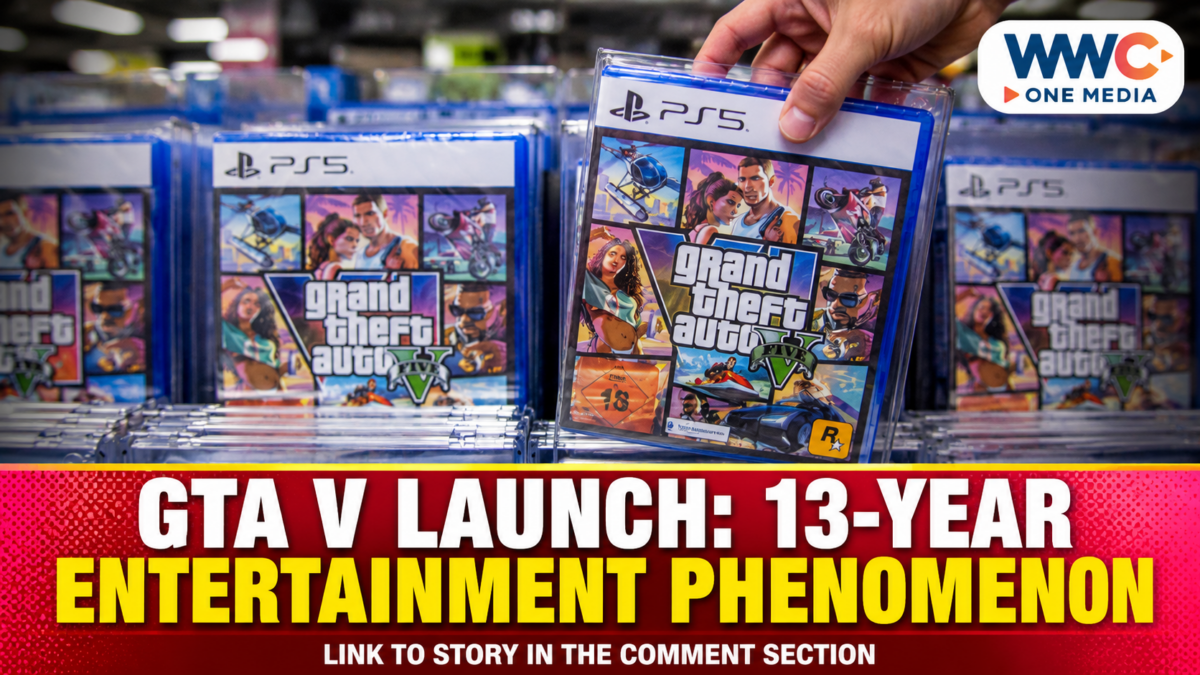
When Grand Theft Auto V arrived on Sept. 17, 2013, Rockstar Games released a title that would quickly become one of the biggest commercial successes in video game history. Within three days, its publisher, Take-Two Interactive Software, announced that worldwide retail sales had exceeded US$1 billion, setting an extraordinary early benchmark for the entertainment industry.
The figures were remarkable, but the longer story is what happened after launch. More than a decade later, GTA V remains commercially significant, demonstrating how a major game can extend its life through new platforms, online services and a continuing audience rather than relying on its original release alone.
GTA V launch produced an immediate commercial milestone
Take-Two announced on Sept. 18, 2013, that GTA V had generated more than US$800 million in worldwide first-day retail sales. The figure excluded the upcoming launches in Japan and Brazil and was based on the company’s estimates.
The announcement also described the release as the highest first-day retail sales performance in the company’s history and that of the Grand Theft Auto series at the time.
The launch took place on PlayStation 3 and Xbox 360. Take-Two’s announcement said more than 8,300 stores in North America opened at midnight to accommodate customers waiting to purchase the game.
Just two days later, on Sept. 20, the company announced that worldwide retail sales had exceeded US$1 billion during the first three days.
These were retail sales estimates, not a declaration that Take-Two had collected US$1 billion in net revenue or profit. The distinction matters because retail spending, publisher revenue and earnings are different financial measurements.
Even with that qualification, the launch established the scale of consumer demand. The game had become a major commercial event almost immediately after reaching stores.
Rockstar built Los Santos around a larger ambition
The commercial result was supported by a project that had been in development for years.
Rockstar officially announced Grand Theft Auto V on Nov. 3, 2011. Its original description placed the game in Los Santos and the surrounding hills, countryside and beaches, drawing inspiration from a reimagined version of present-day Southern California.
The company described the project as a new direction for open-world freedom, storytelling, mission-based gameplay and online multiplayer. Its central theme was the pursuit of money.
That creative foundation helped establish a setting capable of supporting different types of experiences. Players were not confined to a sequence of missions; the fictional environment also encouraged exploration and activities beyond the central storyline.
The game followed three protagonists: Michael, Franklin and Trevor. Their interconnected lives and criminal activities gave Rockstar a narrative structure that could move between different perspectives while maintaining one shared world.
The approach was important to the game’s identity. Instead of treating the open world merely as a backdrop for missions, Rockstar made the environment a central part of the experience.
GTA Online gave the game another commercial life
One of the most consequential decisions surrounding the original release was the inclusion of Grand Theft Auto Online.
Take-Two’s Sept. 18, 2013 announcement confirmed that the online experience would be available free with every copy of GTA V, with its launch scheduled for Oct. 1, 2013.
That arrangement gave the game an additional dimension beyond its single-player campaign. Players could enter a shared online environment and continue engaging with the franchise after completing the main story.
It also created opportunities for Rockstar to support the title through additional content and recurring player activity.
Take-Two later described Rockstar’s strategy as focusing on a limited number of titles with quality and longevity, while creating opportunities for sequels, virtual currency, add-on content and in-game purchases. The company’s business model helps explain why a successful game can remain commercially relevant well beyond its original release.
This is also part of a broader industry challenge. WWC’s coverage of Sony’s decision to cancel the Fairgames project examines the difficult balance between developing multiplayer experiences and sustaining player engagement.
For Rockstar, GTA Online became a way to keep the GTA V world active across multiple years.
New console generations expanded the game’s reach
The original release did not remain limited to the PlayStation 3 and Xbox 360.
On June 9, 2014, Rockstar announced that GTA V would arrive on PlayStation 4, Xbox One and PC. The company highlighted technical improvements, including increased draw distances, finer texture details, denser traffic and enhanced resolution.
Rockstar subsequently announced specific release dates for the new versions: Nov. 18, 2014, for PlayStation 4 and Xbox One, followed by Jan. 27, 2015, for PC.
The expanded releases gave the game access to newer hardware and additional audiences. They also allowed Rockstar to continue supporting an established product rather than depending exclusively on a completely new instalment.
This approach illustrates a wider feature of modern entertainment franchises: a successful property can be repackaged, upgraded and distributed across successive platforms while retaining its original identity.
A similar willingness to experiment with established properties can be seen in other gaming franchises. WWC’s report on Pokémon’s shift towards a different style of gameplay through Pokopia explores how familiar intellectual property can continue developing through new formats and experiences.
More than a decade later, the numbers remain extraordinary
The clearest indication of GTA V‘s staying power is its continuing sales performance.
In a Nov. 20, 2026 corporate announcement, Take-Two and Rockstar stated that GTA V had sold-in nearly 235 million units. The same announcement placed total sales of the wider Grand Theft Auto franchise at nearly 480 million units.
The wording is important. Sold-in figures refer to units supplied into distribution channels and should not automatically be interpreted as a precise count of individual players or verified consumer purchases.
Nevertheless, the figure demonstrates the scale of the title’s distribution over its lifetime.
The company’s announcement also placed GTA V within a much larger business portfolio. Rockstar Games operates as a publishing label of Take-Two Interactive, which oversees the commercial operations of several established entertainment properties.
That relationship means the performance of a major Rockstar release can have significance beyond the individual game. It contributes to the value of a franchise that has become a central part of the publisher’s business.
The scale of that legacy also provides context for the latest instalment. WWC previously examined GTA VI’s commercial and cultural challenge, including the expectations created by its predecessor.
What made GTA V different from an ordinary blockbuster?
The success of GTA V cannot be explained by one sales announcement alone.
Its original launch generated exceptional demand, but its continued availability on newer consoles, PC releases and the development of GTA Online helped extend its commercial life.
The combination gave Rockstar several ways to maintain interest in the same fictional world. Players could experience the story, return for online activities or purchase the game again when moving to another platform.
Analysis: The game’s lasting relevance suggests that a successful entertainment release does not necessarily need to be replaced quickly. When a developer can maintain a strong core experience and give audiences reasons to return, one title can remain commercially important across multiple hardware generations.
That does not mean every game can reproduce the same outcome. GTA V benefited from an established franchise, substantial development resources and a large international audience. Its performance should be viewed as an exceptional case, not a guaranteed formula for other publishers.
What happens next
With GTA VI now available, the franchise has entered another major stage. The commercial challenge for Rockstar is no longer simply to create a successor, but to establish whether a new game can build its own long-term audience while carrying the expectations associated with GTA V.
The older title’s nearly 235 million units sold-in provide a formidable point of comparison. However, the performance of a new release must be evaluated through its own sales, player engagement and longer-term business results.
For the gaming industry, GTA V remains an important example of how a release can evolve into a long-running entertainment product. Its history shows that the launch is only the beginning of a game’s commercial life.
Frequently Asked Questions
When was Grand Theft Auto V released?
Grand Theft Auto V was released on Sept. 17, 2013, for PlayStation 3 and Xbox 360.
How much did GTA V make during its first day?
Take-Two announced more than US$800 million in worldwide first-day retail sales, based on company estimates and excluding the upcoming launches in Japan and Brazil.
When did GTA V reach US$1 billion in sales?
Take-Two announced on Sept. 20, 2013, that worldwide retail sales had exceeded US$1 billion during the game’s first three days.
What is GTA Online?
Grand Theft Auto Online is the multiplayer experience included with GTA V. Take-Two originally announced it as a free offering with every copy of the game, with its launch scheduled for Oct. 1, 2013.
How many copies of GTA V have been sold?
In a Nov. 20, 2026 announcement, Take-Two and Rockstar reported that Grand Theft Auto V had sold-in nearly 235 million units worldwide.