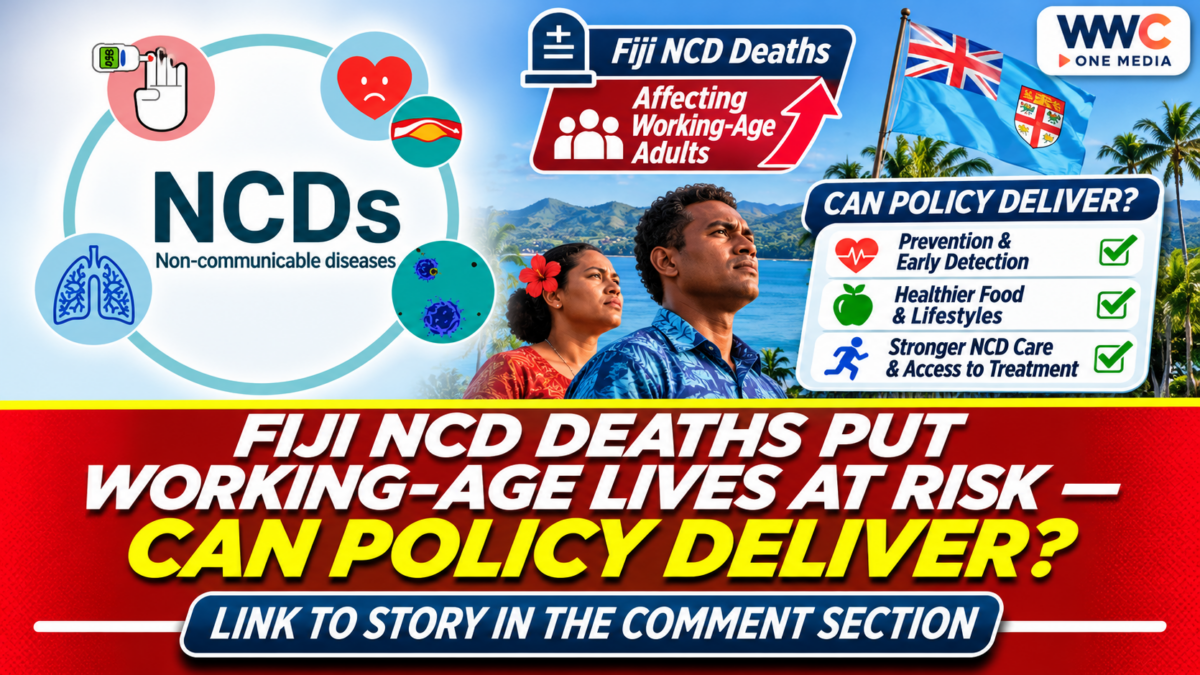
SUVA, Fiji — Fiji’s government launched its National Population Policy 2026–2035 in November, placing population health alongside workforce planning and economic resilience. The policy arrives as a previously published World Bank health review reports that 64% of deaths associated with noncommunicable diseases (NCDs) involve people of working age, exposing a challenge that extends beyond hospitals.
The Fiji NCD deaths figure is not a new count of deaths in 2026. It was already published in the World Bank’s 2024 health-sector assessment, and its significance lies in how preventable illness and early death can affect households, employment and the capacity of public services.
Fiji NCD Deaths: What Does the 64% Figure Mean?
The World Bank’s November 2024 health review reported that noncommunicable conditions accounted for about 80% of deaths in Fiji, with 64% of deaths from those causes occurring among working-age people. It also estimated the crisis’s annual economic cost at approximately FJ$591 million, equivalent in that announcement to US$260 million.
These are different measures. The 80% describes the share of all deaths attributed to NCDs; the 64% describes the age profile within NCD deaths. It does not mean 64% of all working-age residents died, or that the figure represents a fresh annual mortality rate.
The World Health Organization’s country data provide a more recent but differently modelled picture: NCDs represented an estimated 81.6% of deaths in 2023. The WHO warns that limitations in Fiji’s death-registration completeness and cause-of-death information can affect estimates. Figures from different publications must not be treated as interchangeable without checking their years and methods.
A Population Strategy Meets a Health-System Challenge
At the official launch of Fiji’s policy documents, Prime Minister Sitiveni Rabuka said the first comprehensive National Population Policy would connect demographic trends with decisions on health, education, jobs, housing and other services. The prime minister cited a population projection of approximately 879,437 in 2027 and a projected negative growth rate of 0.06%.
The government’s explanation identifies outward migration, ageing, urbanisation and changing family patterns as matters for national planning. The policy launch did not, by itself, prove that any individual illness caused a particular worker to leave employment or that mortality alone explains the population forecast.
WWC analysis: For a country facing workforce constraints, premature illness can compound the effects of emigration and ageing. But a credible policy response needs separate evidence about each pressure, rather than attributing every labour shortage to NCDs.
Why Primary Healthcare Matters More Than One New Programme
The World Bank review describes under-resourced primary healthcare, uneven distribution of health workers and heavy pressure on major hospitals. It notes that, in some areas, a single public health nurse serves a catchment of 30,000 people. These observations help explain why prevention, screening and continuous care matter to economic planning.
The review recommends redesigning primary care, improving NCD screening and registries, retaining healthcare professionals and strengthening financial management. These are recommendations, not completed reforms or guaranteed reductions in disease.
Comparable health-access questions have featured in WWC’s report on LANDBANK’s employee healthcare programme. That initiative operates in the Philippines, not Fiji, and is relevant only as a separate example of how employers can address access to care.
The Economic Cost Needs Careful Interpretation
The World Bank’s FJ$591 million annual figure is an economic estimate, not an amount the Fijian government paid in a single budget line. It should not be described as cash recoverable merely by announcing a new programme.
The review projected that health spending per person could rise to more than two-and-a-half times its then-current level by 2050 if NCD trends continued. Conversely, the review modelled potential economic gains from substantial health-system reforms. Both scenarios depend on assumptions and should not be mistaken for certain outcomes.
WWC has also examined mWell’s proposed digital-health tools in the Philippines. Digital systems can support records and follow-up, but their usefulness depends on staffing, connectivity, safe implementation and patients’ real access to treatment.
Better Measurement Is Part of the Solution
Fiji’s November policy launch also discussed strengthening official statistics and preparing for a 2027 population census. Reliable age-specific mortality data, clear disease definitions and consistent reporting are essential for deciding where public investment should go.
An improved data system could help distinguish preventable deaths, treatment gaps and demographic change more clearly. It would not, on its own, solve shortages of medicines, clinicians or nearby clinics.
Other regional health institutions are also working on system capacity. WWC’s account of Singapore’s disease agency receiving a WHO role concerns a different national system and different disease-control functions, but it demonstrates why institutions must turn formal commitments into measurable service improvements.
What Happens Next
As of Nov. 22, 2026, the primary records establish Fiji’s new population-policy framework, a substantial historical burden of NCD mortality among working-age people and recommendations for stronger primary healthcare. They do not establish that the new policy has already reduced deaths, saved the stated economic cost or achieved particular health outcomes.
The next tests are whether Fiji publishes measurable implementation targets, supports clinics and frontline health workers, improves disease surveillance and reports outcomes consistently. WWC analysis: The strongest indicator of progress will not be another headline percentage, but sustained evidence that more people receive timely, effective care and avoid premature illness and death.
Frequently Asked Questions
What does the 64% Fiji NCD figure mean?
The World Bank reported in 2024 that 64% of people dying from noncommunicable diseases in Fiji were of working age. It is a share of NCD deaths, not a mortality rate for all working-age people.
Are NCDs responsible for most deaths in Fiji?
Yes, in the available estimates. WHO’s 2023 country data attribute approximately 81.6% of deaths to noncommunicable diseases, subject to the agency’s data-quality cautions.
Is the 64% statistic new for 2026?
No. It appeared in the World Bank’s 2024 Fiji health review. The 2026 population-policy launch renewed attention to the country’s demographic and healthcare challenges.
What could help reduce Fiji’s NCD burden?
The World Bank recommends stronger primary care, screening, healthcare workforce capacity and disease-data systems. Their effectiveness depends on implementation and evaluation.
How does health connect with Fiji’s workforce?
Premature illness and deaths can reduce earning capacity and increase care needs, while migration and ageing also affect workforce planning. The precise contribution of each factor needs separate measurement.