
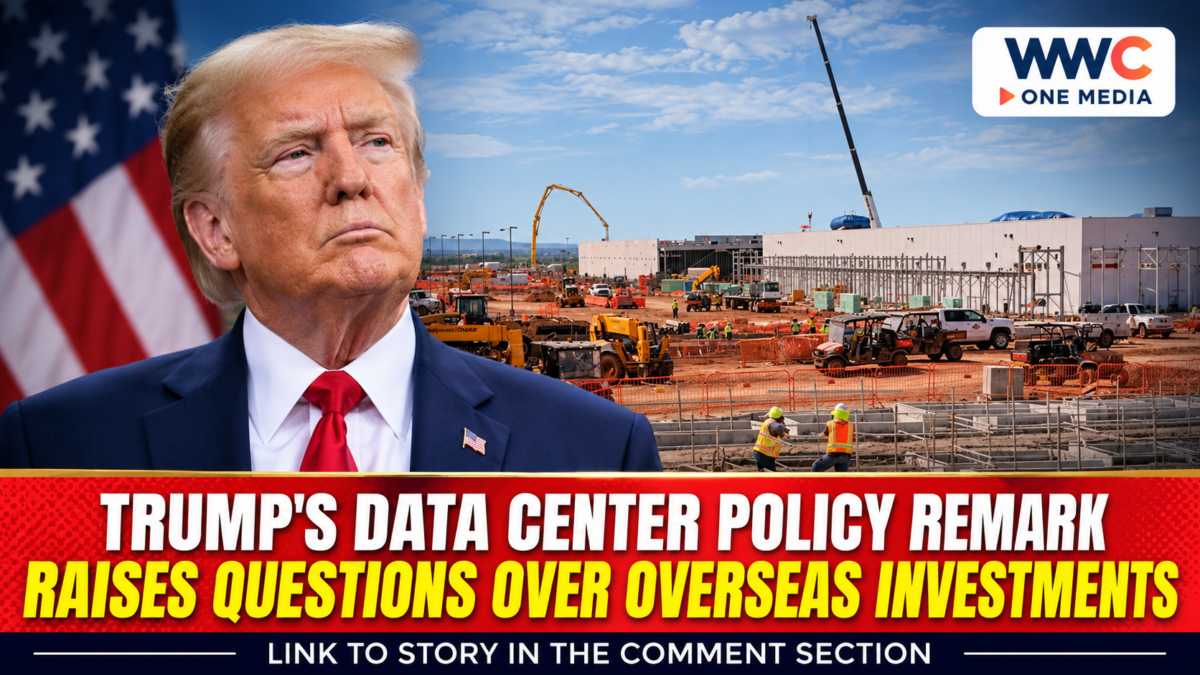
WASHINGTON, November 22, 2026 — US President Donald Trump has called for American technology companies to build data centres within the United States rather than establish facilities overseas, introducing another potential policy challenge for businesses investing in international artificial intelligence infrastructure.
Trump made the remarks during a White House press briefing on November 20, following his return from an Asian diplomatic trip. The White House’s official account of the briefing records him saying: “We’re not going to allow our companies to build data centers outside of our country.” The White House
The announcement raises an important question for the international technology industry: how would Washington implement such a restriction, and what would it mean for American companies operating across multiple countries?
For now, the distinction between presidential statements and enforceable government policy remains critical. The official statement documents Trump’s position but does not provide a detailed regulatory framework explaining how companies would be restricted or penalised.
What Trump’s Data Center Policy Remark Actually Establishes
The November 20 briefing placed domestic technology infrastructure within the administration’s broader economic and national security priorities.
Trump argued that the United States should retain the infrastructure supporting its artificial intelligence industry rather than allow American companies to develop facilities in other countries.
His remarks also referenced concerns about the international movement of technology and the possibility of other countries benefiting from infrastructure investments made by American businesses.
However, the White House release does not identify a specific law, executive order or regulation establishing a prohibition on overseas data centre construction.
It also does not specify which companies would fall under the proposed restriction, whether existing international facilities would be affected, or whether exceptions would be available.
This means businesses should distinguish between the administration’s stated direction and the legal obligations currently established by an implementing document.
The distinction is particularly important for publicly traded technology companies, infrastructure developers and investors making long-term commitments across international markets.
Why Data Centres Have Become a Strategic Economic Asset
Data centres are specialised facilities that house servers, networking equipment and storage systems used to process and distribute digital information.
They support cloud computing, financial transactions, online services and artificial intelligence applications.
As AI systems become more sophisticated, the computing infrastructure required to train and operate them has become increasingly important to technology development.
The US Department of Energy’s United States Data Center Energy Usage Report: 2025 Update, published in June 2026, estimates that data centres could consume 11.8% of total US electricity by 2030 under its reference scenario.
The report also presents a broader range of possible outcomes, from 9.5% to 15.3%, reflecting uncertainty surrounding equipment deployment and electricity consumption. The Department of Energy’s Energy.gov
These projections demonstrate why data centre development is no longer simply a matter of constructing additional buildings.
It also involves substantial decisions about electricity supply, cooling systems, computing equipment, network connectivity and long-term infrastructure financing.
The Department of Energy has separately identified reliable electricity infrastructure and protection against increased costs for households and businesses as important considerations in domestic data centre expansion. Department of Energy
For policymakers, encouraging domestic construction could therefore serve several objectives, including strengthening computing capacity, supporting local employment and maintaining control over strategically important infrastructure.
The International Business Consequences Could Be Significant
American technology businesses do not necessarily operate within the boundaries of a single domestic market.
International infrastructure can help companies serve customers closer to their locations, support regional operations and distribute computing workloads across different geographical areas.
A major change in the treatment of overseas investments could therefore affect future decisions involving construction budgets, infrastructure partnerships and international expansion.
However, the consequences cannot yet be quantified because the White House has not specified how the proposed approach would operate.
For example, a restriction affecting only newly announced projects would have different implications from a measure covering existing facilities, subsidiaries or investments made through international partnerships.
The distinction between owning a data centre, financing its construction and leasing computing capacity from another operator could also become important if detailed rules are eventually introduced.
For companies planning infrastructure investments, uncertainty over the scope of any future policy could complicate long-term financial planning.
This does not mean that overseas projects have automatically become prohibited or that American businesses must immediately withdraw from international markets.
Rather, the announcement signals a policy direction that companies and investors may need to monitor.
What the Development Means for Asia and the Philippines
The issue deserves attention across Asia because the region is increasingly important to the expansion of digital infrastructure and AI-related services.
Countries compete for technology investments through their electricity capacity, telecommunications networks, business environments, skilled workforces and access to regional customers.
The Philippines also has an expanding interest in AI-related infrastructure and digital services.
For example, WWC previously examined Converge’s exploration of AI computing and locally hosted data centre services, illustrating how domestic telecommunications infrastructure could become part of the country’s developing AI ecosystem.
Another relevant development is PLDT’s AI programme involving four Philippine local governments, which demonstrates the growing interest in bringing AI applications into public services.
Meanwhile, the infrastructure challenges facing Philippine companies adopting AI highlight why reliable networks, servers, cybersecurity and computing capacity matter beyond the technology sector itself.
For the Philippines, the potential implications are not limited to whether American companies construct facilities locally.
The country could also be affected by changes in international technology partnerships, cloud-service arrangements, computing access and investment decisions.
Nevertheless, it would be premature to conclude that Trump’s remarks will directly prevent American technology companies from investing in Philippine infrastructure.
That outcome would depend on the eventual wording, jurisdiction and implementation of any actual US measure.
Domestic Expansion Also Brings Infrastructure Challenges
Keeping more data centre investment within the United States would not automatically resolve the practical challenges associated with building and operating these facilities.
Electricity availability, transmission capacity, cooling requirements and construction costs remain significant considerations.
The Department of Energy’s data centre resource programme identifies energy affordability, grid reliability and infrastructure expansion as central components of the country’s AI development strategy. Department of Energy
This creates an important economic consideration.
If companies are encouraged or required to concentrate more infrastructure domestically, the United States must also ensure that the necessary electricity and supporting systems are available.
Otherwise, the policy objective of accelerating domestic computing capacity could encounter practical limitations.
From a business perspective, the success of domestic infrastructure expansion will depend not only on where facilities are constructed but also on whether they can operate reliably and economically.
What Happens Next
The next important development will be whether the administration translates Trump’s remarks into a formal government action.
The official White House briefing summary published on November 20 records his position but does not establish the details of an enforceable overseas construction restriction.
As of November 22, the official materials reviewed for this report do not establish a specific tax rate, penalty schedule, implementation deadline or comprehensive list of affected businesses.
Further clarification would be needed to determine the legal authority, scope, enforcement responsibilities and treatment of existing international investments.
Until those details are published, companies should not interpret the presidential statement as proof that all overseas data centre construction by American businesses has been legally prohibited.
For the global technology industry, the central issue is whether the administration will pursue a formal domestic infrastructure requirement or whether the announcement will remain a broader political and economic policy position.
The answer could influence how companies approach their next generation of AI infrastructure investments.
Frequently Asked Questions
1. What did Donald Trump announce about overseas data centres?
On November 20, 2026, Trump said American companies should not build data centres outside the United States, emphasising his preference for domestic infrastructure development.
2. Has the United States officially banned American companies from building data centres abroad?
The White House briefing record confirms Trump’s statement, but the official material reviewed for this report does not establish a detailed implementing law or regulation creating a comprehensive ban.
3. Will American technology companies face additional taxes?
Trump’s remarks indicated an intention to penalise overseas construction, but the official White House summary does not specify an applicable tax rate, calculation method or enforcement mechanism.
4. Could the announcement affect the Philippines?
Potentially, if future US measures affect American companies’ overseas infrastructure investments or international technology partnerships. However, no direct restriction on Philippine data centre projects has been established by the official statement.
5. Why are data centres important to artificial intelligence?
Data centres provide the computing equipment, storage and networking infrastructure required to train and operate AI systems, as well as support cloud services and other digital applications.










