
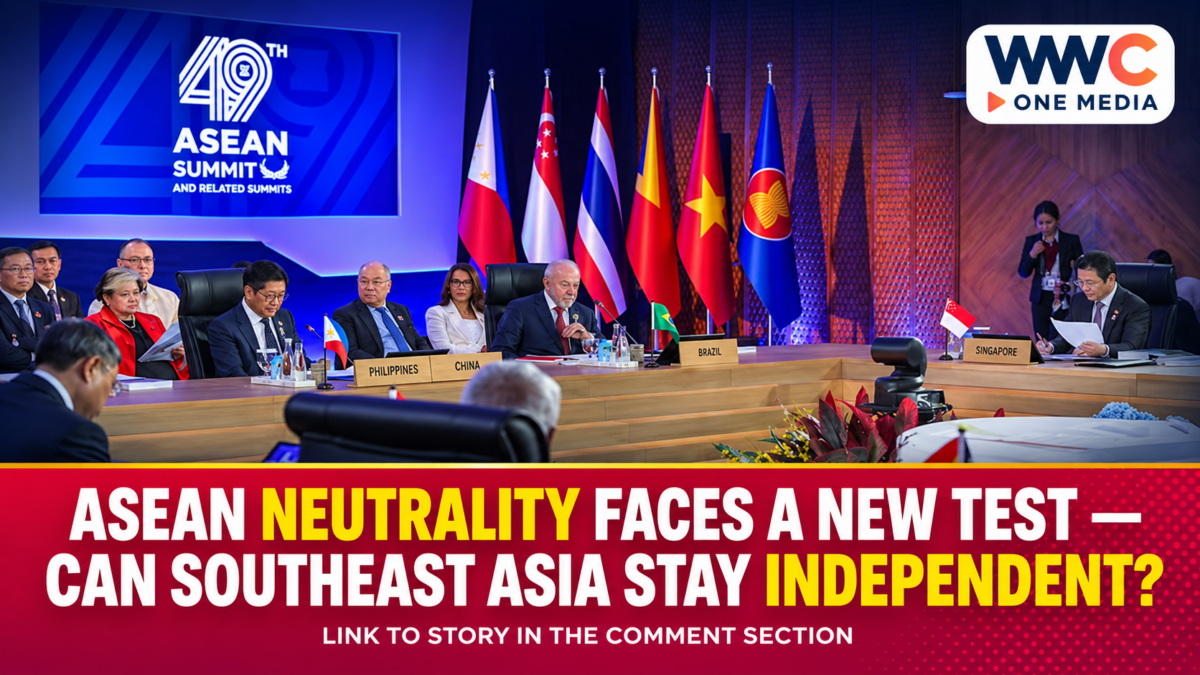
MANILA, Philippines — ASEAN’s leaders concluded their 49th summit in Manila on Nov. 17, 2026, with new cooperation documents involving major international partners. The Philippines also handed the regional chairmanship to Singapore, which will assume the role on Jan. 1, 2027.
Those developments sharpen a longstanding question: can ASEAN neutrality give Southeast Asian governments room to pursue security and economic interests without allowing competition among powerful countries to determine the region’s agenda? The official framework offers an answer, but its practical success depends on decisions that follow summit declarations.
ASEAN neutrality does not mean standing aside
The ASEAN Outlook on the Indo-Pacific, adopted in 2019, favours dialogue and cooperation over rivalry. It emphasises ASEAN centrality, openness, inclusivity, sovereignty, international law and a rules-based regional framework. These are principles for managing relationships, not a prohibition on working with outside partners.
That distinction matters because neutrality is often confused with equal distance from every country. ASEAN’s formal language is more precise: member governments seek an environment in which regional institutions remain relevant and states retain room to make decisions consistent with their interests and obligations.
Analysis: Independence is not measured by the number of meetings a government holds with Washington or Beijing. It is better tested by whether governments can explain their decisions, uphold agreed rules and maintain diplomatic options when their partners disagree.
The Manila summit showed cooperation on several tracks
ASEAN’s November summit outcome documents included a joint statement marking the ASEAN-China comprehensive strategic partnership, an ASEAN-China energy cooperation statement and a work plan for ASEAN-US cooperation covering 2026–2030. The list also included statements involving Australia, India and Japan.
Separately, ASEAN and Canada announced on Nov. 15 that negotiations on their proposed free trade agreement had substantially concluded. That is a significant negotiating milestone, but it should not be mistaken for a treaty already in force or immediate tariff reductions on every product.
For regional businesses, these parallel engagements matter because trade diversification can reduce excessive dependence on any one commercial relationship. Yet agreements must still be evaluated separately, based on their actual terms, effective dates and implementation.
The distinction is visible in WWC’s coverage of China-Canada tariff relief, where specific product categories and schedules determine the commercial effect. ASEAN-wide announcements likewise need to be judged by what businesses can eventually use.
Maritime security puts neutrality under pressure
At the 48th ASEAN Summit in Cebu on May 8, leaders reaffirmed peaceful dispute settlement, respect for sovereignty and territorial integrity, and the importance of international law, including the 1982 United Nations Convention on the Law of the Sea.
Those commitments make a crucial point: maintaining diplomatic channels does not require abandoning maritime rights or avoiding discussion of conduct at sea. Dialogue and adherence to legal principles can operate together, even where competing claims remain unresolved.
For the Philippines, the distinction is especially practical. Manila has pursued closer security cooperation with partners while continuing to participate in ASEAN-led diplomacy. WWC’s report on the Philippines-Australia defence arrangement explains the difference between practical military cooperation and an automatic mutual-defence obligation.
Analysis: ASEAN’s challenge is not to force all members into identical security policies. It is to preserve a common diplomatic framework that can accommodate differences without weakening basic commitments to peaceful dispute settlement and international law.
Economic resilience is another form of strategic choice
In March, ASEAN economic ministers warned that geopolitical uncertainty, disrupted shipping routes and volatile energy markets could raise freight, insurance and logistics costs. They also stressed regional coordination and economic resilience.
This is where geopolitical policy connects directly with household budgets and commercial planning. Transport disruptions can affect import costs, while uncertainty over trade rules can complicate orders, sourcing and investment decisions. These are risks rather than proof that every ASEAN economy experiences the same impact.
WWC’s analysis of US-China trade discussions at APEC illustrates why public promises about openness must be distinguished from enforceable trade rules. For ASEAN, reducing vulnerability requires practical integration, credible regulation and reliable routes to several markets.
Analysis: A country with more viable trading options may be better placed to reject economically costly pressure. However, trade diversification alone cannot settle maritime disputes or remove strategic disagreements.
Why ASEAN centrality still needs results
ASEAN centrality refers to the region’s ambition to shape discussions through its own institutions rather than merely react to choices made elsewhere. The Outlook identifies the East Asia Summit, ASEAN Regional Forum and other ASEAN-led mechanisms as ways to pursue that ambition.
The November summit’s varied partnership documents demonstrate that ASEAN can convene different external powers around overlapping priorities. But convening is only the starting point. Delivering useful cooperation, maintaining members’ confidence and preserving peaceful channels are harder tests.
The latest chairmanship transition adds a timetable. ASEAN’s Secretariat confirmed on Nov. 17 that Singapore will take over on Jan. 1, 2027, under the theme “Deeper Integration, Wider Partnerships.” The theme signals priorities, but the subsequent policies and outcomes will determine how much progress follows.
What happens next
Singapore’s 2027 chairmanship will provide the next opportunity to assess how ASEAN turns its declared principles into action. The measures worth watching include implementation of summit agreements, practical trade cooperation, continued diplomatic engagement and the handling of maritime disagreements under international law.
The November outcome is not proof that regional neutrality has prevailed or failed. It shows that ASEAN is still choosing to engage several partners at once while affirming its own regional role. Whether that remains a meaningful independent choice is the question the next year must answer.
Frequently asked questions
What does ASEAN neutrality mean?
It generally describes the effort to preserve independent regional decision-making and avoid allowing rivalry among external powers to control ASEAN’s agenda. ASEAN’s official Indo-Pacific Outlook emphasises openness, dialogue, centrality and international law rather than isolation.
Is ASEAN required to choose between the United States and China?
No ASEAN-wide declaration reviewed here requires members to choose one of those partners. The November summit’s outcomes included cooperation documents concerning both, although individual member states retain their own foreign-policy choices.
Does neutrality stop the Philippines from making defence agreements?
No. ASEAN’s stated principles do not prohibit member states from cooperating with security partners. Particular agreements must still be assessed under their own terms and applicable legal obligations.
Who will lead ASEAN in 2027?
Singapore will assume the rotating ASEAN chairmanship on Jan. 1, 2027, following the November 2026 handover in Manila.










