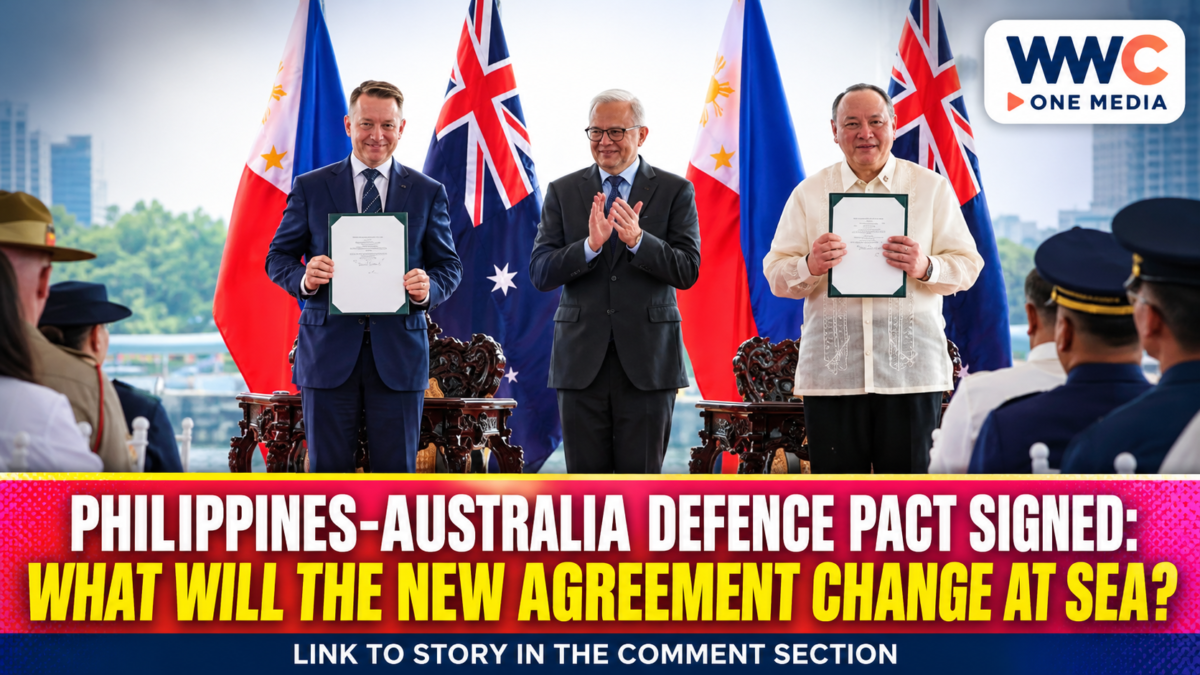
The Philippines and Australia signed a new Defence Cooperation Arrangement in Manila on Nov. 15, 2026, creating an updated framework for military and maritime security cooperation. Australian Prime Minister Anthony Albanese witnessed the signing after visiting HMAS Stalwart in Manila, marking a new stage in the two countries’ defence partnership. Defence Ministers
The arrangement expands on the existing Memorandum of Understanding on Defence Cooperation. Its stated priorities include maritime awareness, information-sharing, strategic dialogue, planning, training, interoperability and defence infrastructure development.
The agreement comes as both countries mark 80 years of diplomatic relations. It also follows months of discussions between their defence officials about updating the existing framework. Defence Ministers+1
What the new agreement covers
The arrangement provides a contemporary framework for practical cooperation between the two defence establishments. Rather than focusing on a single military activity, it identifies several areas where the countries intend to work more closely.
Maritime awareness and information-sharing are particularly significant for an archipelagic country such as the Philippines. Better coordination can help authorities build a clearer picture of activity at sea and support planning for maritime operations.
The agreement also identifies training, strategic dialogue and interoperability as priorities. Interoperability refers to the ability of different military forces to coordinate and operate effectively together.
Why the South China Sea remains part of the picture
The signing follows an August meeting in Darwin between Australian Deputy Prime Minister and Defence Minister Richard Marles and Philippine Secretary of National Defense Gilberto C. Teodoro Jr.
In their Aug. 7 joint statement, the ministers expressed serious concern about the South China Sea, including actions by Chinese vessels towards Philippine vessels. They also highlighted the importance of freedom of navigation and international law under the United Nations Convention on the Law of the Sea. Defence Ministers
The statement records the two governments’ position and concerns. It does not mean the new arrangement resolves the maritime disputes or guarantees that incidents at sea will stop.
For Manila, the practical value of closer cooperation will depend on whether improved coordination translates into better maritime awareness, training and operational readiness.
The agreement is part of wider regional cooperation
The bilateral arrangement is not the only defence initiative involving the Philippines and its partners.
On Nov. 10, Australia, Japan, the Philippines and the United States issued a joint statement following their defence ministers’ meeting in Cebu on Oct. 28. The four countries committed to establishing a Combined Coordination Center in the Philippines, coordinating defence investments and expanding the scope, complexity and frequency of combined exercises and cooperative activities. Defence Ministers
That four-country initiative is separate from the Australia–Philippines arrangement. Both developments, however, show how Manila is expanding practical security cooperation with regional partners.
What the agreement does not automatically mean
The official announcement describes a framework for defence cooperation. It does not announce a new mutual-defence treaty or state that Australia is automatically required to enter a conflict involving the Philippines.
The distinction matters. Defence cooperation can include training, information-sharing, exercises and infrastructure projects without creating a new automatic military commitment.
The full text of the newly signed arrangement and detailed implementation rules were not included in the Australian government’s public announcement. Those documents will be important in understanding the precise obligations and procedures agreed by both sides.
Maritime partnerships and regional support
Alongside the signing, the Australian government announced investment in its Southeast Asia Maritime Partnerships initiative.
The programme is intended to support maritime-domain awareness and cyber resilience among regional partners. The announcement identified aerial and surface drones, secure communications support and operator training as areas of assistance. Defence Ministers
The announcement describes a regional programme. It does not specify that every item or resource mentioned will be allocated exclusively to the Philippines.
For the Philippines, improved maritime monitoring could support the work of agencies responsible for observing activity across the country’s waters. However, the actual impact will depend on equipment delivery, training, maintenance, information-sharing arrangements and how the capabilities are used.
What happens next
The next stage is implementation. Both governments will need to translate the agreement’s broad priorities into practical activities, procedures and projects.
The public release identifies the areas of cooperation but does not provide a detailed timetable for each initiative or a project-by-project funding breakdown.
The results will be measured not by the signing ceremony alone, but by whether the two countries establish effective coordination, complete infrastructure projects, improve information-sharing and conduct training safely and consistently.
For the Philippines, the central question is how the expanded partnership can strengthen national defence capabilities while preserving Philippine sovereignty and supporting regional stability.