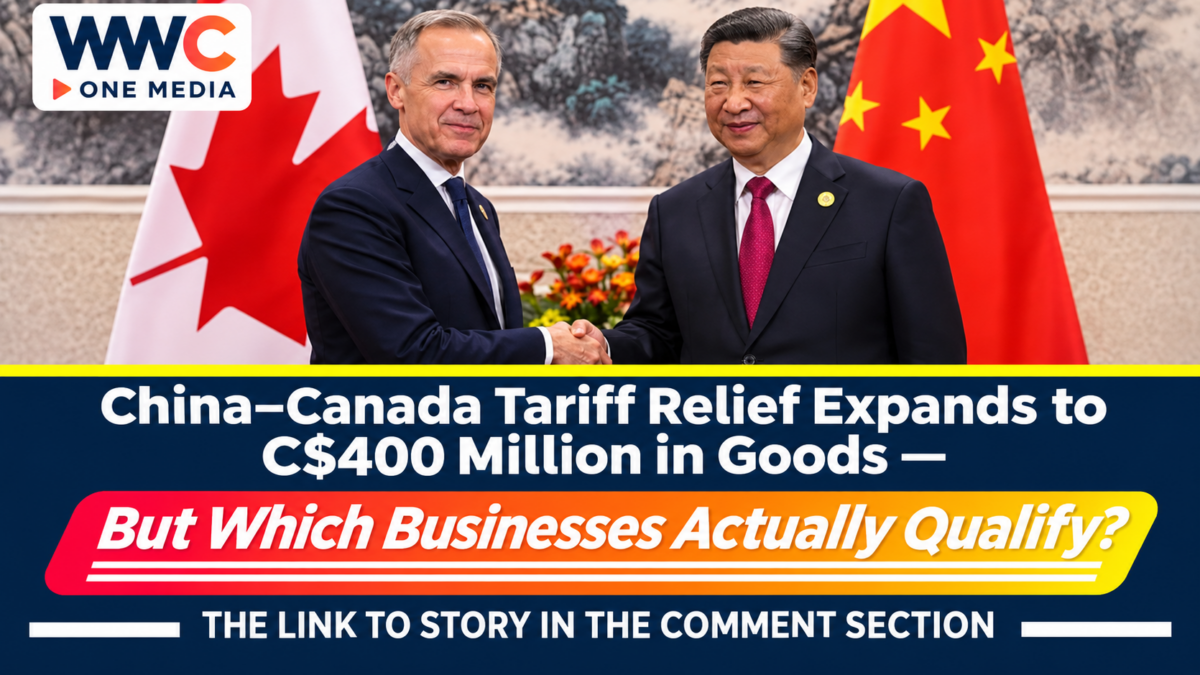
SHENZHEN, China — Canadian Prime Minister Mark Carney and Chinese President Xi Jinping agreed on Nov. 17, 2026, to widen targeted trade relief, covering approximately C$400 million in additional Canadian agricultural and seafood exports. The China–Canada tariff relief arrangement also extends Canada’s exemptions for selected Chinese steel and aluminium products, with the new measures designed to run through Dec. 31, 2028.
The important question for businesses is not whether all tariffs have disappeared. They have not. The official announcements identify specific products, future dates and conditions, while the exact benefit to individual exporters and importers depends on customs implementation.
China–Canada tariff relief: What the new agreement covers
Canada’s Nov. 17 government backgrounder divides the additional export relief into several product groups. It identifies C$116 million in most frozen pork cuts, C$87.5 million in certain frozen cold-water shrimp and prawns, C$61.4 million in particular molluscs including geoduck, C$39.4 million in sea cucumber, and C$96 million in Greenland halibut.
These are estimates of exports within the scope of the announcement, not government guarantees of new orders or additional sales. Adding the published figures produces approximately C$400 million, with rounding accounting for the difference between the detailed figures and the headline amount.
China agreed to suspend the application of the specified anti-discrimination tariffs from Jan. 1, 2027, through Dec. 31, 2028. That timetable matters: the newly announced future period should not be mistaken for an immediate blanket removal of import duties on Nov. 17.
Why canola and seafood exporters already had relief
The new measures build on an earlier arrangement. In February, China’s Customs Tariff Commission announced that additional tariffs would not be imposed on specified Canadian canola meal, peas, lobsters and crabs during March 1–Dec. 31, 2026. The published Chinese notice describes the additional duties previously applied as 100% on particular agricultural products and 25% on lobster and crab.
Separately, Canada’s March announcement said the combined applied tariff on Canadian canola seed had fallen to 14.9%, from almost 85%. The canola-seed rate is a different measure from the temporary suspension of additional duties on canola meal and peas; combining them into one blanket tariff rate would mislead readers.
On Nov. 4, Canada announced that favourable access for canola meal, peas, lobster and crab would continue to the end of 2028. The subsequent Shenzhen agreement adds product categories rather than simply repeating the earlier extension.
What Canada is offering Chinese industrial exporters
Trade concessions run in both directions. Canada agreed to extend selected tariff-remission measures for Chinese steel and aluminium through Dec. 31, 2028, and to widen the list by 32 tariff items: 23 steel classifications and nine aluminium classifications.
Ottawa’s explanation is that the additional classifications cover goods for which domestic Canadian supply is insufficient or unavailable. Remission is relief from specified duties for eligible imports; it does not necessarily eliminate ordinary customs duties, commercial compliance rules or tariffs on unrelated steel products.
Analysis: That makes this a targeted commercial adjustment rather than a comprehensive free-trade agreement. Canada seeks better export opportunities for food producers while making defined exceptions for industrial inputs it says are difficult to source domestically.
Trade diversification extends beyond the tariff schedule
Canada also announced a trade mission to China in 2027 and a Canada–China Year of e-Commerce intended to support small and medium-sized businesses. The government’s Nov. 17 release identified new air services and proposals for further business dialogue.
Official Canadian figures put bilateral merchandise trade with China at C$125.6 billion in 2025, up 5.6% from 2024. The government also said market access had been restored for more than 90% of trade previously subject to tariff action, representing nearly C$7.5 billion in Canadian exports. Those are government assessments of affected trade, not proof that all remaining barriers have disappeared.
The earlier electric-vehicle arrangement is another distinct track: Canadian parliamentary briefing material describes a country-specific quota for Chinese EVs at the 6.1% most-favoured-nation tariff, rather than a universal removal of all vehicle duties. WWC has examined Chinese vehicle exporters and tariffs, but vehicle provisions should not be confused with the new pork and seafood relief.
Why the fine print matters to Philippine businesses
Analysis: The agreement illustrates why market access should be measured by eligible products, dates and enforceable customs rules, not just the value attached to a diplomatic announcement. A product may qualify for a tariff concession and still face food-safety, inspection, logistics and contract requirements.
The Philippines has a separate trade relationship with Canada. WWC’s coverage of the Philippines–Canada FTA negotiations explains the difference between concluding talks and obtaining enforceable tariff preferences. Neither the China–Canada announcement nor that negotiating milestone automatically changes Philippine export duties.
There is a broader regional context in China–ASEAN trading relationships. Nevertheless, agreements between different trading partners must be assessed separately; exporters cannot apply one bilateral arrangement’s concessions to another market without a valid legal basis.
What happens next
The next test is whether implementing customs guidance identifies the applicable tariff classifications and procedures clearly enough for traders to use. Eligible businesses will need to check product descriptions, origin rules, shipment dates and any additional requirements.
The leaders also committed to further work on trade barriers, but that is not a promise that every outstanding tariff will be removed. The most defensible conclusion is that the two governments have expanded a specified package of relief through 2028, with the commercial results still dependent on implementation and demand.
FAQ
What did Canada and China agree on Nov. 17, 2026?
They agreed to expand their preliminary trade arrangement, including relief for approximately C$400 million in additional Canadian exports and extended Canadian remissions for selected Chinese metals.
Which Canadian products gain new relief?
The announced categories include most frozen pork cuts, certain shrimp and prawns, selected molluscs, sea cucumber and Greenland halibut. Detailed product eligibility matters.
When does the new Chinese tariff suspension apply?
The announced suspension for specified anti-discrimination tariffs is scheduled from Jan. 1, 2027, through Dec. 31, 2028.
Did Canada remove all tariffs on Chinese steel?
No. It extended selected remission measures and added 32 specified steel and aluminium tariff classifications, not all Chinese metal products.
Does the agreement automatically reduce tariffs on Philippine exports?
No. It is a bilateral China–Canada arrangement; Philippine exporters must follow the rules applicable to their own products and destination markets.