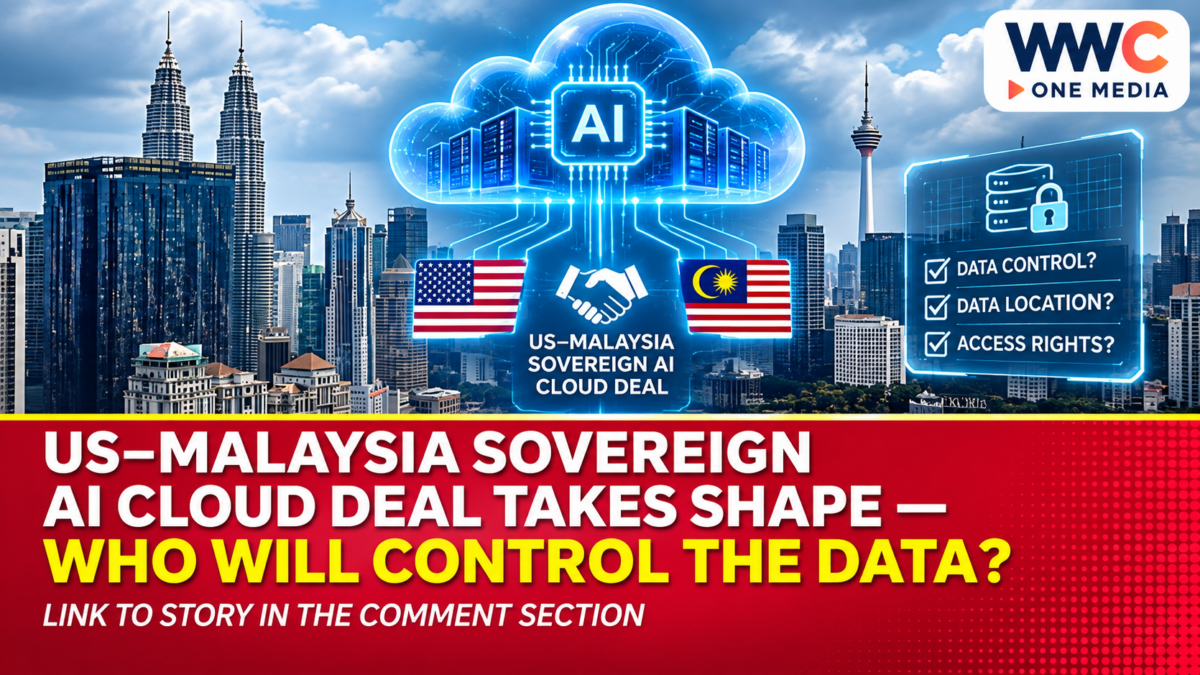
KUALA LUMPUR — Nov. 19, 2026. The United States and Malaysia have announced cooperation on a sovereign artificial intelligence cloud for the Malaysian government, with a US consortium expected to develop the system through the US–ASEAN SI SPARK initiative. The White House confirmed the plan on Nov. 18, but its announcement did not identify the consortium, specify a completion date or establish that the project is already operating.
The agreement raises a practical question: can a cloud built with foreign technology remain under Malaysian legal, operational and technical control? Malaysia’s existing budget and parliamentary records provide a framework for answering it, while leaving essential contract and implementation details unresolved.
Malaysia Sovereign AI Cloud: What Washington Actually Announced
The White House’s Nov. 18 fact sheet records that US President Donald Trump and Malaysian Prime Minister Anwar Ibrahim announced the sovereign cloud project. It says a US consortium will develop the system for the Malaysian government and identifies US–ASEAN SI SPARK as the mechanism facilitating cooperation.
That is a statement of planned cooperation, not an announcement that a government data centre has opened. The fact sheet supplies no location, commissioning schedule, named cloud suppliers or contract value for this particular project. It also does not set out ownership or operational responsibilities.
Separately reported possible US financial support should not be mistaken for an approved grant. The reviewed first-party announcement does not establish the amount, disbursement conditions or whether any funds have been transferred.
Malaysia’s Domestic Cloud Plan Came First
Malaysia’s Ministry of Digital announced in October 2025 that its 2026 budget proposed a RM2 billion investment through the Malaysian Communications and Multimedia Commission (MCMC) to establish a sovereign AI cloud. That earlier proposal gives the new US announcement an important domestic policy context.
It does not prove that the US consortium’s project is identical in scope to every element of the RM2 billion budget initiative, or that the full proposed amount has been spent. Those questions require project-level financing and procurement records.
In his October 2026 budget speech, Anwar again described the planned sovereign cloud as a means of keeping citizens’ data and national strategic information under Malaysian control. The central objective is therefore not simply installing high-performance computers. It is establishing enforceable rules over who may store, operate, access and process sensitive information.
That distinction also matters to nearby economies building their own digital infrastructure, as explored in WWC’s coverage of sovereign cloud services for Philippine organisations.
Parliament Identified Specific Data-Sovereignty Safeguards
An Oct. 29 debate in Malaysia’s parliament provides more detail than the new diplomatic announcement. The government said the cabinet had mandated MCMC and the National Security Council in August 2025 to develop a national sovereign AI cloud framework.
The parliamentary explanation identified domestic data residency, controls on cross-border transfers, strict restrictions on supplier access and encryption-key management inside Malaysia. It also described a prohibition on using citizens’ and public-sector information to train AI models without written government permission.
These are stated policy requirements; the public record does not show whether the still-unnamed US consortium has met them in a signed contract or completed security assessment. The distinction between a policy safeguard and verified technical implementation is essential.
A platform can house servers inside Malaysia yet still depend on overseas providers for software updates, support staff or administrative access. Meaningful sovereignty requires clarity on those arrangements as well as the physical location of equipment.
New US Chip Controls Complicate the Technology Partnership
The agreement arrives alongside more restrictive US rules governing advanced computing technology. On Nov. 16, the Commerce Department announced new controls addressing remote access to powerful US computing through overseas data centres. The published rule also identifies Malaysia among jurisdictions subject to additional licensing requirements for specified advanced semiconductor shipments, with exemptions and reporting conditions in particular cases.
That does not mean Malaysia is prohibited from developing an AI cloud. It does mean proposed equipment purchases, customers and remote-access arrangements may need to be examined against export-control requirements.
WWC’s examination of US AI-chip rules affecting Southeast Asian data centres explains why a cloud’s physical location and the identity of its remote users can be separate regulatory questions.
What this could mean: US cooperation may help Malaysia access technology and expertise, while licensing requirements could affect procurement schedules or system design. Neither a guaranteed acceleration nor a confirmed delay follows from the announcements alone.
Investment Opportunity Meets Infrastructure and Oversight Costs
Malaysia’s investment authorities have identified data centres, cloud computing and AI as important components of the country’s digital infrastructure strategy. In September, the Malaysian Investment Development Authority urged the sector to move beyond attracting projects towards developing domestic capabilities and opportunities for smaller businesses.
But cloud facilities require electricity, network connections, cooling, security and skilled staff. Their potential economic value should therefore be weighed against infrastructure commitments and measurable local benefits.
WWC’s reporting on Malaysia’s planned electricity-market arrangements for major data-centre users examines another part of that calculation: how governments might allocate the cost of serving large new electricity consumers.
The proposed sovereign cloud could become a platform for public-sector computing and domestic AI development. Whether that occurs depends on system design, agency adoption and sustained operating capacity, none of which has yet been quantified in the bilateral announcement.
What Happens Next
The most useful next records would identify the consortium’s members, the Malaysian contracting authority, financing terms, location, delivery milestones and independent security requirements. Public confirmation of how government-held encryption keys, supplier access and cross-border data transfers will be handled would also make the sovereignty commitment measurable.
The Nov. 18 announcement marks an identifiable diplomatic step. It does not yet establish that US financial support has been disbursed, that a functioning national AI cloud has been delivered or that all sensitive Malaysian data will automatically remain beyond foreign legal reach.
The real test is whether procurement, technical controls and independent oversight convert a promising partnership into infrastructure that Malaysia can operate and govern on its own terms.
Frequently Asked Questions
What did the US and Malaysia agree on?
The White House announced on Nov. 18 that a US consortium would develop a sovereign AI cloud for the Malaysian government, facilitated by US–ASEAN SI SPARK. Detailed contract terms were not published in that fact sheet.
Has Malaysia allocated money for a sovereign AI cloud?
Malaysia’s Ministry of Digital described a proposed RM2 billion investment through MCMC in its 2026 budget announcement. That is not proof that the entire amount has already been spent or assigned to the newly announced US consortium.
Will Malaysian government data remain in Malaysia?
The government’s stated framework calls for local data residency, restrictions on transfers and access, and domestic management of encryption keys. Implementation by the future supplier has not yet been independently established.
Has the United States approved US$50 million for the project?
The White House announcement reviewed does not confirm a project-specific approved or disbursed US$50 million grant. Further first-party financing records are needed.