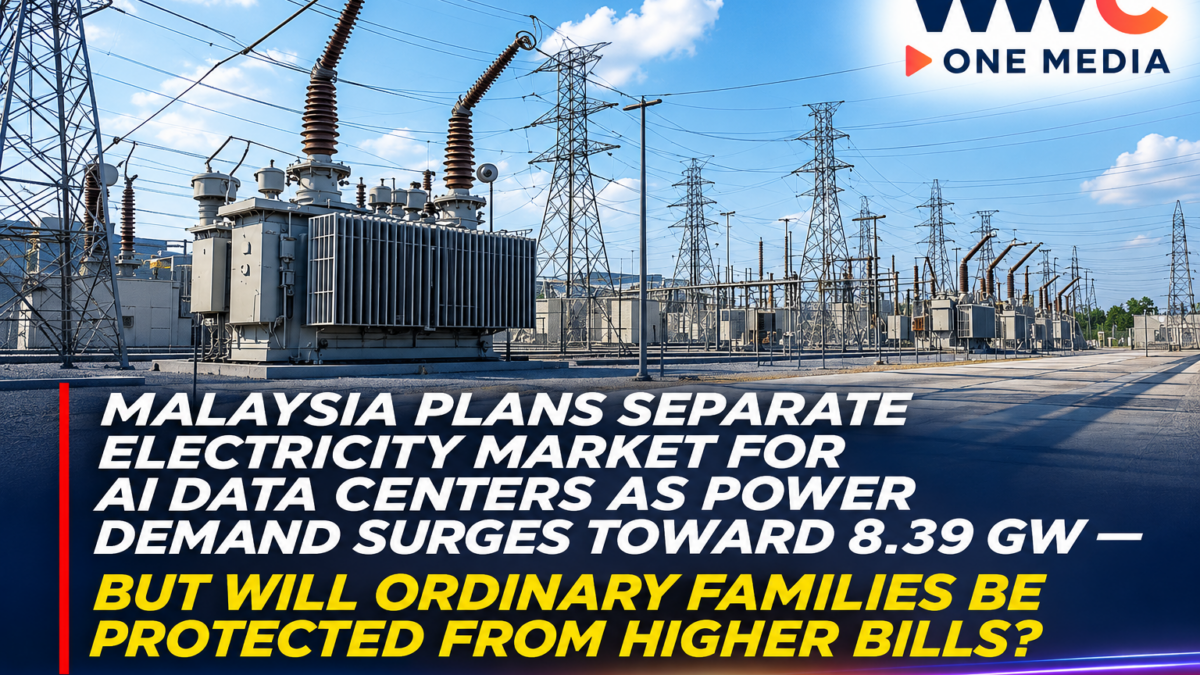
KUALA LUMPUR, MALAYSIA / MANILA, PHILIPPINES — November 11, 2026 | WWC ONE MEDIA | Southeast Asia, Artificial Intelligence, Energy and Global Business
Malaysia is preparing one of Southeast Asia’s most significant electricity-market reforms as the explosive growth of artificial intelligence data centers threatens to put increasing pressure on the country’s power infrastructure.
The Malaysian Energy Commission plans to establish a separate wholesale electricity market for large power consumers, including data-center operators, with implementation targeted for 2029 or 2030.
The announcement signals a major policy shift as global technology companies accelerate investments in cloud computing, artificial intelligence and digital infrastructure.
But behind the multibillion-dollar AI expansion lies a critical concern.
Who should pay for the new power plants, transmission lines and substations needed to support increasingly electricity-hungry data centers?
Malaysia wants to encourage major technology investments without allowing the financial burden to fall unfairly on households and traditional businesses.
The proposed reform comes as government figures show data-center projects had secured approval for approximately 12.3 gigawatts of electricity supply capacity by August 2026.
Actual maximum demand from the sector is projected to reach around 8.39 GW by 2030.
Officials are also tightening rules against developers reserving electricity capacity they may never use.
As Malaysia races to become a major Asian AI hub, can its new electricity market protect consumers and sustain economic growth—or will the extraordinary demand for power create an infrastructure crisis that technology companies cannot solve with investment money alone?
Malaysia Targets 2029–2030 Launch of New Electricity Market
The proposed reform was outlined on November 10 by Rumaizi Abdul Halim, director of the Market, Regulation and Planning Division at Malaysia’s Energy Commission.
Speaking at Bursa Malaysia’s Powering the AI Era event, Rumaizi said the government intends to introduce a separate wholesale electricity market for large consumers.
Data-center operators are among the principal customers expected to participate.
The existing single-buyer electricity market serving households, factories and commercial premises would remain in place.
Both markets are expected to operate within a common framework under a single market operator.
However, authorities have not finalized the detailed arrangements governing how the two markets would interact.
Pricing methods, participation requirements, settlement arrangements and contractual obligations will require further clarification.
The reform is therefore a proposed future market structure rather than a new trading platform already available to operators.
Why Malaysia Wants AI Companies to Pay for Their Own Power Requirements
The government’s priority is to prevent major new electricity users from creating excessive costs for existing consumers.
Large data centers operate servers, computing equipment and cooling systems that require substantial electricity.
Some facilities can demand hundreds of megawatts of power.
Supporting that demand may require new generating plants, substations and transmission infrastructure.
If such investments are built primarily for a small number of enormous customers, regulators must decide how the costs should be recovered.
One approach is to require those customers to make financial commitments reflecting the infrastructure they need.
Another is to distribute costs across a broader electricity system.
But the second approach can create risks for households and smaller businesses if projects are delayed, downsized or abandoned.
Rumaizi emphasized that Malaysia wants data-center development to continue without directly increasing the energy costs borne by other industries.
The separate market is intended to help address that problem.
However, its success will depend on the final tariff arrangements and the enforcement of cost-allocation rules.
Data Centers Already Consume Nearly 10% of Malaysia’s Electricity
The scale of Malaysia’s digital infrastructure expansion is becoming increasingly clear.
In September, Energy Commission chief executive Siti Safinah Salleh reported that data centers accounted for approximately 9.28% of national electricity consumption during a recent monitoring period.
Reuters separately reported that the sector’s consumption had reached approximately 9.3% during the second week of August, compared with an average near 7% during 2026.
The distinction between a particular week’s consumption and the annual average matters.
Data-center electricity use can change with facility occupancy, computing workloads and weather conditions.
Higher temperatures can increase demand for cooling.
Additional facilities scheduled to begin operating during November could raise consumption further.
For Malaysia, the challenge is no longer simply attracting data-center investments.
It is ensuring that enough electricity is available when those facilities become operational.
Approved Data-Center Capacity Reaches 12.3 Gigawatts
Malaysia’s Energy Ministry reported that data-center projects had secured approval for approximately 12.3 GW of electricity supply capacity as of August.
The government projects maximum demand from the sector of approximately 8.39 GW by 2030.
These figures are not identical measures.
Approved supply capacity represents electricity capacity associated with projects that have received relevant approvals.
Projected demand estimates how much power operators may actually require.
Neither figure means that all the associated electricity is being consumed today.
On November 11, The Star reported that Malaysia had approved 117 data-center projects representing maximum requested energy demand of approximately 23,500 MW.
The reported project breakdown included 55 operational facilities, 19 under construction, 16 approved but not started and 27 approved for off-grid supply arrangements.
Another 24 applications remained under review because of electricity and water considerations.
These figures reflect different measures of project approvals, capacity and operating status.
They should not be added together or described as current electricity usage.
Government Cracks Down on ‘Phantom Demand’
A growing concern involves developers reserving electricity capacity long before their facilities need it.
The industry describes this problem as phantom demand.
A developer may request a large power allocation for a proposed data center.
The utility then plans equipment and network infrastructure based on that request.
But the developer may ultimately use far less power than reserved or postpone the project altogether.
That can leave electricity infrastructure underutilized while restricting the capacity available to other customers.
Malaysia is tightening the rules.
According to The Star, Investment, Trade and Industry Minister Johari Abdul Ghani said the connected-load charge had increased from RM8.50 to RM89.64 per kilowatt.
The higher charge is intended to discourage speculative capacity reservations.
The Energy Ministry has also required operators to submit staggered electricity demand forecasts covering ten years and enter binding supply agreements.
Grid connections are being released in phases, subject to technical assessment.
These measures are designed to link infrastructure commitments more closely to actual development plans.
AI Data Centers Can Be Built Much Faster Than Power Plants
One of Malaysia’s biggest challenges is the difference between technology construction schedules and electricity infrastructure development.
According to Energy Commission official Rumaizi Abdul Halim, data centers can typically be developed within approximately 12 to 24 months.
New power-generation projects, by comparison, may require four to five years.
Some can take six or seven years because of equipment availability and other constraints.
This creates a dangerous mismatch.
A technology company may complete a massive computing facility before the electricity infrastructure needed to operate it is ready.
That can delay the commercial use of expensive servers and AI processors.
For Malaysia, better coordination between data-center approvals and electricity planning is therefore essential.
The proposed market reform is only one part of that process.
Google’s $15-Billion Expansion Raises the Stakes
Malaysia has attracted some of the world’s biggest technology companies.
On November 4, Google announced plans to invest approximately US$15 billion in Malaysian data-center and cloud operations.
According to Bloomberg, the spending is expected during 2027 and 2028.
Google also outlined investments involving electricity generation, water security and workforce training.
The announcement highlights Malaysia’s growing importance in Asia’s AI infrastructure market.
But large investment commitments do not automatically guarantee that all proposed facilities will become operational on schedule.
Developers still need reliable electricity, cooling systems, network connections and necessary approvals.
The government’s challenge is ensuring that digital investment delivers genuine economic benefits without creating disproportionate infrastructure costs for other sectors.
Johor Is Emerging as a Major AI Infrastructure Hub
Johor has become one of Malaysia’s most important data-center development locations.
Its proximity to Singapore, industrial infrastructure and growing digital ecosystem have attracted major operators.
Singapore-based Princeton Digital Group, for example, has sought approximately US$1.2 billion in financing for its Malaysian data-center expansion.
The planned development involves a campus with a capacity of approximately 198.8 MW.
In related reporting, WWC ONE MEDIA examined Princeton Digital Group’s proposed financing and the risks associated with funding large AI facilities in Johor.
The project illustrates how capital-intensive data-center development has become.
Companies must finance buildings and computing infrastructure while securing long-term access to electricity.
However, the $1.2-billion financing proposal is separate from Malaysia’s proposed electricity-market reform.
It should not be described as government funding for the new market.
Local Communities Are Raising Questions About Data-Center Expansion
Malaysia’s data-center boom is also generating concerns in residential communities.
In Iskandar Puteri, Johor, some homeowners have expressed unease about large computing facilities and associated power infrastructure near their properties.
The concerns include construction activity, noise, visual changes and uncertainty about property values.
The report documented residents’ concerns rather than establishing that every nearby data center creates a health hazard or causes a decline in property values.
The broader lesson is that infrastructure development requires public engagement.
Communities need reliable information about noise, water use, electricity demand and environmental safeguards.
Without it, local resistance could become another obstacle to investment.
Malaysia Considers Dedicated Gas Power for Data Centers
The government is also examining additional electricity supply options.
On November 10, Johari Abdul Ghani suggested that PETRONAS could supply natural gas for dedicated electricity generation serving data centers.
Such an arrangement could provide an additional commercial opportunity for Malaysia’s national energy company.
It could also allow certain facilities to obtain electricity without relying exclusively on existing grid capacity.
However, the minister described a potential option rather than announcing a completed agreement.
Dedicated gas-fired generation would still require financing, equipment, fuel contracts, permits and construction.
It would also create emissions and fuel-price considerations.
The approach could therefore complement, rather than automatically replace, renewable power and grid-based electricity.
Renewable Energy Could Play a Bigger Role
Malaysia is seeking to increase the use of renewable electricity while meeting growing industrial demand.
Solar generation, battery storage and corporate electricity procurement arrangements are among the available options.
The Corporate Renewable Energy Supply Scheme allows eligible businesses to purchase renewable power through applicable arrangements.
But clean energy projects face their own development challenges.
According to Malaysia’s Sustainable Energy Development Authority, environmental assessments, financing and grid connections can delay construction.
Renewable generation also varies with weather conditions.
Large data centers generally require highly reliable electricity, making storage and other backup arrangements important.
Malaysia must therefore expand clean energy while ensuring sufficient flexible supply.
The challenge resembles developments in neighboring economies.
Thailand’s regulations are separate from Malaysia’s proposed market reform, but both reflect the growing infrastructure demands of artificial intelligence.
A New Electricity Market Will Not Automatically Lower Household Bills
The government’s intention is to protect existing consumers from the costs associated with large new electricity users.
However, creating a separate market does not itself guarantee lower tariffs.
Household bills depend on generation costs, fuel prices, network charges, regulation and the operation of the wider electricity system.
The final design must address how shared infrastructure costs are allocated.
For example, some transmission assets may serve both industrial customers and households.
If an asset benefits several groups, regulators need transparent rules for distributing the costs.
A separate market may improve accountability.
But the practical outcome will depend on detailed implementation.
In related coverage, WWC ONE MEDIA examined the controversy over who should pay for electricity-grid upgrades as AI data centers expand internationally.
The same underlying question now faces Malaysia.
Should infrastructure built to serve very large computing facilities be paid for primarily by those operators, or should the broader electricity system share some costs?
There is no universal answer independent of local regulation and the infrastructure involved.
Why the Philippines Should Watch Malaysia’s Energy Reform
Malaysia’s proposed market provides an important example for other Southeast Asian countries.
The Philippines is also attracting interest in AI infrastructure and energy-intensive digital services.
Developers need reliable electricity at competitive prices.
At the same time, the country faces longstanding concerns about electricity affordability.
In October, Meralco PowerGen and VITRO signed an agreement to explore potential renewable-powered data-center projects.
That initiative is an exploratory cooperation arrangement, not a completed power plant or operating data-center project.
Malaysia’s experience suggests that Philippine regulators and utilities may increasingly need to evaluate how large digital consumers affect electricity planning.
However, Malaysia’s planned wholesale market does not automatically provide a regulatory model suitable for the Philippines.
The countries have different power-market structures, generation mixes and investment requirements.
Five Questions That Could Decide Malaysia’s AI Electricity Strategy
1. Will the new market launch by 2029 or 2030?
The government has identified a target period, but implementation remains subject to further planning.
2. How will electricity prices be determined?
Detailed market trading, procurement and settlement rules have not yet been publicly finalized.
3. Can large data centers pay their share of infrastructure costs?
The design must protect existing users while maintaining commercially viable investment conditions.
4. Will enough generating capacity be available?
Power-plant development can take substantially longer than data-center construction.
5. Can renewable energy expand fast enough?
Solar, storage, grid upgrades and flexible generation will all be important to meeting future demand.
The Bottom Line: Malaysia’s AI Ambitions Have Become an Electricity Challenge
Malaysia is preparing a separate wholesale electricity market for major power users as its data-center industry grows rapidly.
The reform is targeted for 2029 or 2030.
The existing single-buyer electricity market will remain in place, with both systems expected to operate under a common framework.
The policy comes amid extraordinary demand for electricity infrastructure.
Approved data-center supply capacity has reached 12.3 GW, while maximum sector demand is projected at around 8.39 GW by 2030.
New investments from global technology companies could bring significant economic opportunities.
But the expansion also creates questions about electricity costs, grid connections, fuel supply and local environmental impacts.
Malaysia is responding with tighter capacity-reservation rules, new financing incentives and consideration of dedicated energy supplies.
The crucial test will be whether those policies keep electricity reliable and affordable for ordinary consumers while allowing the digital economy to expand.
Malaysia wants to become one of Asia’s leading artificial intelligence hubs, but its data-center boom is creating an unprecedented challenge for the electricity system. With a separate power market planned, stricter rules against unused grid reservations and billions of dollars in technology investment at stake, can Kuala Lumpur protect household electricity bills—or will the next stage of the AI revolution reveal that computing power is easier to build than the electricity needed to run it?