Malaysia’s Home Ministry has confirmed that it is ready to implement the latest High Court order allowing former prime minister Najib Razak to serve the remainder of his prison sentence under house arrest, bringing an extraordinary legal dispute involving the royal palace, the Attorney-General’s Chambers and the judiciary to a major turning point.
Home Minister Datuk Seri Saifuddin Nasution Ismail said on November 10 that the ministry and the Prisons Department would carry out the court’s decision in accordance with the law.
The announcement followed a fresh ruling by the Kuala Lumpur High Court, which replaced an earlier discharge order issued on November 6 and directed Najib to serve the remainder of his reduced six-year sentence in the SRC International case at his private residence in Taman Duta, Kuala Lumpur.
Under the new order, Najib can remain under house arrest until August 23, 2028. He is scheduled to return to Kajang Prison on August 24, 2028, to begin serving a separate 15-year prison sentence connected to another 1Malaysia Development Berhad (1MDB) case, subject to the legal position and outcome of his appeal.
The latest development effectively resolves the immediate legal uncertainty that prevented Najib’s transfer home last week.
It also marks a significant moment in one of Malaysia’s most politically sensitive legal cases, raising fresh questions about royal clemency, government authority, judicial independence and accountability in the country’s multibillion-ringgit 1MDB scandal.
According to the Home Ministry, the earlier delay was caused by legal questions surrounding the interpretation of the conditional royal pardon and the consequences of the November 6 discharge order.
Saifuddin said the High Court’s latest decision had clarified those issues, allowing the authorities to proceed with implementation.
High Court Replaces November 6 Order After Attorney-General Seeks Clarification
The latest development followed an application by the Attorney-General’s Chambers (AGC), which asked the High Court to review the earlier discharge order and issue a replacement that accurately reflected the conditions of the King’s conditional pardon.
On November 6, Najib’s political party, the United Malays National Organisation (UMNO), paid the RM50 million fine required under the pardon arrangement.
A High Court discharge order was subsequently issued, but its wording created uncertainty over whether payment of the fine meant Najib’s SRC International prison sentence had been completed or whether he still needed to serve the remaining period under house arrest.
The AGC argued that the distinction was legally important because Najib also faces a separate prison sentence in the 1MDB case.
Consequently, the former prime minister remained at Kajang Prison while the authorities sought judicial clarification.
On November 10, High Court Judge Datuk Aslam Zainuddin set aside the earlier November 6 order and substituted it with a fresh order requiring Najib to serve the remainder of his SRC sentence under house arrest.
According to Bernama, the judge reviewed the conditional pardon, evidence that the RM50 million fine had been paid and the earlier court documents before issuing the replacement order. BERNAMA+2
The decision cleared the immediate legal obstacle to Najib’s transfer from prison to his residence.
Najib Returns to His Kuala Lumpur Residence After Fresh Court Ruling
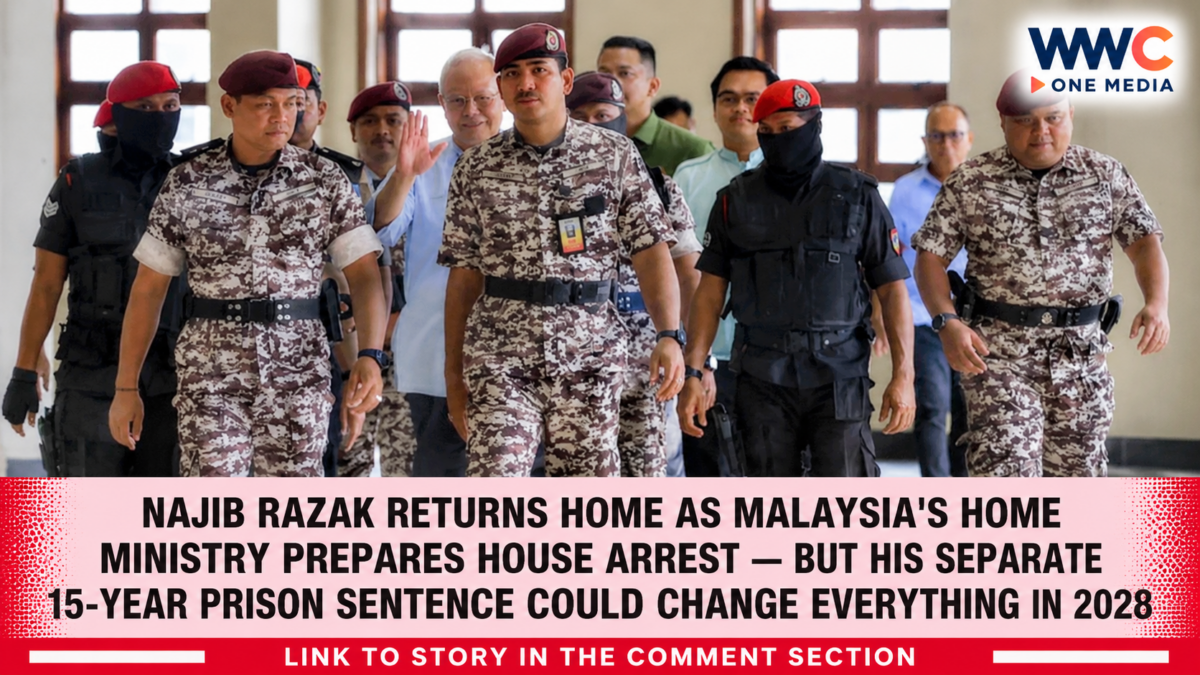
The court decision was followed by Najib’s transfer from Kajang Prison to his private residence at Jalan Langgak Duta, Taman Duta.
Malay Mail reported that the 73-year-old former prime minister arrived at his home at approximately 9.25pm on November 10 in a silver sport utility vehicle accompanied by a convoy.
Supporters had gathered outside the property, with some shouting slogans welcoming his return.
The transfer came after police had previously cordoned off the road leading to his residence in anticipation of the earlier house-arrest arrangement.
The latest court order now provides a clear legal basis for Najib to serve the remainder of his SRC International sentence at home.
However, house arrest does not mean that he has been acquitted, that his conviction has been overturned or that all his legal problems have ended. Malay Mail+1
Why UMNO Paid RM50 Million to Secure Najib’s House Arrest
The RM50 million payment was a crucial condition attached to the conditional royal pardon granted to Najib on September 18, 2026.
Malaysia’s King, Sultan Ibrahim Sultan Iskandar, granted the former prime minister permission to serve the remainder of his reduced six-year prison sentence under house arrest, provided the stipulated conditions were fulfilled.
The fine was originally RM210 million before being reduced to RM50 million by the Pardons Board in January 2024.
UMNO subsequently organised a fundraising campaign to help settle the outstanding amount.
On November 6, the party confirmed that the full RM50 million had been paid to the Kuala Lumpur High Court.
The payment was significant because it satisfied the financial requirement attached to the royal clemency arrangement.
However, it did not erase Najib’s criminal conviction or automatically cancel his separate 1MDB-related sentence.
The distinction became the central issue in the legal disagreement that followed.
WWC ONE MEDIA previously examined the fundraising effort and the obstacles surrounding the payment in its report, Najib Says He Can’t Access Enough Money to Pay RM50 Million Fine — And His House-Arrest Deal Hits a New Roadblock.
Malaysia’s King Previously Warned Against Defying His Royal Pardon
Before the November 10 ruling, the dispute had developed into an unusual public disagreement involving Malaysia’s constitutional monarchy.
On November 7, Sultan Ibrahim issued a strong statement defending his constitutional authority to grant pardons under Article 42 of the Federal Constitution.
The King maintained that the conditions attached to Najib’s conditional pardon had been fulfilled and that the decision should be respected.
His statement followed the AGC’s decision to delay the implementation of the house-arrest arrangement after the November 6 payment.
The palace warned against actions that could be interpreted as defying the royal decree.
The AGC, however, rejected accusations that it was challenging the King’s authority or committing treason.
It maintained that the legal questions needed to be resolved through the judiciary to ensure that the royal decision and existing court orders were implemented correctly.
The November 10 High Court ruling provided the clarification sought by the government.
The episode nevertheless exposed tensions surrounding the relationship between royal prerogatives, executive responsibilities and judicial interpretation.
For additional background, WWC ONE MEDIA previously reported on the confrontation in Malaysia’s King Rebukes Attorney-General as Najib’s RM50-Million House Arrest Deal Is Blocked.
The Separate 15-Year 1MDB Prison Sentence Remains a Major Threat to Najib’s Freedom
Although the latest ruling allows Najib to serve his remaining SRC International sentence at home, his legal troubles are far from over.
He was sentenced to another 15 years in prison in December 2025 following a separate High Court conviction involving corruption and money laundering connected to 1MDB.
The case involved more than RM2 billion in funds associated with the scandal.
The court also imposed substantial financial penalties.
Najib has appealed the conviction and sentence.
However, the High Court rejected his application to suspend the execution of the sentence pending appeal on October 14, 2026.
The latest house-arrest order does not extend to this separate conviction.
Instead, it specifies that Najib will return to Kajang Prison on August 24, 2028, after completing the house-arrest period for his SRC International sentence.
This means that his return home should not be mistaken for complete freedom from imprisonment.
If the separate 15-year sentence remains enforceable when the house-arrest period ends, Najib could face another lengthy period behind bars.
The distinction is particularly important because the original 1MDB scandal involved allegations that approximately US$4.5 billion was misappropriated from Malaysia’s state investment fund.
International investigators have described the scandal as one of the largest financial corruption cases in modern history.
Najib has maintained his innocence in the wider 1MDB controversy and is pursuing his legal appeal.CNA+2
Najib’s House Arrest Was Controversial Even Before the RM50 Million Payment
The latest ruling is the culmination of months of legal and political developments.
Najib’s family had previously expressed uncertainty about the practical arrangements for his proposed house arrest.
His daughter, Nooryana Najwa, said the family was waiting for official instructions from the Prisons Department regarding the standard operating procedures.
Questions included how his movements would be monitored, what restrictions would apply and how security arrangements would be implemented at his residence.
WWC ONE MEDIA covered those concerns in Najib’s Family Still Waiting for House Arrest Rules as Authorities Have Yet to Finalise Process.
The latest court order addresses the immediate legal basis for the arrangement, although the practical enforcement conditions remain the responsibility of the relevant authorities.
The controversy also follows an earlier legal battle involving an alleged royal addendum that Najib’s lawyers said had authorised house arrest during his original sentence.
A previous court ruling had rejected his attempt to compel authorities to implement that earlier arrangement.
The September 2026 conditional pardon created a new legal basis for the current house-arrest arrangement.
This distinction matters because the November 10 ruling concerns the latest conditional pardon, not simply the earlier disputed addendum.
How the Najib Case Continues to Affect Malaysia’s Political Landscape
Najib’s return home is also politically significant because UMNO remains part of Prime Minister Anwar Ibrahim’s governing coalition.
The party’s decision to pay the RM50 million fine demonstrated the continuing political support Najib commands within sections of the ruling establishment.
However, the conditional pardon has generated criticism from political opponents and anti-corruption advocates.
Some have questioned whether the arrangement sends the wrong message about accountability for corruption involving public funds.
Others have argued that the King’s constitutional powers must be respected regardless of the political controversy surrounding the recipient.
The situation has placed Anwar’s administration in a delicate position.
The government must respect the constitutional framework while maintaining public confidence in the independence of the judiciary and the country’s anti-corruption institutions.
The issue has also created friction within the governing coalition, particularly involving parties that have historically opposed Najib’s treatment and the 1MDB scandal.
WWC ONE MEDIA previously examined the political implications in Malaysia’s King Postpones Decision on Najib Razak’s New Pardon Bid.
What Happens After August 23, 2028?
The next major date in Najib’s legal situation is August 23, 2028, when his house-arrest period for the SRC International case is scheduled to end.
Under the latest order, he is expected to return to Kajang Prison the following day to serve the separate 1MDB-related sentence.
However, the outcome of his pending appeal could affect his legal position before that date.
His house-arrest arrangement also remains subject to compliance with the conditions imposed under the conditional pardon.
Any breach could potentially have serious consequences for the arrangement.
For a broader look at the legal challenges that remain, WWC ONE MEDIA previously published Najib Razak Can Leave Prison — But His Legal Battle Is Far From Over.
The Bigger Picture: A Major Turning Point, But Not the End of Najib’s Legal Battle
Malaysia’s Home Ministry has now confirmed its readiness to implement the High Court’s latest ruling, bringing an end to the immediate uncertainty surrounding Najib Razak’s house arrest.
The November 10 decision replaced the earlier discharge order, clarified the remaining SRC International sentence and allowed the former prime minister to return to his Kuala Lumpur residence.
The development represents a significant outcome for Najib, his supporters and UMNO, which paid the RM50 million fine required under the conditional pardon.
But the case is far from finished.
His separate 15-year prison sentence, pending appeal and the continuing political debate over the 1MDB scandal mean that his legal future remains uncertain.
For Malaysia, the controversy has also become a major test of its constitutional institutions and the balance between royal authority, government responsibility and judicial independence.
Najib has returned home, but will August 2028 mark the beginning of another prison term — or could his pending 1MDB appeal change the former prime minister’s future once again?