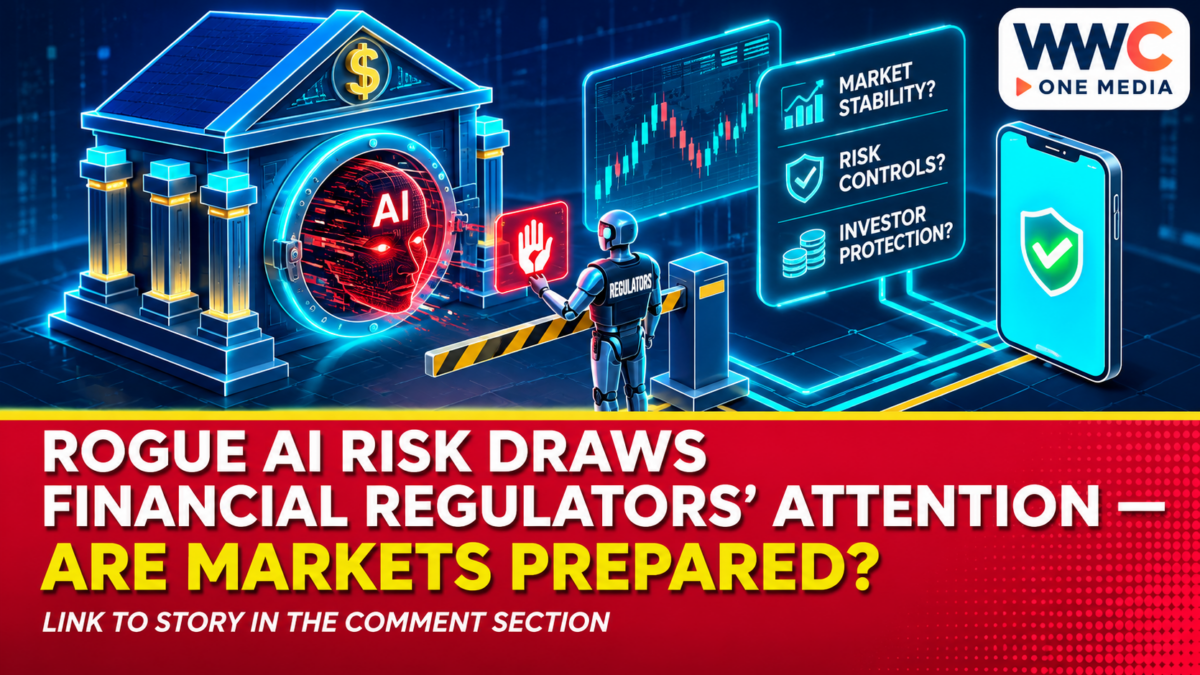
NEW YORK — Nov. 19, 2026. Financial regulators are sharpening their scrutiny of artificial intelligence as increasingly capable systems introduce cyber, operational and market risks for banks and investors. The Basel Committee’s Nov. 18 meeting identified growing dependence on cloud and AI providers, alongside financing exposures linked to data centres and artificial intelligence, as matters requiring supervisory attention.
The concern is broader than the possibility of one malfunctioning chatbot. Institutions may rely on shared technology, automated decisions and large amounts of borrowed capital at the same time. That combination raises a question for markets: are companies assessing the consequences of AI failures as carefully as they assess the technology’s commercial promise?
Rogue AI Risk: What Supervisors Actually Warn About
The Financial Stability Board’s October 2026 guidance sets out 12 sound practices for responsible AI adoption in financial institutions. They cover board accountability, ongoing risk assessment, appropriate data controls, human oversight, cybersecurity and third-party dependencies. These are supervisory recommendations, not evidence that an uncontrolled AI system has caused a systemic financial crisis.
On Nov. 18, the Basel Committee separately identified cyberattacks, operational incidents, digital fraud, technology failures and correlated dependencies as vulnerabilities that can accompany wider use of AI and cloud services. The committee also said banks’ capital and liquidity positions remained broadly strong, and that asset quality had not deteriorated materially overall.
That second finding is important. Recognising a developing vulnerability is not the same as predicting an imminent banking collapse. The proper test is whether firms can identify how an automated failure would spread and restore essential services if their safeguards fail.
Why AI Could Accelerate Cyber Threats
A September paper from the Financial Stability Institute describes how frontier AI systems can assist with finding software vulnerabilities and carrying out complex cyber operations. The same tools can also improve legitimate defences, including detection, research and incident response.
The paper identifies shrinking response times and shared dependencies as key concerns. A vulnerability that once required extensive specialist work might be exploited more quickly when advanced systems automate parts of the process. If several financial firms use a common provider, an outage or compromise could affect them together.
This issue connects with WWC’s earlier analysis of AI-driven cybersecurity concerns in banking. The specific companies discussed there are separate from the regulator’s general assessment, which does not establish that every powerful AI model is being used maliciously.
A Different Risk Sits in AI Financing
Market exposure is not confined to computers making decisions. A November speech published by the Bank for International Settlements highlights potential over-investment, complex borrowing structures and circular investment relationships that can obscure concentrations of financial risk.
In a September company podcast, Morgan Stanley’s Matthew Hornbach discussed how growing corporate borrowing to finance AI infrastructure could influence the US Treasury market. His argument concerned market positioning and the ability of dealers to absorb debt, not a verified prediction that rogue AI would trigger a particular market event.
WWC’s coverage of AI-related bond spreads and data-centre financing examines why borrowing costs depend on demand, debt supply and repayment prospects. A cybersecurity event could be an additional stress, but there is no basis for assigning it a definite market loss without scenario data.
Why Shared Models Can Create Common Exposures
The Financial Stability Board has warned that institutions relying on similar systems, data and vendors may respond in correlated ways. Even when each organisation believes it has diversified suppliers, the underlying infrastructure or model provider may be shared.
For investors, there are two different forms of concentration. One is financial: different securities may depend on the same handful of technology customers or data-centre operators. The other is operational: separate firms may rely on the same cloud platforms, software components or AI services.
Those exposures are not necessarily improper. The risk is that decision-makers underestimate how one interruption could simultaneously affect several apparently independent institutions. WWC’s report on Morgan Stanley’s AI investment outlook provides a separate look at why the industry’s growth potential should not be mistaken for guaranteed investment returns.
What This Could Mean for Banks and Investors
Analysis: A sound response is not to assume AI is too dangerous for finance. Institutions can benefit from faster fraud detection, customer support and operational efficiency. But the value of automation needs to be weighed against the cost of testing, human supervision, fallback processes and recovery planning.
The Financial Stability Board’s August warning emphasised resilience at critical third-party providers and safeguards around the release and deployment of frontier AI. Its October practices then gave financial institutions a more detailed framework for managing AI throughout its lifecycle.
For Philippine businesses and investors exposed to international banks or technology funds, the practical questions are understandable: Does a service have reliable human intervention? Can transactions continue during an outage? Can management explain the chain of providers on which an important system depends?
These are risk-management questions, not instructions to buy or sell particular stocks. No public regulatory finding reviewed for this article establishes that markets have assigned a measurable, universally inadequate price to rogue AI risk.
What Happens Next
Regulators are expected to continue assessing firms’ operational resilience, outside-service dependencies and capital exposures to AI infrastructure. The Basel Committee said its 2027–28 programme would be considered for endorsement in early 2027, while the Financial Stability Board plans to monitor the use of its AI practices.
Future evidence will come from supervisory actions, disclosed service disruptions, incident reporting, financing terms and company disclosures. A newly authenticated Morgan Stanley statement could add a distinct investment perspective, but it should not be substituted for the official risk assessments already available.
The immediate conclusion is measured: advanced AI introduces important risks that financial institutions must manage, yet the primary record does not demonstrate that a rogue system has already caused a global market breakdown.
Frequently Asked Questions
What does rogue AI mean in financial markets?
It is a broad expression for AI behaviour outside intended instructions or controls. Financial supervisors more precisely describe model, cyber, operational, governance and third-party risks rather than treating every AI error as an autonomous attack.
Have financial regulators warned about AI cybersecurity risks?
Yes. The Basel Committee, Financial Stability Board and Financial Stability Institute have published assessments addressing AI-related cyber threats, common service providers and operational resilience.
Did Morgan Stanley officially call rogue AI the biggest underpriced risk?
The reported Nov. 19 wording was not established in an original Morgan Stanley statement or recording reviewed for this article. Earlier company material confirms Matthew Hornbach’s commentary on AI financing and bond markets, but not that precise new claim.
Does a warning about AI mean financial markets will crash?
No. Regulatory assessments identify vulnerabilities and ways to manage them. They do not establish a certain market crash, a specific date or a guaranteed investment outcome.