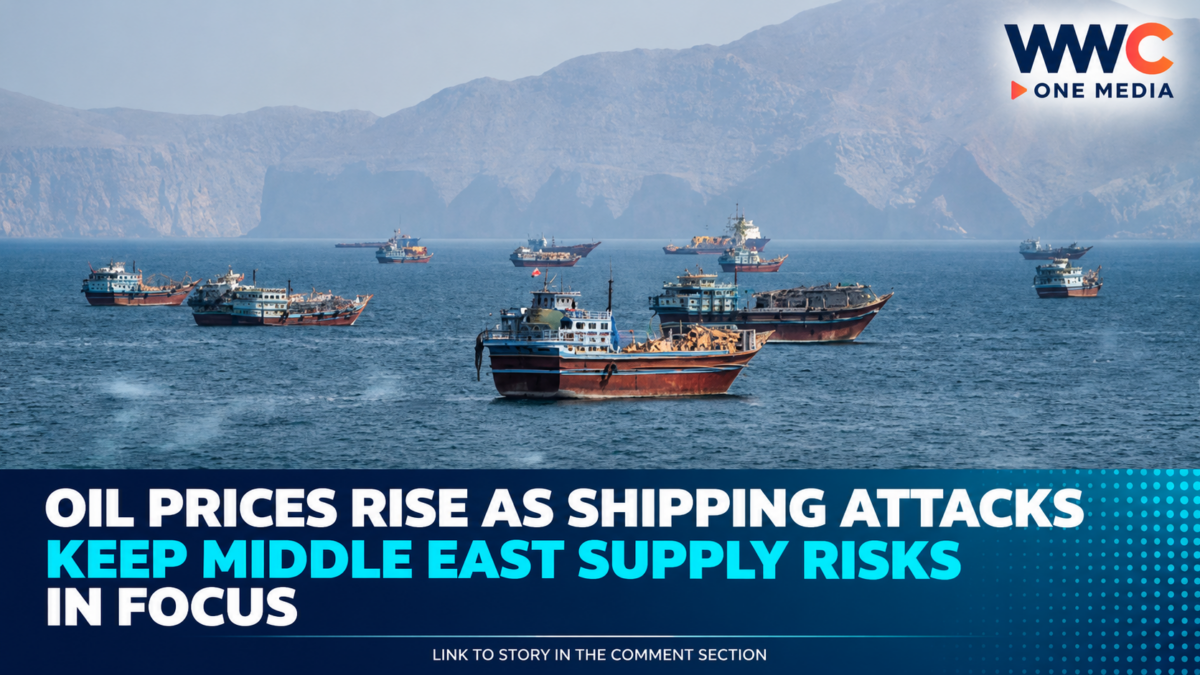
Oil prices climbed on Thursday as renewed attacks on shipping in the Gulf and Strait of Hormuz heightened concerns over the security of crude supplies from the Middle East.
By 0427 GMT, Brent crude futures had risen US$2.28, or 2.28%, to US$102.28 a barrel, while US West Texas Intermediate (WTI) crude gained US$1.66, or 1.88%, to US$89.94, according to Reuters.
The gains came despite efforts by major economies to release emergency oil stocks and stabilise fuel markets as disruptions linked to the conflict continue.
Shipping Attacks Raise Fresh Supply Concerns
The latest increase in prices follows a sharp rise in attacks, attempted attacks and other incidents involving tankers passing through the Strait of Hormuz.
Maritime security sources told Reuters that at least 12 attacks involving oil, liquefied natural gas and liquefied petroleum gas tankers were recorded around the Strait between Sept 28 and Oct 5. That was the highest number of incidents recorded in a single week since the US-Iran war began in February.
The International Maritime Organization separately recorded nine incidents during the same period, although the UN shipping agency typically takes longer to verify incidents.
The latest episode adds another layer of uncertainty for energy markets, which have already been dealing with reduced and unpredictable flows from the region.
The Strait of Hormuz is particularly important because it handled shipments equivalent to roughly 20% of global oil and fuel supplies before the war.
Tanker Hit Near Qatar
Concerns were reinforced by a fresh incident involving a tanker north of Qatar.
The vessel was struck by multiple projectiles, with casualties reported, according to the United Kingdom Maritime Trade Operations agency.
The incident came as Gulf oil producers continued exporting crude despite the increased risks faced by vessels and crews operating in the region.
Analysts said producers appear increasingly willing to accept the additional risks and costs because alternative routes cannot fully replace the Strait of Hormuz for moving oil from the Gulf to international markets.
Daniel Hynes, senior commodity strategist at ANZ, said the willingness to keep shipments moving despite attacks was an important feature of the current market.
The continued movement of tankers has helped prevent an even sharper reduction in global supplies, but the higher risks surrounding each shipment are keeping a geopolitical premium in oil prices.
Gulf Exports Have Recovered — But Remain Vulnerable
The situation is complicated by the fact that Middle Eastern oil exports have been recovering.
Data from Vortexa showed crude, condensate and refined-fuel flows from Saudi Arabia, the United Arab Emirates, Kuwait, Iraq, Qatar, Oman and Bahrain averaged 19.2 million barrels per day in September, compared with about 23.6 million bpd before the Iran war began.
Crude and condensate exports had recovered to around 91% of pre-war levels, while refined-fuel exports remained much weaker at about 60% of their previous levels.
Saudi Arabia has played a major role in the recovery.
Its crude shipments rose sharply in September, helping offset declines elsewhere in the Gulf. But analysts warn that the recent recovery could prove difficult to sustain if attacks on shipping and energy infrastructure continue.
That uncertainty is one reason oil prices remain highly sensitive to every new incident in the region.
Emergency Oil Releases Offer Temporary Relief
Governments have also been attempting to soften the impact of the supply disruptions.
The International Energy Agency agreed to accelerate the release of oil stocks and prioritise diesel supplies under an emergency plan launched earlier in the year.
The move helped push oil prices lower during the previous session, but the relief was short-lived as shipping risks returned to the forefront.
Analysts caution that strategic stock releases can provide additional barrels for a limited period, but they cannot create new production capacity.
That means emergency reserves may help smooth the market, but they cannot permanently solve a disruption if producers and shipping companies remain unable to move supplies normally.
US Inventories Also Support Prices
Oil prices received additional support from fresh US inventory data.
US crude inventories fell by 3.2 million barrels to 424.1 million barrels in the week ended Oct 2, according to the Energy Information Administration.
The decline was larger than analysts had expected. A Reuters poll had forecast a decrease of about 1.7 million barrels.
US distillate inventories, which include diesel and jet fuel, also fell, although the decline was much smaller at 42,000 barrels.
Lower inventories can strengthen oil prices because they indicate tighter available supplies in the world’s largest oil-consuming and producing country.
The data therefore added another bullish factor to a market already focused heavily on geopolitical risks.
Strait of Hormuz Remains a Critical Chokepoint
The Strait of Hormuz connects the Persian Gulf with the Gulf of Oman and Arabian Sea, making it one of the world’s most important energy corridors.
Major producers including Saudi Arabia, Iraq, Kuwait, the United Arab Emirates and Qatar depend heavily on routes through or around the region to reach international customers.
Any sustained disruption could therefore have consequences well beyond the Middle East.
The current conflict has already forced producers and traders to rely more heavily on alternative routes, including pipelines, while shipping companies face higher insurance, security and operational costs.
Those additional expenses can eventually filter through to refiners, businesses and consumers.
Markets Remain Caught Between Higher Exports and Higher Risks
The oil market is currently being pulled in two directions.
On one side, Gulf producers have managed to restore a substantial portion of their crude exports, helping prevent an even more severe supply shortage.
On the other, attacks on tankers and uncertainty around the Strait of Hormuz threaten the reliability of those flows.
That tension has made oil prices particularly volatile.
A sustained reduction in attacks could allow more Gulf exports to reach international markets and ease prices. But further attacks, damage to energy infrastructure or a prolonged closure or restriction of the Strait could quickly reverse those gains.
What It Means for Consumers
For consumers, sustained oil prices above US$100 a barrel could translate into renewed pressure on fuel prices, transportation costs and inflation.
The impact would not necessarily be immediate or uniform. Retail fuel prices depend on factors including refining costs, taxes, currency movements and the timing of purchases by fuel companies.
But if crude prices remain elevated for an extended period, higher energy costs can spread through the wider economy.
Diesel and jet fuel are particularly important because they affect trucking, shipping, aviation and other forms of transportation.
The continued weakness in Middle Eastern refined-fuel exports therefore remains a concern even as crude shipments recover.
Oil Market Faces Another Test
The latest price increase shows how quickly energy markets can react to developments around the Strait of Hormuz.
Brent has again moved above US$100 a barrel, while WTI remains close to US$90 as traders weigh recovering Gulf exports against the growing risks faced by tankers.
Emergency stock releases can provide temporary support for supplies, and Gulf producers have demonstrated an ability to maintain exports despite difficult conditions.
But neither measure eliminates the underlying security problem.
As long as shipping attacks continue and the world’s most important oil chokepoint remains exposed to conflict, the risk premium in oil prices is likely to remain a major force in the market.