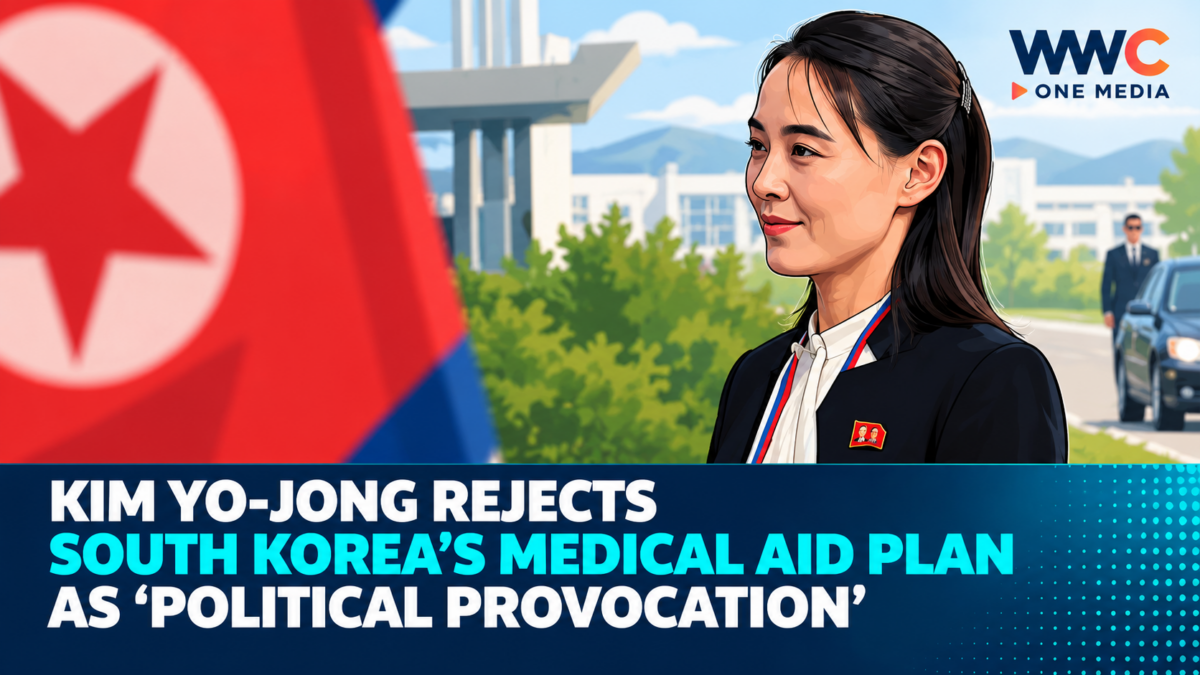
North Korean leader Kim Jong Un’s sister, Kim Yo-jong, has rejected South Korea’s plan to provide medical equipment to Pyongyang, calling the humanitarian assistance a “political provocation” and an infringement on North Korea’s sovereignty.
In a statement carried by North Korean state media on Thursday (Oct 8), Kim said the hostile nature of relations between the two Koreas had not changed and insisted that Pyongyang had no interest in receiving assistance from Seoul.
Her remarks came after South Korea revealed details of a planned shipment of medical equipment to a hospital in Pyongyang, despite Seoul’s broader efforts to reduce tensions and reopen communication with the North.
South Korea Secured UN Exemption for Medical Equipment
South Korea obtained an exemption from the UN Security Council sanctions committee in May to send medical equipment to North Korea.
The planned assistance includes 1,431 medical items across 166 categories, covering equipment needed for diagnosis, surgery and treatment. The shipment is intended for a hospital in Pyongyang and has been valued at roughly US$6.75 million.
The assistance is part of Seoul’s humanitarian medical support programme and includes equipment such as diagnostic and surgical supplies.
South Korea’s Unification Ministry has said the shipment could be sent as early as November, although the actual timing and method of delivery remain subject to discussions with North Korea.
The UN sanctions exemption was necessary because international sanctions imposed on North Korea restrict the transfer of many goods and equipment to the country.
Kim Says Seoul’s Effort Is an Insult
Kim strongly objected to the way South Korea presented the aid programme.
She took particular issue with Seoul’s references to shortages of medicines and medical equipment and worsening health conditions in North Korea.
According to Kim, describing North Korea as needing outside medical assistance was itself an insult to the country.
She accused Seoul of deliberately publicising the aid plan even though, in her view, South Korean officials already knew Pyongyang would reject it.
Kim said the plan was designed to allow Seoul to portray itself as making a goodwill gesture while presenting North Korea as the side refusing cooperation.
North Korea therefore views the initiative not as neutral humanitarian assistance but as an attempt by Seoul to gain political advantage.
Pyongyang Says It Has Nothing to Receive From Seoul
Kim reiterated North Korea’s increasingly hostile position toward South Korea.
She said there was “nothing to give or receive” between the two sides and argued that the hostile nature of their relationship could not be changed through Seoul’s latest outreach.
The statement reinforces Pyongyang’s recent rejection of South Korean efforts to reopen dialogue.
North Korea has increasingly treated South Korea as a hostile state rather than as a partner for reconciliation, while Seoul’s government under President Lee Jae Myung has repeatedly expressed a desire to reduce military tensions and restore communication.
That fundamental difference has made humanitarian cooperation increasingly difficult.
Medical Aid Plan Comes Amid Border Tensions
Kim’s rejection also came against the backdrop of a recent incident along the heavily fortified Demilitarised Zone (DMZ).
On Sept 21, three South Korean soldiers were injured in explosions near the border.
South Korea’s military later concluded, following a joint investigation involving the US-led United Nations Command, that the explosions were caused by North Korean mines. The UN Command said the discovery represented a violation of the 1953 armistice agreement.
North Korea has rejected responsibility and accused Seoul of fabricating the findings.
Kim referred to the mine incident in her latest statement, arguing that South Korea was simultaneously claiming to seek peace while accusing Pyongyang of responsibility for the explosions.
She described Seoul’s handling of the dispute as another example of what she considers contradictory behaviour.
North Korea Continues to Reject Seoul’s Outreach
President Lee has repeatedly promoted dialogue and practical measures aimed at easing tensions with Pyongyang.
His administration has said it wants to restore communication channels and create conditions for renewed engagement between the two Koreas.
North Korea, however, has repeatedly dismissed those overtures.
Earlier this month, Kim criticised Lee’s calls for reduced military tensions and rejected a proposal from South Korea’s Unification Ministry to discuss the military demarcation line.
She said North Korea wanted to sever relations with South Korea and had no interest in negotiating its border.
The latest rejection therefore appears to be part of a broader pattern rather than an isolated disagreement over medical supplies.
Humanitarian Assistance Caught in Political Dispute
The dispute illustrates the difficulty of separating humanitarian cooperation from the wider political and security conflict on the Korean Peninsula.
South Korea describes its medical assistance as humanitarian support intended to improve healthcare, while North Korea sees the public presentation of the offer as politically motivated.
For Seoul, the aid programme could have provided an opportunity to demonstrate that humanitarian cooperation remains possible even while political and military disagreements continue.
Instead, Pyongyang’s rejection has become another source of friction between the two governments.
The fact that Seoul obtained a UN sanctions exemption demonstrates that the South Korean government had taken steps to make the proposed transfer possible. But an exemption from international sanctions does not mean North Korea is required to accept the assistance.
A Wider Breakdown in Inter-Korean Relations
The disagreement reflects the broader deterioration in relations between North and South Korea.
North Korea has expanded border fortifications and taken steps to reinforce its separation from the South. Pyongyang has also increasingly described South Korea as an enemy rather than a counterpart for reconciliation.
Seoul, meanwhile, continues to argue that communication and practical cooperation are necessary to prevent further escalation.
That leaves the two sides pursuing sharply different approaches.
The South is attempting to keep diplomatic and humanitarian channels open, while the North has repeatedly signalled that it does not want engagement on Seoul’s terms.
No Sign of Immediate Breakthrough
Kim’s latest statement suggests that South Korea’s medical aid proposal is unlikely to produce an immediate improvement in relations.
The shipment itself has not necessarily been cancelled by Seoul, but its implementation remains complicated by the North’s rejection and the absence of meaningful inter-Korean communication.
South Korea’s Unification Ministry has nevertheless indicated that it will not allow individual developments to completely derail its broader efforts to reduce distrust.
For now, however, Pyongyang’s message is clear: North Korea does not view Seoul’s proposed medical assistance as a simple humanitarian gesture.
Instead, Kim Yo-jong has portrayed the plan as another politically motivated attempt to influence perceptions of the two Koreas’ increasingly hostile relationship.
Her rejection underscores the widening gap between Seoul’s efforts to reopen engagement and Pyongyang’s insistence that its relationship with South Korea remains fundamentally adversarial.