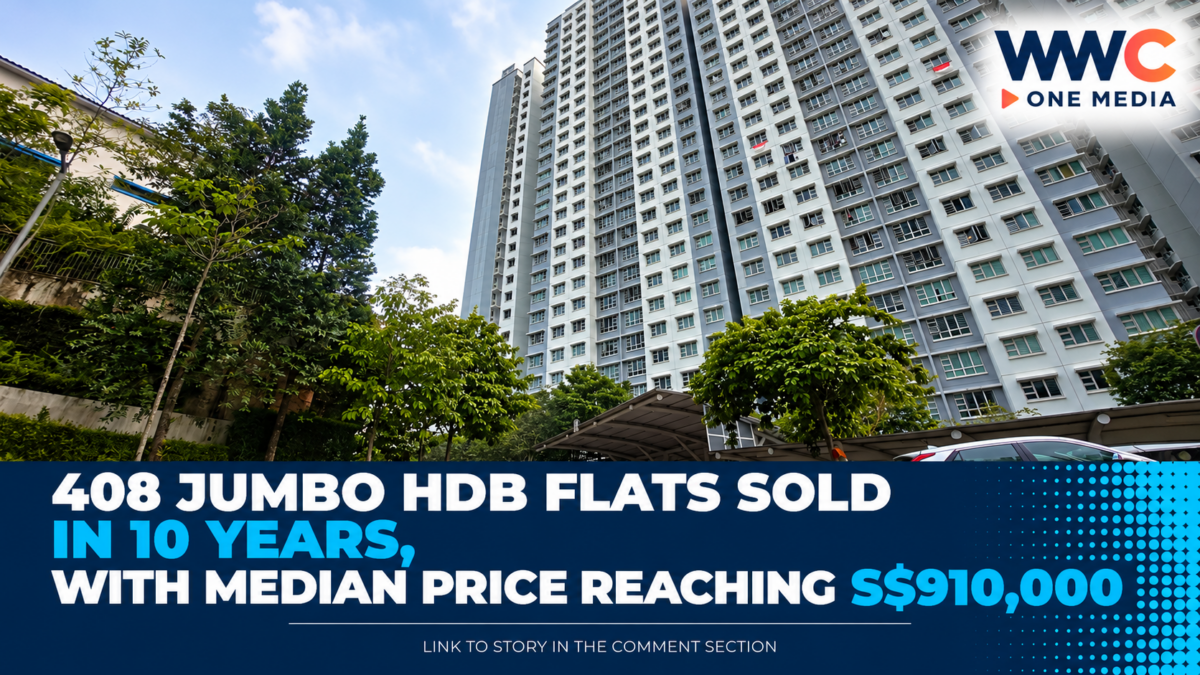
SINGAPORE — A total of 408 converted HDB “jumbo flats” were sold between 2016 and 2025, with the median resale price reaching S$910,000 in 2025, National Development Minister Chee Hong Tat said in Parliament on Wednesday (Oct. 7).
The figures come as public attention grows over the prices of unusually large HDB flats, particularly after a jumbo unit in Telok Blangah was recently listed for S$2.18 million — a price that has since been reduced to S$1.99 million.
Chee was responding to a parliamentary question from Jurong East-Bukit Batok GRC MP David Hoe, who asked how many converted flats had been sold in recent years and whether HDB assesses their resale prices to ensure they remain accessible to larger households.
408 jumbo flats sold over a decade
The 408 transactions cover converted flats sold over the 10-year period from 2016 to 2025.
Chee said the prices varied depending on prevailing market conditions as well as the location and attributes of each flat.
For transactions completed in 2025, the median resale price was S$910,000.
The figure provides a broader picture of the market for jumbo flats, which are relatively uncommon compared with standard HDB flat types.
However, a median price does not mean every jumbo flat is worth around S$910,000. Individual prices can vary considerably depending on factors such as location, remaining lease, floor level, size and condition.
What is a jumbo flat?
Jumbo flats are created under HDB’s Conversion Scheme, which allows eligible owners of three-room or smaller flats who need additional living space to combine their unit with an adjoining three-room or smaller flat.
The two units can be merged into a single larger flat, subject to HDB’s approval of the structural feasibility of the conversion and other eligibility requirements.
The resulting home is held under one lease after the conversion.
Such flats are not simply ordinary large HDB units. Their unusual size comes from combining two adjoining homes, giving owners substantially more space than a typical three-room or four-room flat.
The scheme was introduced in 1993 and was designed to provide larger living spaces for eligible households without requiring them to leave their existing estates.
Why the S$2.18 million listing attracted attention
The latest parliamentary discussion follows public concern over a jumbo flat at Block 93B Telok Blangah Street 31.
The high-floor unit, comprising two combined three-room flats, was listed for S$2.18 million in September. The asking price was subsequently reduced to S$1.99 million, although the listing remained active.
HDB said the original S$2.18 million asking price was “significantly higher” than comparable transactions in the area.
The board noted that individual three-room flats nearby had been transacted at between S$673,000 and S$771,000. Using the upper end of that range, two such flats would amount to about S$1.54 million.
That meant the S$2.18 million asking price was more than S$600,000, or over 40 per cent, above that comparison.
HDB also pointed out that if the unit were eventually sold at the listed price, a substantial cash-over-valuation (COV) amount would be involved. COV must be paid fully in cash by the buyer.
As of HDB’s latest statement, no resale application had been received for the property.
HDB reviewing the conversion scheme
The controversy has also prompted HDB to review the jumbo-flat conversion scheme.
The review comes as authorities continue to balance the availability of larger homes with the broader objective of keeping public housing affordable and accessible.
The unusual size of jumbo flats can make them attractive to multigenerational families or households that want more space while remaining in an established neighbourhood.
At the same time, the limited number of such homes means there may be fewer directly comparable transactions when sellers set asking prices.
That can make individual listings appear significantly more expensive than typical HDB flats in the same area.
Minister urges buyers to do their homework
Chee advised prospective buyers to research the market carefully and evaluate their housing options before committing to a purchase.
He also urged buyers to plan their finances prudently so they do not end up overpaying for a property.
That advice is particularly relevant for jumbo flats because their unusual size and scarcity can make simple comparisons with standard HDB units difficult.
A buyer considering such a property would need to look beyond the headline price and assess factors including comparable transactions, remaining lease, location, renovation condition and the potential cash component of the purchase.
Could S$2 million HDB flats become more common?
The Telok Blangah listing has also reignited debate over whether HDB resale prices could eventually cross the S$2 million mark more regularly.
Property agent Thomas Tong, who represents the Telok Blangah seller, previously said such a price was not unrealistic given the property’s location, size and remaining lease.
He pointed to rising prices for larger homes in sought-after neighbourhoods and said the market may eventually become more accepting of seven-figure and even S$2 million HDB transactions.
The current record for a jumbo flat in nearby Bukit Merah was S$1.53 million, set in May 2026, according to AsiaOne.
But asking prices and completed transactions are not the same thing.
A property being advertised for S$2 million or more does not mean a buyer will ultimately pay that amount. The final resale price will depend on negotiations and HDB’s approval of the transaction.
Larger homes, but a changing affordability debate
The latest figures show that jumbo flats remain a small but established part of Singapore’s resale market, with 408 transactions recorded over the past decade.
The S$910,000 median price in 2025 also illustrates how much these unusually large homes can command compared with standard HDB flats.
Yet the controversy surrounding the Telok Blangah listing shows why these properties are attracting increasing scrutiny.
For buyers, jumbo flats offer something that can be difficult to find in Singapore’s public-housing market: significantly more living space without necessarily having to move to a different estate.
For policymakers, however, the challenge is ensuring that the conversion scheme continues to serve households that genuinely need larger homes without contributing to an affordability problem in the resale market.
With HDB now reviewing the scheme, the future rules governing these rare, extra-large flats could have an important bearing on how they are bought and sold — and how much buyers are willing to pay for them.