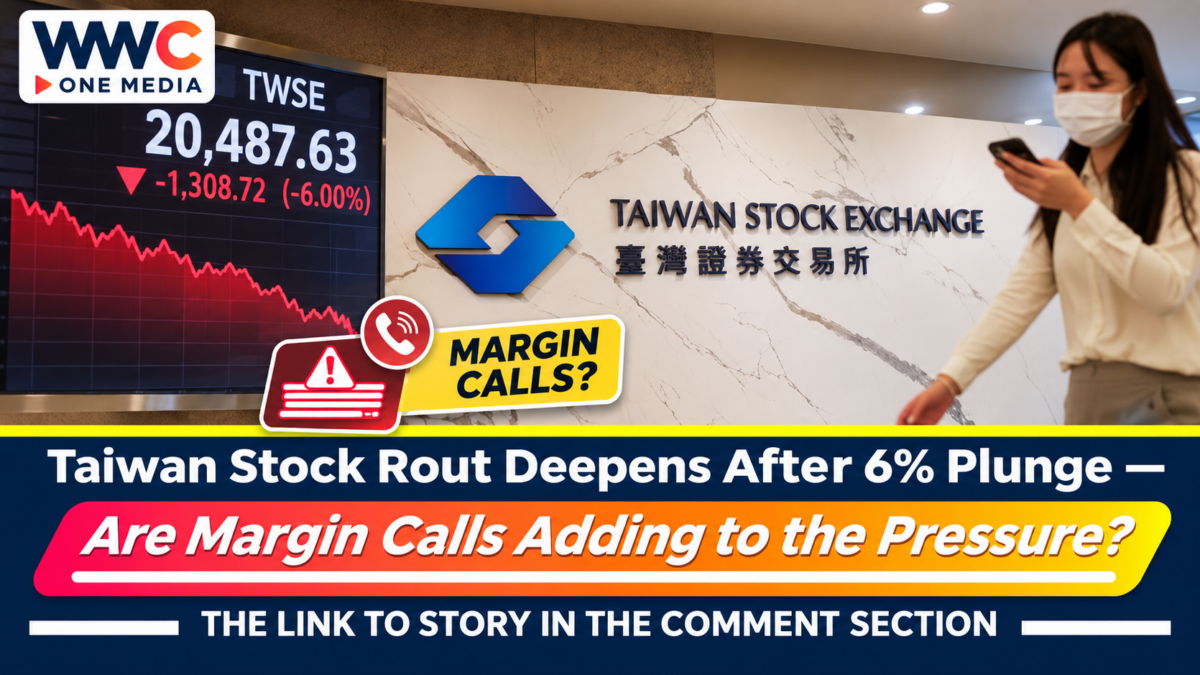
TAIPEI, Taiwan — Taiwan’s benchmark TAIEX index dropped 6.03% on Monday, Nov. 16, 2026, and fell another 2.31% on Tuesday, Nov. 17, exchange records show. The Taiwan stock rout has renewed attention on borrowed-money share purchases, after officials had already authorised market-stabilisation operations earlier in November.
The selling is measurable; its precise causes require more caution. Taiwan Stock Exchange (TWSE) rules describe how falling securities prices can trigger margin calls and broker liquidations, but those rules alone do not prove how much of this week’s decline resulted from forced retail selling.
Taiwan stock rout: Two sessions of heavy losses
The TAIEX closed at 41,040.08 on Nov. 16 after losing 2,635.04 points, or 6.03%, in one session. Exchange statistics recorded total securities trading value of about NT$903.1 billion that day, with 948 individual stocks declining and 99 advancing.
The weakness continued on Nov. 17. The benchmark finished at 40,092.11, down another 947.97 points, or 2.31%. The exchange reported total trading value of about NT$961.8 billion and 789 declining stocks against 234 advancing.
The figures show selling across a broad part of the market, although they cannot identify the financial circumstances of every seller. Turnover includes transactions by different investor groups; it does not separate voluntary profit-taking from sales required to meet collateral obligations.
The slide follows Taiwan’s earlier technology-share selloff, which had already drawn attention to the market’s sensitivity to semiconductor valuations.
How a margin call can accelerate a falling market
A margin purchase lets an investor acquire shares using borrowed funds while maintaining securities or cash as collateral. If those shares fall enough, their value may no longer adequately cover the loan under the broker’s requirements.
Under Article 54 of TWSE’s published margin-trading operating rules, a securities firm must issue a margin call when the overall collateral maintenance ratio falls below 130%. The customer generally has two business days from receiving the call to supply the required additional collateral.
If the deficiency is not corrected, the rules provide for disposal of collateral under specified conditions. That sale can happen irrespective of whether the investor believes the shares remain attractive for the long term.
Analysis: Forced liquidation can amplify a decline because a distressed borrower may have to sell into an already weak market. Additional selling can then push prices down, raising collateral pressure elsewhere. This is a mechanism, not proof that it dominated trading on Nov. 16 or Nov. 17.
Historical margin statistics offer a caution
TWSE’s analysis of margin trading from January to July 2026 described a market in which widespread forced liquidations had not been evident during the period examined. As of July 31, the overall collateral maintenance ratio was approximately 172.90%, above the regulatory trigger.
The exchange estimated average daily margin calls of NT$97 million and average forced liquidations of NT$33 million during those seven months. It also reported approximately 170,000 accounts with outstanding margin loans at the end of July, about 1.2% of roughly 14.6 million account holders.
Those historical figures are useful as a baseline, not as a snapshot of November. They cannot establish how many investors received fresh calls during the latest decline, whether the average liquidation amount rose, or how much selling came from retail borrowers rather than institutions.
A conclusion that leveraged retail investors caused most of the November losses would require more current and directly relevant transaction evidence.
Why Taiwan activated a stabilisation mechanism
Taiwan’s National Financial Stabilization Fund held an extraordinary committee meeting on Nov. 6 and authorised its executive secretary to deploy resources as market conditions warranted. The finance ministry explained that the index had fallen sharply amid international uncertainty and selling by foreign investors.
Its statement recorded net foreign-investor sales of NT$994.316 billion in October and another NT$524.4 billion from the start of November through Nov. 6. The committee also highlighted the market’s exposure to technology shares and the Philadelphia Semiconductor Index.
Authorising a fund to intervene does not reveal whether particular shares were purchased or how much was committed on any given later session. It is an available stabilisation measure, not a guarantee of rising prices.
The wider regional pressure was already examined in WWC’s account of the November selloff across Asian AI stocks. Taiwan’s official records establish its own index movements without implying that every neighbouring market suffered identical losses.
What the decline means for individual investors
Analysis: Investors who own fully paid shares may choose whether to sell, subject to their circumstances. Investors using margin financing can face different constraints: collateral requirements may force a decision before their preferred investment horizon ends.
A sharp fall in the index does not make all Taiwanese businesses financially unsound, just as a subsequent rebound would not show that every share is fairly priced. The corporate results, balance sheets and cash flows of individual issuers remain essential evidence.
There is also a distinction between buying during a decline and having the capacity to withstand further losses. WWC’s coverage of the return of retail investors during a US technology selloff considers similar questions about risk-taking, although the trading rules and investor composition differ across markets.
For Philippine readers holding overseas funds, currency exposure and fund holdings can make personal returns different from the TAIEX itself. No index movement guarantees an equivalent gain or loss in a particular investment account.
What happens next
The next tests are Taiwan’s daily exchange reports, updated margin-financing and collateral statistics, and any formal notices describing stabilisation activity. Such records would help assess whether forced selling is growing, easing or remaining limited.
For now, the verified position is clear: Taiwan’s benchmark fell steeply across Nov. 16 and 17; regulators have a defined margin-call and liquidation framework; and a public fund has been authorised to support market stability when warranted. The claim that forced retail liquidation was the principal cause remains unproven by the primary records reviewed.
FAQ
How far did Taiwan stocks fall on Nov. 16, 2026?
The TAIEX lost 2,635.04 points, or 6.03%, closing at 41,040.08, according to the stock exchange’s daily record.
Did Taiwan’s stock market recover on Nov. 17?
No. The TAIEX declined a further 2.31% to 40,092.11 on Nov. 17.
What triggers a margin call in Taiwan?
The TWSE’s published margin-trading rules provide for a margin call when an account’s overall collateral maintenance ratio falls below 130%.
Did forced retail selling cause the stock rout?
Margin rules show how forced sales can occur, but the primary records reviewed do not establish how much of the November decline was caused by those sales.