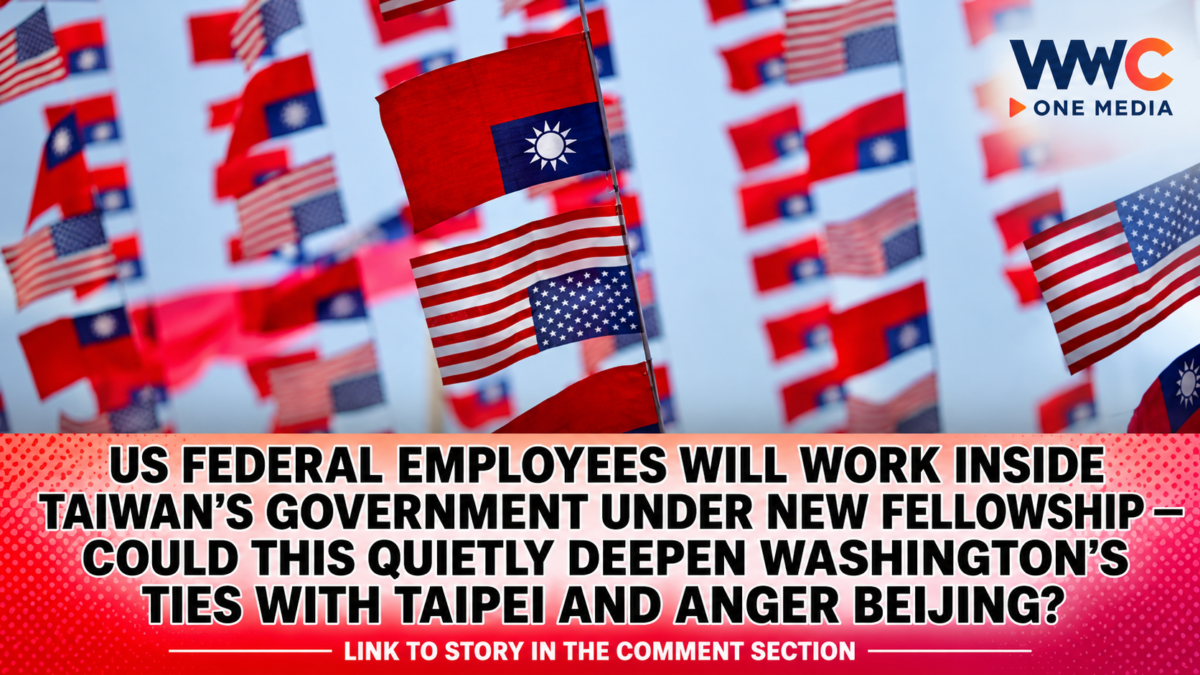
TAIPEI, Taiwan — The United States and Taiwan have taken another step toward strengthening their unofficial relationship after signing an agreement that will allow eligible American federal employees to study in Taiwan and eventually work inside Taiwanese government institutions for up to a year.
The new initiative, called the Taiwan Fellowship Program (TFP), will give selected US government employees up to one year of intensive Mandarin-language training and regional studies, followed by a possible placement lasting up to another year in Taiwan.
These placements may include parliamentary offices, government ministries, other public agencies and selected organisations outside the public sector.
The agreement was signed on November 10 in Arlington, Virginia, by Ingrid Larson, Washington managing director of the American Institute in Taiwan (AIT), and Alexander Yui, Taiwan’s representative to the United States. The agreement was announced publicly on November 11.
The programme is intended to strengthen cooperation between Washington and Taipei by giving American officials a deeper understanding of Taiwan’s political environment, culture, language and relationship with mainland China.
But the announcement carries significance beyond a traditional educational exchange.
The United States does not maintain formal diplomatic relations with Taiwan, yet it remains the island’s most important international supporter and principal arms supplier. Allowing American government employees to gain direct professional experience inside Taiwanese institutions could deepen working relationships between the two sides.
That relationship remains one of the most sensitive issues in Washington-Beijing relations.
What Is the Taiwan Fellowship Program?
The Taiwan Fellowship Program is a US government initiative designed to develop American officials with stronger knowledge of Taiwan and the broader Indo-Pacific region.
According to the American Institute in Taiwan, selected participants will first undertake intensive Mandarin training and regional studies.
After completing that stage, fellows are expected to work for up to one year in Taiwan’s legislative offices, ministries, government agencies or organisations outside the public sector.
The programme has two main objectives:
- Strengthen the professional and institutional relationship between the United States and Taiwan.
- Improve American officials’ knowledge of Taiwan through language training, cultural understanding and direct professional experience.
AIT said the initiative will help build a network of US federal professionals with Mandarin skills, regional knowledge and lasting working relationships across Taiwan.
The agreement also reflects bipartisan support in Washington for maintaining people-to-people ties with the island.
However, the programme is not a military deployment or an announcement that American diplomats are being formally stationed inside Taiwan’s government.
It is a fellowship and professional-exchange arrangement involving eligible US federal employees.
How Long Will American Employees Stay in Taiwan?
The programme can last up to two years in total.
Under the structure outlined in the Taiwan Fellowship Act, the first year is dedicated to studying Mandarin, Taiwan’s history and political environment, and issues affecting US relations with the Indo-Pacific region.
The second year is intended for professional placements.
These placements may take place in:
- Taiwan’s legislative offices
- Government ministries
- Other government agencies
- Selected non-government organisations and private-sector institutions
The exact placement will depend on the fellow’s professional background, the relevant US government agency and the approval of the programme’s administrators.
The law also sets an initial target of approximately five fellowships during the programme’s first two years, followed by approximately 10 fellowships in each subsequent year, subject to available funding.
AIT did not disclose how many participants will take part in the initial programme following the November announcement.
That means the programme’s eventual scale and the number of American officials who will work directly with Taiwanese institutions remain important details to watch.
Not Every US Federal Employee Can Apply
The fellowship is not open to every American government worker.
Under Section 3384 of Title 22 of the US Code, eligible applicants must meet specific requirements.
These include:
- Being a US citizen and an employee of the US government.
- Having at least two years of experience in a US government position.
- Having received at least one exemplary performance review within the previous three years.
- Demonstrating a professional or educational background connected to US relations with the Indo-Pacific region.
- Showing a commitment to continued service in the US government.
Participants must also agree to remain in federal government employment for a specified period after completing the fellowship.
The law requires at least four years of continued federal service after a fellowship longer than one year, or at least two years for a fellowship lasting one year or less.
One particularly important safeguard is that participants are prohibited from engaging in intelligence or intelligence-related activities on behalf of the US government as part of the fellowship.
This provision distinguishes the initiative from intelligence operations or covert assignments.
It is designed as a professional exchange programme, not an intelligence deployment.
Why Was the Taiwan Fellowship Act Passed?
The programme was authorised under the Taiwan Fellowship Act, which was incorporated into the James M. Inhofe National Defense Authorization Act for Fiscal Year 2023.
Former US President Joe Biden signed the legislation into law on December 23, 2022.
The law directed the US government to establish a fellowship that would improve American officials’ understanding of Taiwan and the Indo-Pacific.
It also provided a framework for arranging placements with Taiwanese institutions through the American Institute in Taiwan and an implementing partner.
However, the programme’s formal implementation took considerably longer than the original legislation anticipated.
Focus Taiwan, citing the AIT announcement, noted that the agreement was signed nearly three years after the law was enacted. AIT did not publicly explain the delay.
The November 10 memorandum of understanding now provides a framework for moving the initiative forward.
Why the United States Uses the American Institute in Taiwan Instead of an Embassy
One of the most important details behind the programme is the diplomatic status of Taiwan.
The United States does not maintain formal diplomatic relations with Taiwan. Washington switched formal diplomatic recognition from Taipei to Beijing in 1979.
However, the two sides have maintained extensive unofficial relations through the American Institute in Taiwan.
AIT performs many functions normally associated with an embassy, including facilitating economic, cultural, educational and security cooperation.
Taiwan also maintains its own representative office in the United States, the Taipei Economic and Cultural Representative Office.
These institutions allow Washington and Taipei to maintain close practical relations without formally recognising Taiwan as a separate sovereign state.
The arrangement reflects the complicated diplomatic framework governing US-China relations.
Washington maintains its One China policy, while continuing to support Taiwan’s ability to defend itself and maintain unofficial international relationships.
For Beijing, however, the growing depth of US-Taiwan cooperation remains a persistent source of concern.
Why the New Programme Matters as China Watches Taiwan
China considers Taiwan part of its territory and has repeatedly opposed closer official and unofficial engagement between Washington and Taipei.
Beijing has also demanded that the United States stop selling weapons to Taiwan and reduce its contacts with the island’s authorities.
The new fellowship does not change the formal diplomatic status of Taiwan, but it could strengthen the day-to-day institutional relationships between American and Taiwanese officials.
The programme may also give US government employees a more detailed understanding of Taiwan’s political system, public administration and cross-strait challenges.
That knowledge could become useful in future policymaking involving the Indo-Pacific.
The announcement comes amid continued military and political pressure around Taiwan.
Taiwan regularly reports Chinese military aircraft and naval activity near the island, while Beijing maintains that it has not renounced the use of force to achieve reunification.
WWC ONE MEDIA recently examined Taiwan’s growing preparations for a potential military crisis and the expansion of civilian emergency planning.
The fellowship should not be interpreted as evidence that Washington is preparing for an imminent conflict. Its stated purpose is professional development and stronger bilateral cooperation.
Nevertheless, the timing highlights how important Taiwan has become in US strategic planning.
Taiwan’s Relationship With Washington Goes Beyond Military Cooperation
The United States-Taiwan relationship is not limited to defence.
Trade, technology, education, semiconductors and supply-chain security are also major areas of cooperation.
Taiwan is home to Taiwan Semiconductor Manufacturing Company (TSMC), one of the world’s most important producers of advanced semiconductors.
Its manufacturing capabilities are essential to industries ranging from artificial intelligence and smartphones to data centres and advanced computing.
The United States has been encouraging greater semiconductor investment and production capacity on American soil, while Taiwanese companies continue expanding their international operations.
This economic relationship gives Washington and Taipei additional reasons to maintain close institutional and commercial connections.
WWC ONE MEDIA previously reported on Taiwan’s efforts to reassure Washington that their relationship remains strong despite uncertainty surrounding a proposed US$14 billion arms package.
Read: Taiwan Says US Ties Remain Robust Despite Trump-Xi Summit and Delayed Arms Deal.
The report highlighted how defence cooperation, economic ties and political assurances are all part of the broader relationship.
The new fellowship adds another layer: developing officials who understand Taiwan through direct experience rather than relying exclusively on briefings and diplomatic discussions.
The Programme Is Separate From US Military Cooperation With Taiwan
The announcement may raise questions about whether American personnel will be stationed in Taiwan for security or military purposes.
However, the Taiwan Fellowship Program is distinct from military training and defence cooperation.
Its legal framework specifically focuses on language learning, regional studies and professional placements.
It also prohibits fellows from carrying out intelligence-related activities on behalf of the US government.
There have been separate reports about American defence personnel and advisers working with Taiwan’s military institutions.
TaiwanPlus reported in October on media accounts of possible US defence officials being stationed with Taiwan’s Ministry of National Defense to assist with policy coordination and assessments of military capabilities.
That separate reporting should not be confused with the newly announced fellowship.
The Taiwan Fellowship Program is a civilian professional-development initiative, and its stated placements are broader than defence institutions alone.
Could the Programme Trigger Another Diplomatic Dispute With Beijing?
China has consistently criticised US efforts to expand ties with Taiwan.
Beijing considers the island’s status a core issue in its relationship with Washington and has repeatedly warned against actions it views as encouraging Taiwanese independence.
The fellowship could attract further criticism because it provides American government employees with opportunities to work directly in Taiwanese institutions.
However, the announcement does not establish formal diplomatic recognition or create a new US embassy presence in Taiwan.
It also does not change Washington’s existing diplomatic framework.
Instead, it expands the practical cooperation that has existed between the two sides for decades.
The bigger issue is how Beijing interprets the programme and whether it becomes another point of tension during future US-China discussions.
WWC ONE MEDIA previously examined how China and the United States have continued to clash over Taiwan even as their leaders pursue diplomatic engagement.
Read: Trump-Xi Talks Leave Taiwan Questions Unanswered as U.S. Arms Package Remains in Limbo.
The report highlights the delicate balance Washington faces: maintaining cooperation with Taiwan while managing its broader relationship with Beijing.
What Happens Next?
The November 10 memorandum provides the framework for implementing the Taiwan Fellowship Program, but several details remain to be clarified.
These include:
- The first group of fellows: AIT has not publicly specified the number of participants who will enter the programme initially.
- Placement institutions: The specific Taiwanese ministries, parliamentary offices and organisations that will host participants have not been announced.
- Implementation timetable: The exact dates for recruitment, Mandarin training and the first placements remain to be confirmed publicly.
- Long-term impact: The programme’s success will depend on whether the participants build lasting professional relationships and bring their regional expertise back into US government service.
The statutory framework provides for approximately five fellowships during the first two years and approximately 10 in each subsequent year, subject to funding.
The programme is therefore designed to build a continuing network of specialists rather than send a large group of American officials to Taiwan all at once.
A Quiet Expansion of US-Taiwan Ties With Wider Strategic Implications
The new Taiwan Fellowship Program may not involve weapons deliveries, military exercises or a change in diplomatic recognition.
But it could have a lasting impact on how Washington and Taipei work together.
By allowing American federal employees to study Taiwan’s language, history and political environment before taking professional placements inside its institutions, the programme aims to develop a deeper understanding between the two sides.
For Taiwan, it offers another opportunity to strengthen its international relationships at a time of continuing pressure from Beijing.
For the United States, it provides a way to develop government professionals with direct experience of one of the Indo-Pacific’s most sensitive geopolitical issues.
The initiative also sends a message that cooperation between Washington and Taipei extends beyond military support and diplomatic statements.
The programme is not a military deployment or a formal diplomatic recognition of Taiwan. But as American officials prepare to study and work alongside Taiwanese institutions, the bigger question is whether these new professional relationships will quietly reshape the US-Taiwan partnership — and how far Beijing will allow that relationship to deepen.