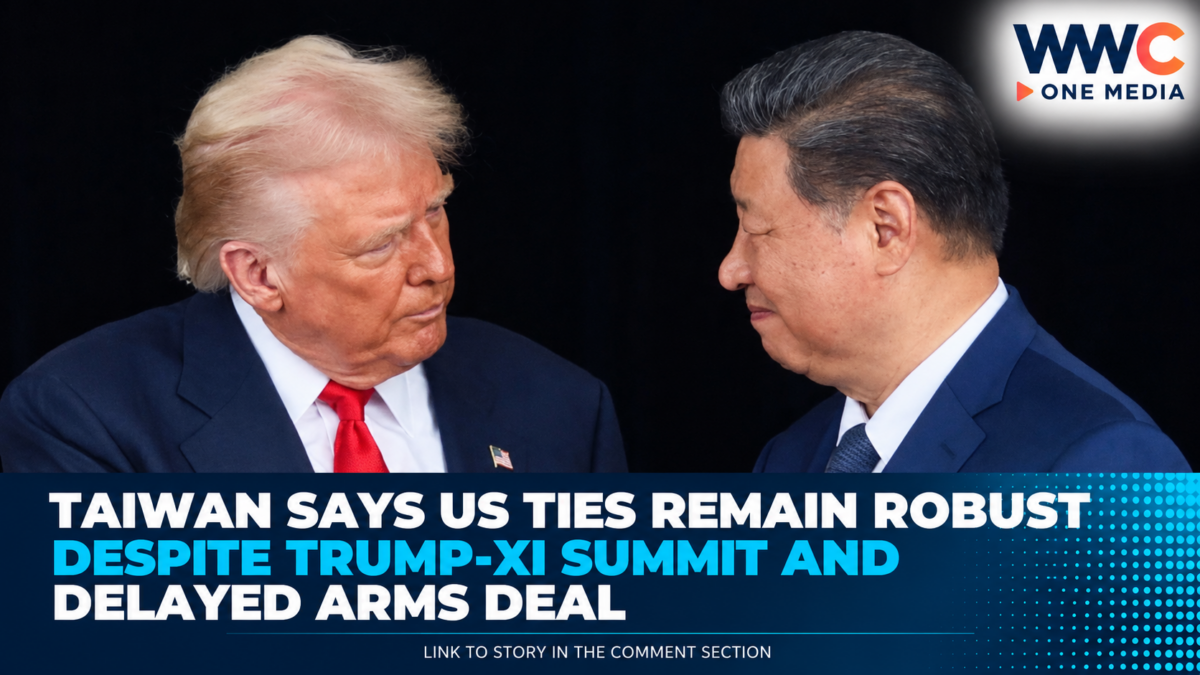
Taiwan’s de facto ambassador to the United States has sought to reassure Taipei’s partners that relations with Washington remain strong following President Donald Trump’s recent summit with Chinese President Xi Jinping, even as the administration holds back a new US$14 billion arms package for the island.
Alexander Yui, Taiwan’s representative in Washington, said on Oct. 7 that there had been no indication of a fundamental change in US policy toward Taiwan following Trump’s September meeting with Xi.
“I can say quite confidently that US-Taiwan relations remain robust,” Yui said at a symposium in Washington, while stressing that the credibility of Taiwan’s defence depends not only on purchasing weapons but also on receiving them on time and ensuring troops are properly trained to use them.
His comments come at a sensitive moment for Taiwan. Trump has said he is holding up approval of a new US$14 billion package of weapons for Taipei, describing the sale as a negotiating tool in dealings with Beijing. China strongly opposes US arms sales to Taiwan, which Beijing claims as part of its territory.
Taiwan Seeks Reassurance After Trump-Xi Meeting
Trump and Xi met in Washington in late September during a three-day state visit by the Chinese leader. Taiwan was one of the most closely watched issues surrounding the summit because Beijing has repeatedly pressed Washington to oppose Taiwan independence and stop selling weapons to Taipei.
The White House’s public account of the summit did not include Taiwan among the issues discussed, while China’s account said Xi urged Washington to oppose “Taiwan independence” and handle the Taiwan issue cautiously.
Taiwanese officials subsequently said they had received assurances through multiple channels that Washington’s policy had not changed. Taiwan’s deputy foreign minister Chen Ming-chi said in September that US officials had repeatedly confirmed that there was “no change” in Washington’s Taiwan policy.
Yui’s latest remarks reinforce that message, although they also highlight Taipei’s concern about maintaining a credible defence relationship with Washington.
US$14 Billion Arms Package Remains on Hold
The biggest uncertainty involves the proposed US$14 billion arms package.
Trump has held back approval of the package after his meeting with Xi, saying the weapons deal could serve as a bargaining chip as Washington works to maintain its broader relationship and trade truce with Beijing.
The decision does not mean all US military cooperation with Taiwan has stopped.
In December, the Trump administration approved an earlier arms package worth about US$11 billion. Taiwan has also continued receiving previously ordered equipment, including the first two of 65 F-16V Block 70 fighter jets manufactured in the United States.
Yui pointed to the arrival of those aircraft as evidence that US-Taiwan defence cooperation is continuing.
But he warned that deterrence depends on more than announcing arms purchases.
“For deterrence to be credible,” he said, Taiwan’s investment must be matched by “timely delivery, effective training” and the ability to turn those investments into effective defence capabilities.
Taiwan Says Strength Is Key to Preventing Conflict
Yui argued that the best way to preserve peace across the Taiwan Strait is to make the cost of military aggression sufficiently high that an attack does not appear worthwhile.
He said Taiwan needed to strengthen its resilience and ensure that “aggression can never be regarded as an easy or an inexpensive option.”
The comments reflect Taipei’s broader strategy of strengthening its military capabilities while avoiding predictions about a specific date for a possible Chinese attack.
Yui said Taiwan’s preparations were not based on a particular year, despite continued international discussion about whether China could attempt military action around 2027 or 2028.
“There’s been different opinions about maybe 2027, maybe 2028, or beyond,” he said. “But our responsibility is the same: to make Taiwan stronger, more resilient, and harder to be coerced by the adversary.”
US officials have also played down the idea that a Chinese invasion is inevitable within a specific timeframe.
Reuters reported this month that US officials believe an invasion before 2028 is becoming increasingly unlikely, despite Chinese military preparations and President Xi’s long-standing instruction for the People’s Liberation Army to be capable of taking Taiwan by force if necessary.
Economic Ties Are Becoming More Important
Taiwan’s relationship with the United States extends well beyond defence.
Taiwanese Foreign Minister Lin Chia-lung, speaking by video at the same symposium, described the two economies as increasingly “symbiotic” partners, pointing to cooperation in semiconductors, artificial intelligence and supply-chain security.
At the centre of that relationship is Taiwan Semiconductor Manufacturing Co., the world’s largest contract chipmaker.
TSMC has invested tens of billions of dollars in semiconductor manufacturing facilities in Arizona, strengthening ties between Taiwan’s technology industry and the US economy. The projects have also received substantial US government support as Washington seeks to expand domestic production of advanced chips.
For Washington, Taiwan’s role in the global semiconductor industry makes the island strategically important well beyond its military significance.
For Taipei, deeper economic integration with the United States provides another layer of resilience as it faces growing pressure from Beijing.
China Continues to Reject US Arms Sales to Taiwan
Beijing has consistently opposed American weapons sales to Taiwan, arguing that they interfere with China’s sovereignty claims and encourage what it calls separatist forces.
China regards Taiwan as part of its territory and has never renounced the use of force to bring the island under its control, although Beijing says it prefers peaceful reunification.
The United States, meanwhile, does not maintain formal diplomatic relations with Taiwan but has extensive unofficial relations with Taipei.
Under the Taiwan Relations Act, Washington is required to make defence articles and services available to Taiwan in quantities necessary for the island to maintain a sufficient self-defence capability.
That longstanding framework remains a central pillar of Taiwan-US relations. Taiwanese officials have repeatedly cited it alongside the Six Assurances as evidence that the basic foundation of US policy has not changed.
Trump Faces a Delicate Balance
The arms-sale decision highlights the difficult balance facing the Trump administration.
Washington wants to strengthen its position in the Indo-Pacific and maintain Taiwan’s ability to deter military coercion. At the same time, Trump is seeking stable relations with Beijing and has placed considerable emphasis on trade negotiations and economic agreements with China.
The September summit produced a limited improvement in US-China relations, particularly around trade, but major disagreements remained over Taiwan, technology, security and other geopolitical issues.
For Taiwan, the concern is that improved US-China relations could come at the expense of its own security interests.
Yui’s comments appear intended to counter that possibility by stressing that the underlying relationship between Taipei and Washington remains strong even as individual arms decisions are delayed.
Taiwan Focuses on Resilience Rather Than a Deadline
Taiwan is meanwhile continuing to strengthen its own defence capabilities.
Yui’s emphasis on resilience reflects a broader effort by Taipei to reduce vulnerabilities not only to a conventional military attack but also to cyberattacks, economic pressure, disinformation and other forms of coercion.
Former Taiwanese President Tsai Ing-wen made a similar argument during a visit to the United States this week, warning of sustained Chinese “grey zone” pressure, including military patrols, cyberattacks, information manipulation and economic coercion.
Tsai said Taiwan needed to maintain its freedom of action while strengthening its ability to defend itself should deterrence fail.
Those concerns have become increasingly significant as Taiwan remains deeply integrated into global technology and manufacturing supply chains.
A Relationship Under Close Watch
For now, Taipei appears confident that the Trump-Xi summit has not fundamentally altered Washington’s approach to Taiwan.
But the delayed US$14 billion arms package remains an important test.
Taiwan wants weapons delivered quickly enough to strengthen deterrence. Washington must balance that demand against its broader strategic and economic relationship with Beijing. China, meanwhile, continues to insist that US military support for Taiwan should end.
The arrival of the first new F-16Vs and continued cooperation in semiconductors and artificial intelligence provide Taiwan with evidence that its partnership with Washington remains active.
Yet the fate and timing of the pending arms package will be closely watched as a measure of how the Trump administration balances its relationship with China against its longstanding security commitments to Taiwan.
For Taipei, the message from Washington remains reassuring for now: the relationship has not changed, but Taiwan is still pressing for the defence support needed to make that commitment credible.