ADELAIDE, AUSTRALIA — November 12, 2026 | WWC ONE MEDIA | Artificial Intelligence, Global Business, Energy, Technology and Climate
Australia’s ambition to become one of the world’s leading artificial intelligence infrastructure hubs has suffered another major setback after a developer suspended plans for a massive 1,200-megawatt data center in South Australia following fierce opposition from residents concerned about electricity consumption, water supplies, environmental damage and the future of their rural communities.
Quantum DC has confirmed it will not seek development approval in 2026 for its proposed Tungkillo Compute and Energy Hub, an enormous AI infrastructure project planned for farmland in the Adelaide Hills.
The decision follows growing public resistance, hundreds of community complaints and mounting political pressure over the environmental and social consequences of building hyperscale computing facilities.
Quantum DC chief executive Alby Tomassi acknowledged that the company had underestimated opposition to the development.
The developer received contacts from more than 350 people and a consolidated list of 432 questions about the proposal.
According to Bloomberg’s November 12 report, the decision marks another setback for Australia’s rapidly expanding data-center industry as communities increasingly challenge projects designed to serve the global AI boom.
The announcement comes just days after property developer Stockland abandoned plans for a controversial AI data center near Sydney’s Cooks River.
Together, the developments reveal an increasingly serious problem for technology companies and their financial backers.
Australia may possess attractive land, significant renewable energy resources and strong demand for computing capacity.
But investors are discovering that securing electricity, water and community acceptance can be much harder than announcing billion-dollar AI developments.
The central question is whether Australia’s enormous AI investment ambitions can survive growing resistance from the communities expected to host the infrastructure.
Quantum DC Halts 1,200-MW Tungkillo Project After Public Backlash
At the center of the controversy is Quantum DC’s proposed Tungkillo Compute and Energy Hub.
The project would be located along Collins Road in Tungkillo, approximately 41 kilometers directly east of central Adelaide.
It involves a planned hyperscale data center with 1,200 megawatts of capacity, alongside supporting energy infrastructure.
The development was intended to create a major new location for artificial intelligence computing.
Large AI data centers contain powerful processors, networking equipment, storage systems and cooling infrastructure used to train and operate advanced artificial intelligence models.
Facilities of this scale can attract substantial construction and technology investment.
However, the Tungkillo proposal encountered intense resistance from local residents.
Community members raised concerns about the facility’s physical footprint, electricity requirements, water consumption and possible effects on surrounding agricultural land.
They also questioned whether the development would create excessive noise, artificial lighting and additional traffic.
Other concerns included bushfire risks and the project’s proximity to environmentally sensitive locations.
Following weeks of criticism, Quantum DC announced that it would pause the development process and pursue a more comprehensive consultation program.
The developer has not ruled out proceeding with the project in the future.
That distinction is important.
The Tungkillo data center has been delayed, not formally abandoned.
Developer Admits It Misjudged Community Opposition
Quantum DC’s decision came with an unusually direct acknowledgment from its chief executive.
Alby Tomassi said the company had underestimated the strength of local opposition and accepted that its initial engagement process had failed to address important public concerns.
He apologized for the confusion and frustration experienced by residents.
The developer had originally scheduled community consultation sessions but postponed them amid safety concerns.
Local residents subsequently organized their own protest gatherings, attracting hundreds of participants.
The company said more than 350 people had contacted it, while community representatives submitted 432 consolidated questions.
The questions covered electricity supply, water use, noise, lighting, agricultural land, traffic, bushfire preparedness and environmental protection.
Quantum DC now plans to establish an independent expert panel to review technical studies and make the findings publicly available.
The company will also reconsider how it communicates with affected communities.
That approach could provide greater transparency.
However, consultation alone will not guarantee that local residents eventually support the project.
Opponents have already made clear that they question whether Tungkillo is an appropriate location for such a large facility.
Why Residents Fear a 1,200-MW AI Data Center
One of the biggest concerns surrounding the proposal is its enormous electricity requirement.
A facility with 1,200 MW of operating electrical demand would represent a substantial new load on the power system.
For illustration, a facility consuming 1,200 MW continuously for an entire year would use approximately 10.5 terawatt-hours of electricity.
That calculation is hypothetical.
It does not mean Quantum DC’s proposed project would necessarily consume that amount annually.
Actual electricity consumption would depend on the completed facility’s configuration, equipment utilization, construction phases and operating efficiency.
Nevertheless, the planned capacity demonstrates why residents and policymakers are examining electricity infrastructure so closely.
Data centers require dependable power supplies.
Unexpected interruptions can disrupt computing systems and customers relying on those services.
Supporting infrastructure may include high-voltage connections, substations, backup power systems and new electricity generation.
Residents want to understand whether these requirements would affect local electricity prices, infrastructure costs or the surrounding environment.
Quantum DC’s proposal also includes on-site gas-fired generation.
That has raised questions about emissions, noise and the developer’s longer-term energy strategy.
The company will need to demonstrate how its proposed electricity arrangements would operate and how their environmental effects would be managed.
Water Consumption and the River Murray Raise Environmental Questions
Water availability is another major concern.
Some data centers use substantial quantities of water to cool equipment and maintain operating temperatures.
However, water consumption varies significantly depending on the cooling technology, climate and facility design.
Residents near Tungkillo have questioned whether the proposed development could affect groundwater resources or surrounding water systems.
The area’s proximity to the River Murray region has heightened concern.
Quantum DC has previously said the project would not use water from the River Murray or existing groundwater reserves.
Nevertheless, residents have sought more detailed information about the project’s proposed water sources and long-term requirements.
Public scrutiny has also focused on construction-related water consumption.
Local reporting indicates that the proposed development could require approximately 150 million to 250 million liters during construction and at least 20 million liters annually during operations.
These are preliminary project estimates, not verified actual consumption.
The environmental assessment process would need to evaluate whether the proposed water arrangements are sustainable.
For residents, the issue is particularly sensitive because agricultural communities depend on reliable water supplies.
Australia’s Dark Sky Reserve Becomes Another Flashpoint
The controversy also extends beyond electricity and water.
Local residents and officials have expressed concerns about light pollution affecting the River Murray International Dark Sky Reserve.
The reserve is internationally recognized for its exceptionally dark night skies.
Large industrial facilities can introduce substantial lighting requirements for security, maintenance and operations.
Without appropriate controls, those lights can affect nearby communities, wildlife and nighttime visibility.
Noise is another important consideration.
Large data centers may operate cooling systems, ventilation equipment, electrical infrastructure and backup generators.
The potential effects depend on equipment selection, building design, distance from homes and operating conditions.
Residents also question whether heavy construction vehicles could place additional pressure on rural roads.
Mid Murray Council Mayor Simone Bailey has identified concerns involving the project’s location, surrounding environment, access roads and distance from emergency services.
The combination demonstrates why the debate extends beyond the data center itself.
A hyperscale computing facility can require extensive supporting infrastructure that changes the character of its surrounding area.
South Australian Premier Calls for Tougher Data Center Rules
The controversy has now reached the highest levels of South Australian politics.
Premier Peter Malinauskas has called for a stronger regulatory framework governing data-center development.
He argues that large facilities should not be proposed in locations where their effects on communities and the environment cannot be adequately managed.
The government is considering legislation intended to ensure community interests receive greater protection during the planning process.
The debate reflects a growing tension between two policy objectives.
South Australia wants to attract investment, support economic development and participate in the global technology industry.
At the same time, the government faces pressure to protect communities from poorly located industrial projects.
Stronger rules could improve transparency and investor certainty if developers understand what must be demonstrated before applications proceed.
But the requirements could also increase planning costs or delay projects that do not meet the standards.
The challenge will be establishing consistent rules without treating every data-center proposal as environmentally identical.
Location, energy sourcing, cooling technology and community impacts can vary substantially between projects.
Sydney’s $3.5 Billion Development Also Lost Its AI Data Center
The Tungkillo setback follows another major development in Sydney.
On November 8, property developer Stockland confirmed it would remove an AI data center from the proposed redevelopment of the former Kogarah Golf Club site near the Cooks River.
The larger logistics and technology precinct was estimated at approximately A$3.5 billion.
Stockland and development partner John Boyd Properties had proposed a four-storey data center within the redevelopment.
However, residents and environmental campaigners strongly opposed the facility.
Their concerns included electricity consumption, water use, noise and potential effects on the Cooks River ecosystem.
The developer subsequently removed the data center from the revised masterplan.
Importantly, the broader logistics redevelopment is continuing.
As previously reported by WWC ONE MEDIA in its investigation of Stockland’s abandoned Sydney AI facility, the decision marked another victory for community campaigners challenging large computing facilities.
The Sydney cancellation and Tungkillo suspension are separate events.
But together they demonstrate that public opposition has become a material risk for developers.
Australia’s Data Center Problems Are Spreading Beyond Adelaide and Sydney
The industry has also experienced setbacks involving other major projects.
In September, Goodman Group withdrew its proposal for a 90-MW data center known as Project Mars in Lane Cove, Sydney.
The project was valued at approximately A$1.2 billion.
It faced objections from residents because of its proximity to homes and a primary school.
Reuters reported that the proposed facility would have been approximately 20 meters from the nearest residence.
Goodman cited changing regulatory conditions and community feedback when withdrawing the application.
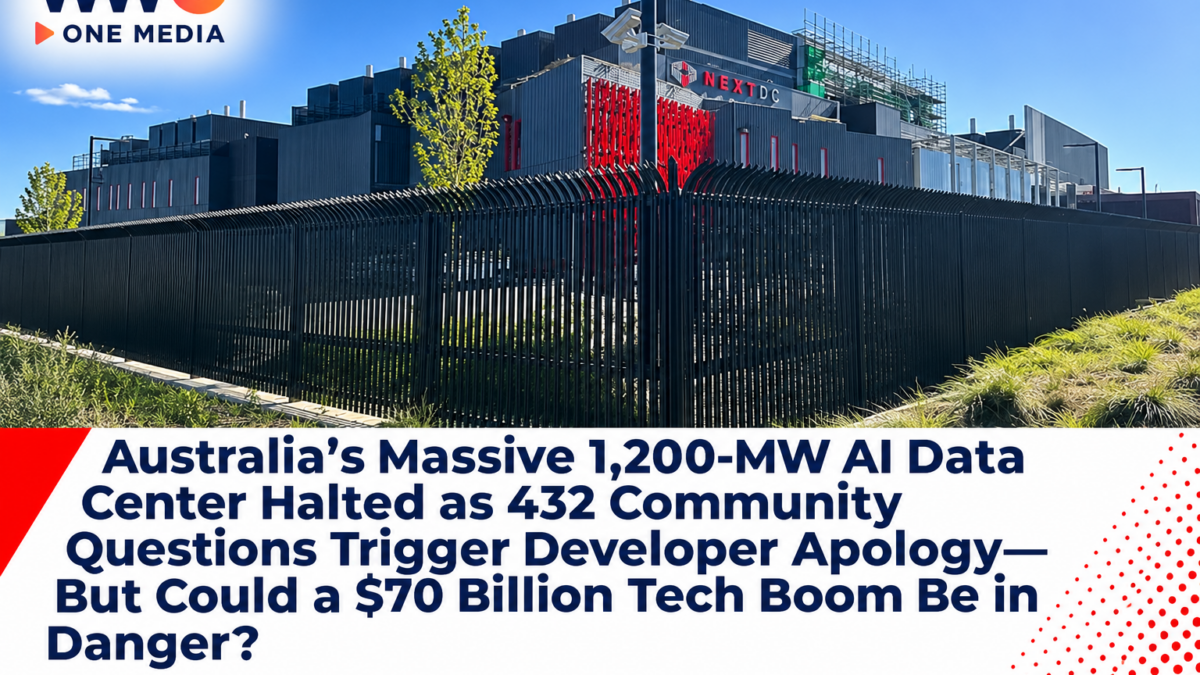
Meanwhile, Australian data-center operator NextDC has encountered delays affecting its M3 facility expansion in Melbourne.
The difficulties involved electricity supply infrastructure and community opposition.
On November 9, Reuters reported that NextDC would pause development work on projects without contracted customers.
The company had earlier reduced its financial guidance following delays at the Melbourne facility.
These developments have increased investor scrutiny of the country’s data-center pipeline.
The companies involved face different circumstances, but they share a common problem.
Announcing computing capacity does not guarantee that the required infrastructure can be delivered on schedule.
More Than $70 Billion in Australian AI Data Center Investment Faces Infrastructure Risks
The stakes extend far beyond individual projects.
Bloomberg previously examined more than 40 major data centers planned or under construction around Sydney and Melbourne.
Those projects represented more than A$100 billion, or approximately US$70 billion, in proposed investment.
Yet only 23% had publicly confirmed electricity supply or grid connection arrangements.
The findings underscore the enormous gap between announced investment ambitions and the infrastructure required to make those projects operational.
Electricity connections can take considerable time.
Large facilities may require network upgrades, additional substations or new generating capacity.
Other development requirements include land-use approvals, water arrangements, financing and telecommunications connectivity.
The absence of publicly confirmed grid arrangements does not prove that every remaining project will fail.
Some developers may have confidential negotiations or infrastructure plans that have not been publicly disclosed.
Nevertheless, the limited confirmation rate indicates substantial uncertainty.
As WWC ONE MEDIA reported in its coverage of global data-center electricity demand and the risk of rising fossil-fuel generation, the challenge is becoming increasingly international.
The demand for advanced computing is expanding rapidly, but electricity systems cannot always grow at the same pace.
AI Data Centers Could Account for 13% of Australia’s Electricity Demand
Australia’s energy challenge could intensify over the coming decade.
The Australian Energy Market Operator has projected that data centers could account for approximately 13% of national electricity consumption by 2035–36.
That would represent a major increase from current levels.
The projection is not a guaranteed outcome.
Actual electricity demand will depend on which projects proceed, technological efficiency, renewable energy development and the pace of AI adoption.
Nevertheless, the forecast illustrates why governments and network operators are paying closer attention to the industry.
Australia is already managing the transition away from aging coal-fired power stations while expanding renewable electricity and transmission capacity.
Large AI facilities introduce another potentially substantial source of demand.
If electricity infrastructure fails to keep pace, data-center developers may face higher costs and project delays.
The wider public will also want assurance that new connections do not unfairly increase household electricity bills.
Could Renewable Energy Help Resolve the Crisis?
Some developers are attempting to address power constraints by supporting additional renewable electricity generation.
Blackstone-backed AirTrunk has announced an agreement with European Energy Australia to advance solar, wind and battery projects in New South Wales.
The proposal includes up to 610 MW of solar and wind capacity and more than 800 megawatt-hours of battery storage.
The projects could support AirTrunk’s electricity requirements, including its proposed 550-MW data-center campus near Kurri Kurri.
As WWC ONE MEDIA reported on AirTrunk’s renewable energy partnership, the initiative offers one approach to aligning digital infrastructure expansion with additional electricity generation.
However, the renewable projects remain under development.
The proposed generating capacity is not equivalent to continuous electricity supply, and long-term commercial arrangements are still being discussed.
Renewable energy can help reduce the environmental footprint of data centers, but it does not automatically resolve every planning concern.
Land use, water consumption, noise, transmission infrastructure and community engagement remain important.
The Backlash Is Becoming a Global Challenge for AI Developers
Australia’s experience reflects a wider pattern.
Communities in the United States, Europe and other regions have increasingly questioned the environmental and economic consequences of large data centers.
Residents often want clearer information about electricity requirements, water use, potential noise and local financial benefits.
Governments are also examining whether large computing operators should pay more of the costs associated with electricity network expansion.
As WWC ONE MEDIA examined in its report on growing international opposition to AI data-center development, community acceptance is becoming an increasingly important factor in investment decisions.
The issue is not necessarily public opposition to artificial intelligence itself.
Many residents support technological development while questioning whether particular industrial facilities are appropriate for their communities.
For developers, that distinction matters.
A project can offer economic benefits while still facing legitimate concerns about its location and infrastructure needs.
Public consultation, transparent impact assessments and credible safeguards could help reduce conflict.
But those measures must happen early enough to influence project design rather than simply defend decisions already made.
Why the Philippines Should Pay Attention
The developments also offer lessons for the Philippines, which is pursuing greater investment in artificial intelligence and cloud infrastructure.
Large data centers require reliable electricity, suitable sites, strong connectivity and effective environmental planning.
The Philippines faces its own challenges involving electricity costs, grid capacity and permitting.
Developers hoping to attract hyperscale computing operators must consider these issues before committing to major projects.
In October, Meralco PowerGen Corporation and VITRO announced cooperation to explore potential renewable-powered data centers.
As WWC ONE MEDIA reported in its coverage of the MGEN–VITRO initiative, the companies intend to examine how power generation and digital infrastructure could be developed together.
The collaboration remains exploratory and does not represent completed new facilities.
Nevertheless, it illustrates the importance of coordinating electricity planning with computing investment.
Australia’s experience suggests that obtaining financing and identifying customers are not sufficient.
Developers also need to demonstrate that their facilities can operate without imposing unacceptable costs on surrounding communities.
What Happens Next for the Tungkillo Project?
Quantum DC’s next steps will determine whether the proposal can eventually proceed.
The company intends to establish an independent expert panel to review technical studies.
It will also pursue a longer-term community engagement process.
The findings could influence the project’s design, proposed infrastructure arrangements and eventual approval application.
However, no new submission date has been confirmed.
The company has explicitly ruled out seeking development approval during the remainder of 2026.
Local opposition also remains strong.
Residents have questioned whether any revised version of the facility would be suitable for Tungkillo.
Meanwhile, South Australian policymakers are considering stronger rules governing the location and environmental effects of large data centers.
Three issues will be particularly important: whether the developer can address the community’s concerns, whether the proposed electricity and water arrangements are sustainable, and whether the project can satisfy future regulatory requirements.
Until those matters are resolved, the development’s commercial future remains uncertain.
The Bigger Picture: Australia’s AI Boom Has a Community Problem
The suspension of Quantum DC’s Tungkillo project represents another warning for the global AI industry.
Technology companies are investing enormous sums in processors, data centers and electricity infrastructure.
Investors are betting that demand for artificial intelligence will continue expanding.
But local communities are increasingly demanding a say in how the physical infrastructure supporting that growth affects their homes and environment.
Australia has become a particularly visible example of the conflict.
Goodman abandoned its Lane Cove proposal.
Stockland removed an AI data center from its Sydney redevelopment.
NextDC has faced major infrastructure delays.
And Quantum DC has now suspended its Tungkillo approval plans after acknowledging that it misjudged community opposition.
These events do not mean Australia’s entire AI infrastructure industry is collapsing.
Nor do they establish that all proposed data centers are environmentally harmful.
They do, however, demonstrate that community acceptance, grid access and reliable infrastructure are now critical factors in determining which projects can proceed.
For Australia, the challenge is no longer simply attracting billions of dollars in AI investment. It is proving that the development of massive computing facilities can coexist with affordable electricity, environmental protection and the interests of surrounding communities.
And as another 1,200-MW project is put on hold while more than $70 billion in proposed data-center investment faces infrastructure uncertainty, one question remains: Can Australia still become a global AI powerhouse — or will the communities hosting its biggest technology projects have the final say?