NEW YORK / SANTA CLARA, UNITED STATES — November 12, 2026 | WWC ONE MEDIA | Global Business, Artificial Intelligence, Semiconductors and Wall Street
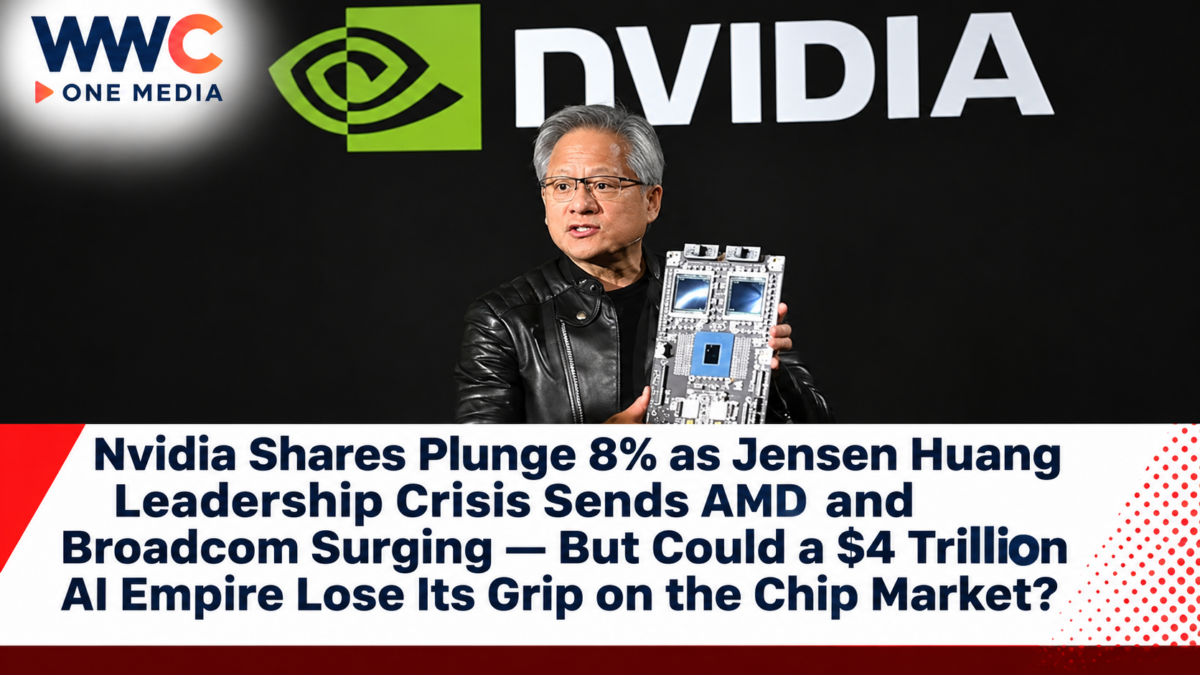
Wall Street’s artificial intelligence power struggle has taken a dramatic turn as Nvidia shares plunged more than 8% in after-hours trading while rivals Advanced Micro Devices and Broadcom surged, fueled by speculation that the world’s dominant AI chipmaker could face an unprecedented leadership transition.
Investors are increasingly questioning whether Nvidia’s competitors could benefit if uncertainty surrounding Chief Executive Jensen Huang disrupts the company’s relationships with major technology customers.
The sudden divergence follows reports that Nvidia’s board is considering whether to remove Huang, its co-founder and longtime CEO, amid an investigation involving his personal conduct and allegations concerning a woman suspected by US authorities of connections to Chinese intelligence.
According to Bloomberg’s November 12 report, the controversy is creating expectations that AMD and Broadcom could capture additional business as some customers reassess their dependence on Nvidia.
The reaction has been swift.
Nvidia dropped approximately 8% after Wednesday’s closing bell, while AMD gained around 4% and Broadcom advanced approximately 3% in extended trading.
The market movements reflect investors’ expectations of potential competitive benefits rather than evidence that major Nvidia customers have already canceled contracts or transferred orders.
Nevertheless, the developments expose an increasingly important vulnerability in the AI industry.
Has Nvidia’s extraordinary dominance become too dependent on the leadership of one man?
And if Huang’s position becomes uncertain, could rivals finally gain the opening they have spent years trying to create?
Nvidia’s Jensen Huang Crisis Sends Shockwaves Across Wall Street
Nvidia has become synonymous with the global artificial intelligence investment boom.
The company’s graphics processing units power many of the advanced computing systems used by technology giants, cloud providers and AI developers.
Its hardware, software and networking products have helped establish an enormous competitive advantage.
But the latest controversy surrounding Huang has introduced a risk investors had not previously treated as central to the company’s valuation: leadership continuity.
Reuters reported that Nvidia’s directors were meeting to consider Huang’s future following allegations involving two extramarital relationships.
One reported relationship involved Alice Huang, a Chinese businesswoman whom US intelligence authorities reportedly suspected of links to an intelligence operation.
Separate reports alleged another relationship involving a Nvidia executive.
Huang previously acknowledged infidelity, while Nvidia’s board established an independent investigation into whether its chief executive had been targeted by a foreign intelligence operation.
The company said it had no reason to believe its proprietary information or US national-security secrets had been compromised.
These distinctions are essential.
The allegations do not establish that Huang knowingly participated in espionage or that Nvidia illegally transferred sensitive technology.
Any determination of wrongdoing would require evidence produced through the relevant investigations.
However, the controversy has raised questions about corporate governance, national security and the company’s ability to maintain stability.
As previously examined by WWC ONE MEDIA in its report on Nvidia’s search for potential leadership alternatives, directors reportedly explored possible successors and interim leadership arrangements.
Those discussions underscore the importance investors are placing on Nvidia’s leadership structure.
But as of the reporting reviewed for this article, Huang’s removal had not been formally confirmed.
AMD Stock Jumps as Investors Bet on Lisa Su’s AI Chip Strategy
Advanced Micro Devices emerged as one of the clearest potential beneficiaries of the leadership uncertainty.
AMD shares rose approximately 4% in Wednesday’s extended trading.
The company, led by CEO Lisa Su, is widely regarded as one of Nvidia’s most direct competitors in the market for advanced data-center AI accelerators.
AMD’s Instinct processors are designed for demanding AI workloads, including model training and inference.
The company has also developed its ROCm software platform to help customers deploy applications across its hardware.
These investments are important because Nvidia’s competitive strength extends beyond the performance of individual processors.
Its CUDA software ecosystem, networking technology and established developer relationships make switching suppliers technically demanding.
AMD must therefore persuade customers that its products offer advantages in performance, availability, operating costs and flexibility.
The latest Nvidia controversy could provide an opportunity.
Large technology companies may seek greater supplier diversification to reduce dependence on a single chipmaker.
That could benefit AMD even if Nvidia retains the largest share of the market.
However, management uncertainty at Nvidia does not automatically translate into increased AMD orders.
Cloud operators must evaluate technical compatibility, deployment schedules, operating costs and long-term support before changing their computing infrastructure.
Investors will therefore be watching whether the stock-price gains eventually translate into stronger sales and market share.
AMD’s $17 Billion Revenue Forecast Strengthens Its Challenge to Nvidia
AMD enters the latest semiconductor turmoil with momentum of its own.
Earlier this month, the company issued a fourth-quarter revenue forecast of approximately $17 billion, exceeding Wall Street expectations.
Demand for AI processors and data-center equipment has been a major driver of its growth.
As WWC ONE MEDIA reported in its analysis of AMD’s $17 billion fourth-quarter forecast and surging data-center sales, the company has been expanding its position in a market long dominated by Nvidia.
AMD’s growing relationships with leading AI companies strengthen its competitive prospects.
In February, AMD and Meta announced a multiyear agreement involving the planned deployment of up to six gigawatts of AMD GPUs.
The arrangement includes technology from AMD’s Instinct product family and its broader data-center platform.
Separately, AMD and OpenAI announced a major computing partnership involving planned deployments of up to six gigawatts.
In July, AMD and Anthropic announced another strategic partnership involving up to two gigawatts of AMD Instinct MI450-series processors.
These agreements demonstrate that major AI developers are willing to invest in alternatives to Nvidia.
But the headline gigawatt figures represent planned multiyear deployments, not installed capacity already producing revenue.
They also do not guarantee that every anticipated purchase will proceed unchanged.
For AMD, the opportunity is substantial.
If customers accelerate efforts to diversify their AI computing infrastructure, the company could benefit from an existing pipeline of technology partnerships.
Broadcom Climbs as Wall Street Focuses on Custom AI Chips
Broadcom is another company attracting investor interest as uncertainty surrounds Nvidia.
Its shares advanced approximately 3% in extended trading.
But Broadcom’s business model differs from AMD’s.
While AMD competes more directly in general-purpose AI accelerators, Broadcom has established a major position in custom-designed processors and networking equipment.
Large cloud companies increasingly want specialized chips optimized for their own computing requirements.
These custom accelerators can be designed for particular AI workloads, potentially improving efficiency and reducing dependence on commercially available processors.
Broadcom works with major technology customers on custom semiconductor designs and supplies networking products used in large data centers.
The opportunity is increasingly important because running AI systems requires more than processors.
Advanced computing facilities also need high-speed connections between thousands of chips, memory systems and storage infrastructure.
Broadcom’s networking products help support those requirements.
If cloud companies become concerned about relying too heavily on Nvidia’s integrated computing platform, custom processors and alternative networking solutions could become more attractive.
However, Broadcom’s gains should not be interpreted as evidence that its products directly replace every Nvidia accelerator.
The companies compete in some areas while also participating in overlapping parts of the wider AI infrastructure ecosystem.
Broadcom’s AI Revenue Growth Shows Why Investors Are Excited
Broadcom’s recent financial results provide another explanation for its positive market reaction.
In its fiscal third quarter of 2026, the company reported approximately $16.7 billion in AI semiconductor revenue, representing growth of 221% year over year.
Its total quarterly revenue reached approximately $29.6 billion.
Broadcom also forecast approximately $21.7 billion in AI semiconductor revenue for its fiscal fourth quarter.
Those figures indicate strong demand for custom AI processors and networking equipment.
The company’s growth is being supported by substantial investment in data centers and advanced computing infrastructure.
For investors, Broadcom offers exposure to AI spending through a different combination of products and customers than Nvidia.
That diversification could become more appealing during periods of uncertainty surrounding Nvidia’s management.
Nevertheless, Broadcom remains exposed to the same broad industry risks.
A slowdown in data-center investment, delays in customer projects or weaker-than-expected AI profitability could affect orders.
Its growth prospects depend on sustained demand from large technology customers.
The current share-price gains therefore reflect both company-specific optimism and a changing assessment of competitive risks.
Why Nvidia’s Customers Cannot Simply Switch to AMD or Broadcom Overnight
One of the biggest questions facing investors is whether Nvidia’s leadership controversy will actually change purchasing decisions.
The answer is more complicated than the recent stock movements suggest.
Nvidia has spent years building an extensive ecosystem around its computing products.
Its CUDA software platform is widely used by AI developers and researchers.
The company also supplies high-speed networking products, complete computing systems and specialized tools that help customers deploy large AI workloads.
For many organizations, replacing Nvidia equipment would require additional engineering work.
Software might need to be modified.
Applications would need to be tested on alternative processors.
Companies could face new maintenance, training and support requirements.
These switching costs create an important competitive advantage.
Even if a customer wants to diversify, the process may take months or years depending on its infrastructure.
The more realistic opportunity for competitors may involve winning a larger share of new installations rather than immediately replacing equipment already deployed.
Major cloud providers could gradually introduce more AMD processors or develop additional Broadcom-supported custom chips.
That would increase competition without necessarily causing Nvidia’s existing business to collapse.
For Wall Street, the distinction is critical.
Short-term gains in AMD and Broadcom shares are measurable. A permanent transfer of Nvidia’s market share remains unproven.
Wall Street Analysts Grow More Cautious on Nvidia
Investor anxiety has also been reinforced by changing analyst recommendations.
Reuters reported on November 11 that investment firm Baird downgraded Nvidia to a neutral rating.
The downgrade reflected uncertainty over data-center spending in 2027, potential weakening demand and questions about Huang’s future.
Morgan Stanley separately removed Nvidia from its Top Pick list while maintaining an overweight rating.
That distinction means Morgan Stanley was no longer identifying Nvidia as a preferred stock within its coverage, but it had not necessarily turned bearish on the company.
The changes demonstrate how analyst concerns are expanding beyond Nvidia’s immediate financial results.
Investors are considering leadership continuity, industry spending trends and the possibility of tighter US technology export restrictions.
Nvidia’s exposure to China adds another layer of uncertainty.
Washington has imposed export controls on advanced semiconductors in an effort to limit access to technologies with potential military applications.
Any additional restrictions could affect Nvidia’s ability to serve certain customers.
Nevertheless, competitive risks and regulatory investigations should not be confused with established wrongdoing.
The company’s future financial performance will depend on both its technology leadership and its ability to manage these challenges.
Nvidia’s Leadership Crisis Comes as the AI Stock Market Faces Another Test
The latest turmoil follows a period of sharp volatility in technology shares.
Earlier in November, investors began reassessing the extraordinary valuations assigned to companies benefiting from the artificial intelligence boom.
Concerns included rising borrowing costs, enormous infrastructure commitments and uncertainty over how quickly AI investments would generate sustainable profits.
On November 5, the Nasdaq Composite suffered a steep decline as technology stocks sold off.
AMD and Nvidia were among the companies experiencing significant share-price losses.
As WWC ONE MEDIA examined in its report on the $3.2 trillion AI stock-market rout, investors were increasingly questioning whether the industry’s spending boom could support existing stock valuations.
But the market subsequently staged a rebound.
On November 11, CoreWeave shares surged approximately 24.7% after the AI infrastructure provider reported strong revenue growth and offered investors a more encouraging financing outlook.
The recovery helped lift other technology companies.
Nvidia itself gained approximately 2.9% during Wednesday’s regular trading session before falling sharply after hours on the latest leadership reports.
The divergence illustrates how quickly market sentiment can change.
As WWC ONE MEDIA reported in its coverage of CoreWeave’s rally and Wall Street’s AI stock recovery, demand for AI computing remains substantial despite growing concerns about the financial cost of supporting that demand.
The critical issue is whether the industry can convert its investments into consistent profits.
Nvidia’s Influence Extends Far Beyond Its Own Shareholders
Nvidia’s importance to the stock market extends well beyond investors directly holding its shares.
The company’s large market capitalization gives it significant weight in major US equity indexes.
At the end of October, Nvidia represented approximately 6.3% of the S&P 500, according to MarketWatch.
That means sharp movements in Nvidia can influence the value of index funds and retirement portfolios held by millions of Americans.
Nvidia also has substantial commercial relationships with data-center operators and technology companies.
Its processors are used throughout the AI computing industry.
A major disruption to its operations could therefore influence customers, suppliers and other companies involved in semiconductor manufacturing.
However, a declining share price does not automatically mean Nvidia’s factories, customers or business operations have been disrupted.
Stock-market valuation and operational performance are related but distinct.
The current volatility primarily reflects investors reassessing risk amid uncertainty over leadership and future strategy.
Whether the controversy develops into a broader commercial disruption remains to be seen.
What the AMD and Broadcom Rally Means for Asian Semiconductor Markets
The US semiconductor industry is deeply connected to Asian manufacturing and technology supply chains.
Taiwan plays a central role in producing advanced chips used by Nvidia, AMD and other technology companies.
South Korea supplies important memory products used in AI computing systems.
Japan contributes specialized materials and semiconductor manufacturing equipment.
Changes in demand for processors and data-center infrastructure can therefore influence businesses throughout Asia.
If more AI customers diversify their chip suppliers, manufacturers could see changes in production orders and product mixes.
However, an increase in AMD or Broadcom’s market share would not necessarily reduce total demand for advanced semiconductor manufacturing.
In some cases, a more competitive market could encourage additional investment.
The outcome will depend on how quickly the overall AI computing market expands.
For the Philippines, the developments are primarily relevant through global financial-market sentiment and the country’s exposure to electronics manufacturing and investment flows.
A sharp selloff in US technology stocks can influence investor appetite for emerging-market assets.
But the effect on individual Philippine companies depends on their specific operations and customers.
Can Lisa Su and Hock Tan Turn Nvidia’s Crisis Into a Competitive Advantage?
The recent market reaction places AMD CEO Lisa Su and Broadcom CEO Hock Tan in an unusually favorable position.
Both companies have been investing heavily in technologies designed to compete for a greater share of AI infrastructure spending.
AMD is developing processors and complete computing platforms.
Broadcom is expanding its custom accelerators and networking technology.
Their strategies offer alternatives to different parts of Nvidia’s product portfolio.
The leadership controversy could make those alternatives more appealing to customers seeking to reduce supplier concentration.
However, winning additional business requires more than a competitor’s difficulties.
AMD and Broadcom must demonstrate technical performance, reliable production, competitive pricing and long-term software support.
They must also compete with in-house chip development programs operated by major cloud companies.
The opportunity is therefore significant but not guaranteed.
Investors may be anticipating faster diversification.
Actual purchasing decisions will determine whether that expectation becomes reality.
What Happens Next? Three Critical Developments to Watch
The first major development is Nvidia’s board investigation and any official announcement concerning Huang’s future.
A confirmed leadership transition could create further uncertainty, especially if investors believe the company lacks a clearly identified successor.
Conversely, a decision providing greater leadership clarity could reduce some of the immediate anxiety.
The second development involves Nvidia’s financial results.
The company is scheduled to report earnings on November 17, giving investors an opportunity to evaluate revenue growth, demand for advanced processors and management’s outlook.
Strong results could demonstrate that Nvidia’s commercial fundamentals remain intact despite the controversy.
The third development is customer behavior.
Investors will watch whether AMD and Broadcom announce new orders, partnerships or deployments that suggest they are gaining additional business.
Those developments would provide more meaningful evidence of competitive change than short-term stock-price movements alone.
The Bigger Picture: Is Nvidia’s AI Dominance Facing Its Biggest Challenge Yet?
The latest semiconductor market turmoil illustrates how rapidly the competitive landscape can change.
Nvidia remains the dominant supplier of many advanced AI computing systems.
Its technology ecosystem, customer relationships and established products represent substantial competitive advantages.
But the leadership controversy surrounding Jensen Huang has exposed a risk that goes beyond ordinary competition.
Investors must now consider whether the company’s extraordinary success has created excessive dependence on its founder.
At the same time, AMD and Broadcom are better positioned than in previous years to challenge important parts of Nvidia’s business.
Both have established technology portfolios and relationships with major AI customers.
Their recent stock gains suggest investors see an opportunity.
But it remains too early to conclude that Nvidia’s competitive position has fundamentally weakened.
The crucial test will be whether the company’s customers begin making lasting changes to their infrastructure strategies.
Nvidia’s after-hours plunge and the simultaneous gains in AMD and Broadcom have revealed a striking shift in market expectations. Investors are beginning to price in the possibility that uncertainty at the AI industry’s dominant chipmaker could create opportunities for its rivals.
But as Jensen Huang’s future hangs over Nvidia and competitors position themselves to capture a larger share of the AI market, could the world’s most powerful chipmaker be entering a historic turning point — or will its technology advantages prove stronger than the leadership crisis threatening its $4 trillion empire?