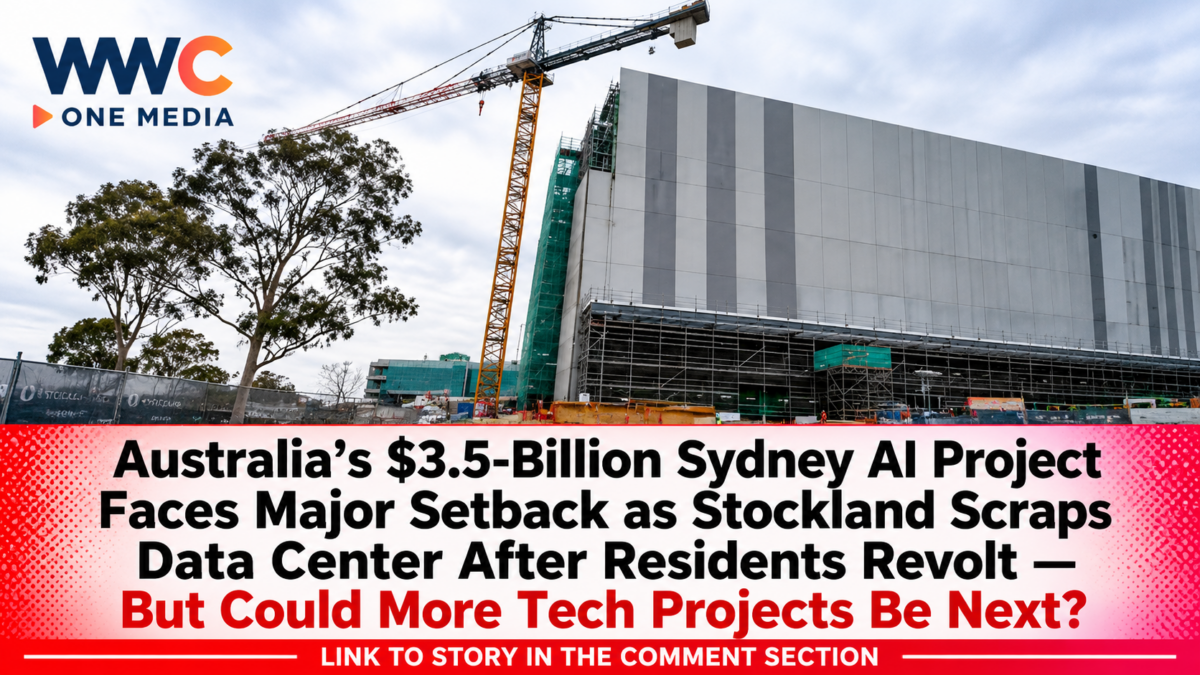
SYDNEY, AUSTRALIA — November 8, 2026 — Australia’s artificial intelligence infrastructure boom has suffered another major setback after property developer Stockland abandoned plans for a controversial four-storey AI data center in southern Sydney following fierce opposition from residents concerned about electricity consumption, water supplies and the future of the Cooks River.
The decision marks a significant victory for community campaigners who spent months fighting the proposed facility at the former Kogarah Golf Club site in Arncliffe.
According to Bloomberg, the Australian Broadcasting Corporation (ABC), The Australian and the Sydney Morning Herald, Stockland and development partner John Boyd Properties have removed the data center from their masterplan for an estimated A$3.5-billion logistics and technology precinct.
The abandoned facility would have occupied approximately 25,400 square meters within the larger 18.3-hectare redevelopment.
But while the AI data center has been removed, Stockland is continuing with plans for a major logistics hub near Sydney Airport and Port Botany.
The announcement comes as Australia faces a widening backlash against large computing facilities, with communities questioning whether the economic benefits of artificial intelligence justify their potential effects on electricity networks, water resources, local neighborhoods and ecosystems.
The bigger question is whether Stockland’s retreat represents an isolated planning decision—or another warning that Australia’s multibillion-dollar AI infrastructure expansion is colliding with growing public resistance.
Stockland Scraps Sydney AI Data Center Following Public Opposition
Stockland confirmed on November 7 that the revised masterplan for the former Kogarah Golf Club would no longer include an AI data center.
The site is located beside the Cooks River at Arncliffe, in Sydney’s south.
The developers originally proposed transforming the former golf course into a large industrial and technology precinct featuring warehouses, logistics facilities, commercial premises and a four-storey data center.
However, the proposal encountered sustained criticism from residents and environmental campaigners.
Opponents argued that the facility’s electricity and water requirements could place excessive pressure on local resources.
They also questioned potential noise impacts and the risks of constructing large industrial buildings near environmentally sensitive sections of the river.
Stockland maintained that its revised plans reflect the property’s suitability for logistics and industrial development.
A company spokesperson told Australian media that the developers were concentrating on a high-quality logistics precinct without a data center.
The company highlighted the site’s proximity to Sydney Airport, Port Botany and major transport connections.
Importantly, Stockland has not announced that the entire redevelopment is being abandoned.
Instead, the developers are changing the proposed land uses while retaining the broader logistics project.
Residents Celebrate a Major Victory Against AI Development
The decision was welcomed by the community campaign Stop the Cooks River AI Project, known as SCRAP.
The organization formed to oppose the proposed data center and attracted hundreds of supporters concerned about its potential environmental and social consequences.
Campaign organizer Paddy Gibson described the cancellation as an important victory for community pressure.
Residents had argued that the Cooks River corridor should be protected from development that could place additional stress on its recovering ecosystem.
The river, also known as Goolay’yari in local Indigenous languages, has experienced a long history of industrial pollution.
Environmental restoration initiatives have sought to improve its condition and protect remaining natural habitats.
Campaigners feared that a large computing facility could complicate those efforts.
Their concerns included water consumption, possible contamination, noise and the effects of intensive industrial activity on local wildlife.
Bayside Greens councillor Peter Strong also welcomed Stockland’s decision.
Strong had opposed the development and argued that local councils should have greater influence over whether major data centers can be constructed in their communities.
Campaigners say the decision demonstrates that organized opposition can influence the plans of major property developers.
However, their wider campaign is not over.
SCRAP has indicated that it will continue scrutinizing the proposed logistics development and advocating restrictions on additional AI data centers.
Why the Cooks River Became Central to the Controversy
The proposed development site lies within an area of considerable environmental and community significance.
The former Kogarah Golf Club property includes green space near the Cooks River, which has become a focus of rehabilitation and ecological protection.
Residents say portions of the former golf-course landscape have provided habitat for wildlife since golf activities ended.
Campaigners raised concerns that extensive construction and industrial activity could affect that environment.
Their objections were not limited to the data center’s physical buildings.
The facility would also have required supporting electricity, cooling and other infrastructure.
Depending on their design, large data centers can require substantial amounts of power and water.
Cooling systems can use different technologies, meaning actual water consumption varies significantly between facilities.
Likewise, electricity demand depends on computing capacity, hardware, efficiency and operating conditions.
The concerns raised by residents were therefore legitimate planning questions, but they should not be mistaken for independently verified measurements of the cancelled facility’s eventual environmental impact.
Stockland’s withdrawal means the proposed data center will not proceed under the revised masterplan.
The environmental effects of the remaining logistics development will still require assessment through the relevant planning processes.
Stockland’s A$3.5-Billion Logistics Precinct Will Continue
Despite cancelling the data center, Stockland remains committed to developing the wider property.
The proposed precinct is valued at approximately A$3.5 billion and covers around 18.3 hectares.
Stockland and John Boyd Properties intend to pursue industrial and logistics facilities suited to the site’s strategic location.
Sydney Airport and Port Botany provide access to major passenger, freight and supply-chain networks.
That makes the location commercially attractive for warehousing, distribution and related services.
According to Australian reporting, the revised development is expected to include approximately 290,000 square meters of industrial space, subject to the final plans and approvals.
The project may also incorporate complementary retail and hospitality uses.
Stockland has identified several planned community improvements, including a one-kilometer public foreshore connection along the Cooks River.
The wider plans also include future delivery of the 14-hectare Pemulwuy Park, local road upgrades and improved pedestrian and cycling connections.
These elements remain proposals and should not be presented as completed amenities.
The revised project will continue through the necessary planning and consultation processes.
The commercial significance is clear.
Stockland is abandoning the AI data center component, not walking away from the broader redevelopment opportunity.
Another Sydney Data Center Project Was Already Cancelled
The Stockland decision follows similar controversies elsewhere in Sydney.
In September, Goodman Group abandoned plans for a large data center known as Project Mars in Lane Cove.
That proposal involved an approximately A$1.2-billion facility with planned electrical capacity of 90 megawatts.
The project would have been located around 20 meters from nearby homes.
Residents opposed the development over potential noise, environmental effects and the proximity of industrial computing infrastructure to established residential neighborhoods.
Reuters reported on September 28 that Goodman withdrew its development application after considering changing government policies and community feedback.
The company acknowledged that the regulatory environment for data center development had evolved significantly since the project was first proposed.
The Lane Cove cancellation became an important example of how public opposition can affect the commercial viability of major AI infrastructure projects.
Other Sydney proposals have also encountered criticism, including developments in Guildford and Merrylands.
However, the different proposals involve separate developers, locations and regulatory circumstances.
They should not be combined into a single cancelled project or treated as evidence that all Australian data center development has stopped.
The emerging pattern is more specific: projects in sensitive or densely populated locations are facing increasingly difficult planning and community-acceptance challenges.
Australia’s AI Backlash Is Part of a Global Movement
The controversy is not unique to Sydney.
Large data centers are facing growing opposition in several countries as governments and businesses accelerate investment in artificial intelligence.
The facilities can deliver construction activity, tax revenue, digital infrastructure and specialized employment.
But their physical impacts are concentrated in the communities where they are built.
Local residents may experience additional construction traffic, industrial noise, changes in land use and pressure on electricity and water systems.
This creates an economic tension.
The benefits of AI computing can reach customers worldwide, while many infrastructure costs and environmental concerns arise locally.
As WWC ONE MEDIA previously reported, resistance to large data centers has spread across Europe, Asia and Africa.
Related WWC ONE MEDIA coverage: AI Data Center Backlash Is Spreading Across Europe, Asia and Africa — But Billions in Investment Are Already at Risk
The report examined how permitting disputes and community concerns can delay projects even when investors remain enthusiastic about artificial intelligence.
However, the financial value of projects facing opposition should not automatically be interpreted as investment permanently lost.
Some developments may be redesigned, relocated or delayed rather than cancelled outright.
New South Wales Faces Pressure to Strengthen Data Center Rules
Stockland’s withdrawal also comes amid an important policy debate in New South Wales.
The state government has been developing a framework intended to support data center investment while protecting residents and infrastructure.
In August, the government introduced a data center policy framework addressing issues such as energy supply, water use and project assessment.
But a parliamentary inquiry has questioned whether existing planning processes adequately consider the combined effects of multiple large facilities.
Reuters reported on November 5 that the inquiry identified shortcomings in evaluating cumulative electricity and water demand.
The committee called for a more comprehensive state strategy and stronger coordination between planning authorities.
However, it stopped short of recommending a blanket moratorium on new data center approvals.
The decision is significant because some environmental and community advocates have called for temporary restrictions until the long-term effects of rapid expansion are better understood.
The New South Wales government has until February 2027 to respond to the inquiry’s recommendations.
For developers, the outcome could influence future investment decisions.
Clearer rules may improve regulatory certainty.
But additional requirements could also increase costs or lengthen approval timelines for projects that cannot demonstrate adequate infrastructure and community safeguards.
Electricity and Water Are Becoming Critical AI Investment Risks
Artificial intelligence requires far more than advanced software.
Large-scale AI systems depend on powerful processors operating inside specialized data centers.
Those systems require electricity for computing equipment, networking infrastructure and cooling.
As companies install more advanced hardware, the power demands of some facilities can become substantial.
In regions where electricity networks are already constrained, new data centers may require expensive infrastructure upgrades.
That raises difficult questions about who should pay for additional substations, transmission lines and generating capacity.
Households may oppose developments if they believe industrial electricity demand could increase residential utility bills.
But the actual financial impact depends on local electricity regulation and the agreements between developers and utilities.
Not every data center automatically increases nearby electricity prices.
As WWC ONE MEDIA previously examined, these concerns have already become major political issues in the United States.
Related WWC ONE MEDIA coverage: AI Data Centers Are Setting Off Alarms in Washington — And Now Congress Is Moving on the Power Bill
Water consumption presents another challenge.
Some facilities use water-intensive cooling systems, while others rely on closed-loop or alternative technologies intended to reduce consumption.
Environmental assessments therefore need to examine the actual design of individual projects rather than assume every facility has identical resource requirements.
For developers, demonstrating responsible electricity and water management is becoming essential to obtaining community support.
Stockland Is Not Abandoning Australia’s Data Center Industry
The Sydney cancellation should not be interpreted as Stockland withdrawing from data centers entirely.
The company continues to explore other opportunities in Australia’s rapidly expanding digital infrastructure sector.
Stockland’s website identifies a separate proposed data center at Aldington Road in Kemps Creek, in Western Sydney.
That project is undergoing planning and community engagement processes.
A development application and environmental impact assessment are expected to form part of the approval process.
Stockland has indicated that a determination could occur in 2027.
This demonstrates the difference between withdrawing an individual project and abandoning an entire investment strategy.
A developer may conclude that one location is unsuitable while continuing to pursue opportunities elsewhere.
The investment outlook depends on factors such as electricity availability, land use, financing, infrastructure connections and community acceptance.
The Cooks River decision may encourage developers to pay closer attention to those factors before committing substantial capital.
Australia’s Data Center Investors Face Growing Uncertainty
The backlash is unfolding during a period of heightened financial scrutiny of the artificial intelligence industry.
Companies and investment funds are committing enormous amounts of money to computing infrastructure.
But the commercial returns depend on demand, construction costs, energy availability and successful project completion.
Delays can increase financing expenses and postpone revenue.
Environmental objections and regulatory uncertainty therefore represent financial risks as well as political challenges.
Australia’s listed data center companies have already experienced significant market volatility.
As WWC ONE MEDIA recently reported, shares in NEXTDC surged following major investments by Goodman Group and Digital Realty, highlighting continuing investor interest in Australian digital infrastructure.
Related WWC ONE MEDIA coverage: NEXTDC Shares Rocket 46% as Goodman and Digital Realty Launch A$715 Million Stake Raid — But Could a Full Takeover Be Next?
The contrast is revealing.
Investors may remain enthusiastic about data centers while individual projects face significant obstacles.
Strong stock-market performance does not guarantee that every proposed development will receive approval.
Likewise, the cancellation of one facility does not prove that the broader AI investment market is collapsing.
Why Community Opposition Could Reshape the AI Industry
A growing number of communities are demanding a greater role in decisions about large computing facilities.
Their concerns often center on transparency.
Residents want to know how much electricity and water projects will consume, what environmental safeguards will be required and whether local infrastructure can support development.
They also want clearer information about jobs, tax revenue and the potential costs of hosting industrial facilities.
Developers traditionally emphasized the economic benefits of construction and technology investment.
But those arguments may no longer be sufficient.
The importance of community support is becoming particularly evident in countries where AI data center development has become politically contentious.
As WWC ONE MEDIA reported following the November 3 US elections, local restrictions on data center construction received strong support in numerous American communities.
Related WWC ONE MEDIA coverage: America Rejects AI Data Centers in 46 of 47 Local Votes as Big Tech Faces a Massive Backlash — But Could the Trillion-Dollar AI Boom Be in Danger?
Those voting results reflect specific local measures rather than a universal rejection of artificial intelligence.
Nevertheless, they show how difficult it can become to secure approval for large infrastructure developments without public confidence.
For Australian developers, the message is increasingly relevant.
Projects may need to demonstrate measurable community benefits, credible environmental protections and a clear strategy for managing infrastructure demands.
What the Stockland Decision Means for the Philippines
The controversy offers important lessons for the Philippines, which is seeking to expand investment in digital infrastructure, cloud computing and artificial intelligence.
The country’s ability to attract major data center projects depends on several factors.
These include reliable electricity, competitive energy prices, telecommunications connectivity, suitable land and clear regulatory procedures.
However, large infrastructure projects must also address the interests of surrounding communities.
Developers need to assess whether electricity and water resources can accommodate additional industrial demand.
They must also consider environmental effects, construction impacts and potential changes in land use.
The Stockland decision demonstrates why engagement with local residents can be important before projects reach advanced planning stages.
For Philippine policymakers, the challenge is to encourage investment without allowing poorly planned developments to create avoidable pressure on communities and public infrastructure.
The country also has opportunities to explore data centers linked to renewable-energy sources.
But such projects must still demonstrate commercial viability and adequate environmental protection.
There is no evidence that Stockland’s cancelled Sydney proposal has directly affected any existing Philippine data center project.
Its significance lies in the broader lessons for governments seeking to participate in the AI infrastructure boom.
What Happens Next for Stockland’s Sydney Development?
Stockland and John Boyd Properties will continue developing the revised masterplan for the former Kogarah Golf Club site.
The data center has been removed.
The remaining project will focus on logistics, industrial facilities and potential complementary commercial uses.
The developers have also identified plans for public foreshore access, green space and transportation improvements.
However, the revised development will still need to proceed through applicable planning and assessment processes.
Community campaigners have indicated that they will continue monitoring the project.
That means withdrawing the data center may reduce one major source of opposition without resolving every disagreement about the property’s future.
For Stockland, the next challenge will be demonstrating that the revised development can deliver economic benefits while addressing environmental and community expectations.
For residents, the priority will be ensuring that promises involving river protection, public access and environmental safeguards are reflected in the project’s final design.
The Bigger Picture: Is Australia’s AI Expansion Facing a Turning Point?
Stockland’s decision to abandon its proposed AI data center beside the Cooks River demonstrates the growing influence of community opposition on infrastructure investment.
A major property developer has removed a four-storey computing facility from an ambitious A$3.5-billion redevelopment.
Residents are celebrating a significant victory.
Environmental advocates say the decision reflects growing concern about the demands that AI infrastructure places on electricity, water and land.
But the wider logistics project remains alive, and Stockland continues exploring data center opportunities elsewhere.
That distinction is important.
Australia has not abandoned artificial intelligence infrastructure.
Investors are still interested in the industry, and demand for cloud and computing services continues.
What appears to be changing is the willingness of communities to accept large facilities without stronger safeguards.
Developers may increasingly need to prove that the benefits of AI investment outweigh the local costs.
Governments, meanwhile, face pressure to introduce planning rules that address resource use, environmental protection and public consultation without unnecessarily discouraging economic growth.
The cancellation of Stockland’s Sydney data center is not proof that Australia’s AI boom is ending.
But it is another sign that technological ambition alone may no longer be enough to secure approval for multibillion-dollar infrastructure projects.
And as communities across Australia question whether enormous AI data centers belong near homes, waterways and sensitive ecosystems, one question now looms over the industry:
Could Stockland’s retreat become the beginning of a wider wave of project cancellations—or will developers find a way to win back public trust before Australia’s AI ambitions face even greater resistance?