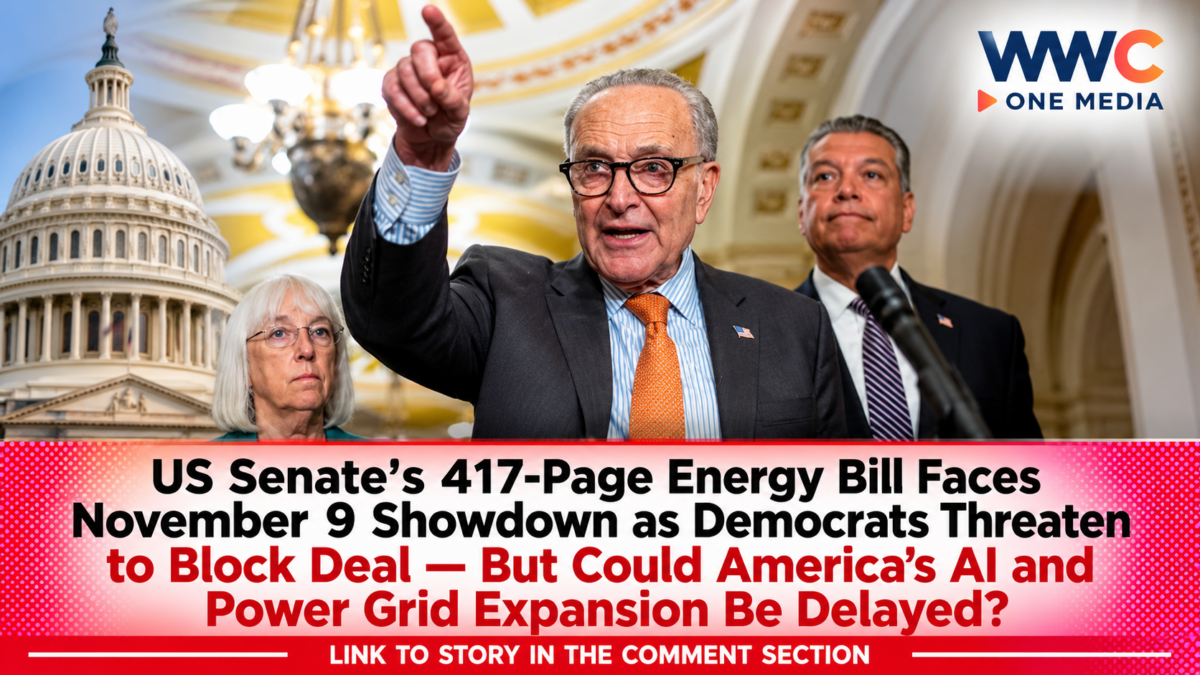
WASHINGTON, D.C. — November 8, 2026 — A landmark bipartisan effort to accelerate America’s energy infrastructure is facing a major political showdown after Democrats’ sweeping midterm election victories threatened to derail a long-negotiated agreement covering power grids, oil and gas pipelines, renewable energy facilities and artificial intelligence data centers.
The proposed Bipartisan American Affordability and Jobs Act of 2026, developed through months of negotiations between Republican and Democratic senators, is scheduled to face its first procedural vote on Monday, November 9.
According to Bloomberg’s November 7 report, lawmakers are racing to preserve a compromise that could dramatically change how the federal government approves major infrastructure projects.
But the political landscape has shifted.
Democrats won control of both chambers of Congress in the November 3 elections, giving party leaders a stronger negotiating position when the new Congress convenes in January 2027.
That victory has encouraged some Democrats to demand tougher environmental safeguards and greater involvement in drafting the legislation rather than accepting the current Senate agreement.
House Democratic leader Hakeem Jeffries has opposed the proposal in its current form, while environmental organizations and Native American tribal representatives have raised concerns about weakening environmental protections and public participation.
Supporters warn that delaying the measure could prolong infrastructure bottlenecks, slow renewable-energy deployment and make it harder to satisfy America’s rapidly growing electricity demand.
The question now is whether Washington can secure one of its most significant energy compromises in years—or whether political divisions will leave America’s power grid, energy developers and AI industry waiting even longer for reform.
US Senate Prepares for Major November 9 Energy Vote
The legislation represents one of Washington’s most ambitious attempts to overhaul the federal energy permitting system in more than a decade.
The original bipartisan proposal runs 417 pages and would modify several important federal laws governing energy development and environmental reviews.
Its central objective is to make it easier to construct major infrastructure projects without requiring developers to navigate years of overlapping approvals, regulatory uncertainty and lengthy litigation.
Projects potentially affected include electricity transmission lines, natural gas pipelines, solar farms, wind installations, mines and infrastructure supporting large data centers.
The legislation was negotiated by four senators representing both parties.
Republicans Shelley Moore Capito of West Virginia and Mike Lee of Utah worked with Democrats Sheldon Whitehouse of Rhode Island and Martin Heinrich of New Mexico.
The negotiations culminated in an agreement unveiled on September 30.
Supporters argue that the legislation could improve electricity reliability, unlock private investment and help lower energy costs by making essential infrastructure easier to build.
But the planned November 9 vote is only an initial procedural step.
It is not a final vote to make the measure law.
The proposal would still need to overcome Senate procedural hurdles, secure approval in both congressional chambers and receive the president’s signature.
Its future remains uncertain.
Democrats’ Midterm Victory Changes Everything
The biggest obstacle may not be the technical details of the legislation.
It may be the political consequences of the November 3 elections.
Democrats secured majorities in both the House and Senate, transforming the balance of power in Washington for the next congressional session.
Before the election, Republican control of Congress gave Democrats an incentive to negotiate with GOP lawmakers over energy permitting.
The midterm victory has changed that calculation.
Some Democrats now believe they can obtain stronger environmental safeguards and fewer concessions to fossil-fuel companies by reopening negotiations next year.
The result is a growing disagreement within the party itself.
Senate Democrats who helped negotiate the bill want to proceed immediately.
Other Democrats, particularly in the House, argue that the newly empowered party should not rush to approve a proposal they believe could be improved.
As previously reported by WWC ONE MEDIA, Democrats’ congressional victory has created major new challenges for President Donald Trump’s legislative agenda.
Related WWC ONE MEDIA coverage: Democrats Seize Control of US Congress in Historic Midterm Upset as Trump Accepts Defeat — Two Years of Political Showdown Loom
The energy permitting dispute is emerging as one of the first major tests of whether the two parties can still cooperate before the new Congress begins.
Hakeem Jeffries Pushes Back Against the Senate Agreement
House Democratic leader Hakeem Jeffries has become a central figure in the growing controversy.
According to Bloomberg, Jeffries opposes the legislation in its current form because he believes House Democrats have not been sufficiently involved in shaping it.
His position creates an important obstacle even if the bill advances through the Senate.
The House must still approve identical legislative language before a measure can be sent to the president.
Jeffries has signaled that House Democrats should not be expected to approve a deal negotiated primarily by senators without adequate consultation.
California Representative Jared Huffman has also argued that Democrats should wait until next year and use their incoming congressional power to obtain a stronger agreement.
Progressive lawmakers are particularly concerned about provisions that could accelerate fossil-fuel infrastructure development.
Their objections reflect a broader debate over whether permitting reform should prioritize faster construction above existing environmental and community safeguards.
However, the divisions are not simply between Republicans and Democrats.
Some Democrats believe the current compromise represents an unusually valuable opportunity to advance clean-energy projects.
Others believe the party should demand more.
This internal disagreement could determine whether the bill survives.
Senator Sheldon Whitehouse Warns America Cannot Keep Waiting
Rhode Island Senator Sheldon Whitehouse, one of the proposal’s principal Democratic negotiators, has strongly defended the agreement.
Whitehouse argues that years of negotiations were required to reach a compromise capable of attracting Republican and Democratic support.
He believes delaying the legislation could jeopardize urgently needed improvements to electricity transmission and renewable-energy development.
His home state is also connected to major offshore wind projects, making federal permitting policy particularly relevant to its energy future.
Whitehouse and fellow Democratic negotiator Martin Heinrich have emphasized that the current bill represents an opportunity to modernize energy infrastructure while addressing persistent regulatory delays.
Heinrich has argued that transferring control of Congress to Democrats will not automatically make bipartisan reform easier.
Their position is that energy developers cannot afford another prolonged period of political uncertainty.
The senators have also attempted to address criticism by revising the legislation.
On November 7, the bill’s authors released an amendment intended to strengthen protections against political interference with approved projects and revise provisions related to tribal consultation.
The changes demonstrate that negotiations remain active.
But they do not guarantee that House Democrats, environmental groups or other opponents will support the revised proposal.
What the 417-Page Energy Bill Would Change
The legislation targets several areas that developers and utilities identify as major obstacles to constructing energy infrastructure.
Faster environmental reviews
The proposal would establish deadlines and modify review procedures under the National Environmental Policy Act.
Supporters argue that federal agencies frequently conduct overlapping reviews, increasing costs and delaying projects.
Critics warn that tighter deadlines could prevent agencies from properly assessing environmental consequences.
Electricity transmission expansion
The bill includes provisions designed to accelerate construction of high-voltage power lines.
Transmission networks are essential for connecting electricity generation facilities to cities, factories and industrial consumers.
Better transmission infrastructure could also allow more renewable electricity to reach consumers.
Pipeline and energy development
The legislation would modify certain permitting requirements affecting natural gas pipelines and other major energy facilities.
Oil and gas companies argue that clearer approval procedures could improve energy supply and reduce development uncertainty.
Environmental groups warn that accelerating fossil-fuel infrastructure could lock in additional emissions and environmental damage.
Stronger protection for approved projects
The proposal would create additional safeguards intended to prevent already-approved energy projects from being arbitrarily blocked or delayed by future administrative decisions.
This provision has attracted interest from renewable-energy developers concerned about policy reversals.
Data center electricity costs
The legislation also includes measures addressing how large electricity consumers, including AI data centers, contribute to the transmission infrastructure needed to support their operations.
The aim is to reduce the risk that households and smaller businesses are required to pay for costs created primarily by major industrial users.
These provisions are significant, but the precise requirements could change during congressional negotiations.
America’s AI Boom Is Running Into a Power Grid Crisis
One of the most important economic implications of the bill involves artificial intelligence.
Technology companies are investing heavily in new data centers to support increasingly sophisticated AI systems.
But these facilities require enormous quantities of electricity.
Many projects also need expensive substations, transmission upgrades and additional generating capacity before they can operate.
In some regions, securing power connections has become a major obstacle to construction.
The proposed permitting reforms aim to accelerate portions of the infrastructure development process.
For AI companies, faster approval of transmission lines and electricity facilities could make it easier to bring new computing capacity online.
But that creates another question.
Who should pay for the infrastructure required to support enormous AI data centers?
Households and smaller businesses are increasingly concerned that electricity utilities could pass additional network costs on to ordinary customers.
As WWC ONE MEDIA previously reported, Washington has already been confronting the financial consequences of rising electricity demand associated with AI.
Related WWC ONE MEDIA coverage: AI Data Centers Are Setting Off Alarms in Washington — And Now Congress Is Moving on the Power Bill
The debate illustrates why energy permitting reform has become an economic issue as well as an environmental one.
Without adequate grid infrastructure, investment in AI chips and computing equipment cannot automatically translate into operational data centers.
Tech Companies Could Face Higher Costs Without Energy Reform
Power availability is becoming increasingly important to the economics of artificial intelligence.
Data center operators must secure not only land and computing hardware but also dependable electricity and sufficient network capacity.
If transmission upgrades take years, new facilities may be delayed even after investors have committed substantial capital.
Those delays can reduce financial returns and increase project development costs.
However, faster permitting alone cannot resolve every problem.
Developers may still face equipment shortages, construction constraints, local opposition, water-resource limitations and insufficient electricity generation.
WWC ONE MEDIA previously examined these challenges through comments from Nokia Chief Executive Officer Justin Hotard, who argued that AI infrastructure could expand more quickly if computing components and electricity were more readily available.
Related WWC ONE MEDIA coverage: Nokia Says AI Data Centers Could Be Built Twice as Fast — But Power and Memory Are Becoming the Real Bottleneck
The significance of the Senate proposal therefore extends beyond the energy sector.
It could influence America’s ability to expand domestic AI infrastructure and compete in an increasingly technology-dependent global economy.
Environmental Groups Warn the Bill Could Weaken Public Protections
While supporters describe the proposal as necessary modernization, opponents argue that it risks reducing oversight of environmentally damaging projects.
The Sierra Club has criticized the legislation, warning that it could weaken protections covering water resources, wildlife, public health and community participation.
The organization is particularly concerned about expanded executive authority and changes to existing environmental laws.
Native American tribal representatives have also raised concerns over potential consequences for tribal sovereignty and consultation requirements.
Energy and infrastructure projects can affect tribal lands, cultural resources and sites of historical significance.
Federal consultation procedures therefore play an important role in protecting legally recognized tribal interests.
Opponents fear that faster approval timelines could leave affected communities with fewer opportunities to challenge harmful developments.
The revised amendment released November 7 attempts to address some of the concerns.
But environmental organizations have not universally endorsed the changes.
The dispute illustrates a fundamental policy tradeoff.
Faster construction can help address infrastructure shortages.
But reducing approval requirements may also increase the risk of projects proceeding without adequate environmental review.
The challenge for lawmakers is finding a process that is both efficient and accountable.
Oil and Gas Companies Join Renewable-Energy Industry in Supporting Reform
One unusual feature of the proposal is its broad industry support.
Organizations representing both fossil-fuel producers and renewable-energy developers have backed the general effort to streamline approvals.
The American Petroleum Institute has expressed support for reforming the existing system.
The American Clean Power Association has highlighted provisions designed to make it easier to build high-voltage transmission lines.
Their interests are not identical.
Oil and gas companies want more predictable approval processes for pipelines and conventional energy infrastructure.
Renewable-energy developers want faster access to transmission networks and greater certainty for wind, solar and storage projects.
But both industries face financial consequences when permits take longer than expected.
The current proposal attempts to address those shared concerns.
That bipartisan and cross-industry appeal is one reason its Senate sponsors believe a compromise is possible.
However, support from both industries does not establish that every provision benefits the public equally.
Each project must still be evaluated on its economic, environmental and community impacts.
Analysts Slash Chances of the Bill Passing This Year
The Democratic election victory has substantially weakened expectations that Congress will approve the deal before the end of 2026.
Investment research firm TD Cowen lowered its estimated probability of passage during the lame-duck session from 40% to 25% following the election.
Other analysts have also become more cautious.
Rapidan Energy Group reduced its estimate to approximately 20%–25%.
These forecasts reflect the increased bargaining power of Democrats and the possibility that lawmakers will postpone negotiations until the new Congress convenes.
However, these percentages are analyst judgments, not official congressional forecasts.
They do not establish that the legislation will fail.
The first procedural vote could still demonstrate that a substantial bipartisan coalition supports moving forward.
But even a successful procedural vote would leave important legislative hurdles.
The revised bill would still need to secure enough support in both chambers and reach President Trump’s desk before the current Congress adjourns.
Can Trump Secure an Energy Deal Before Democrats Take Control?
The Trump administration has made faster energy permitting a major priority.
The White House argues that reducing regulatory delays could encourage investment, strengthen energy security and support infrastructure development.
The administration has expressed support for the bipartisan Senate compromise.
But the midterm elections have weakened the president’s position in congressional negotiations.
Democrats now know they will control both chambers beginning in January.
Some therefore see little reason to accept a compromise they believe could be improved after the transition.
Others worry that waiting may create an even more difficult political environment.
Trump will remain president after January 2027 and will retain the authority to veto legislation.
Most major Senate legislation will also continue to require bipartisan cooperation to overcome procedural obstacles.
As previously examined by WWC ONE MEDIA, congressional Republicans have a narrow remaining window to advance their legislative agenda before the transfer of power.
Related WWC ONE MEDIA coverage: Trump’s Republicans Have Just 57 Days to Push Through Final Agenda After Democrats Seize Congress — But Could a Last-Minute Power Play Change America’s Future?
The permitting bill has consequently become an early test of whether the two parties can cooperate despite the election outcome.
Could the Legislation Lower Americans’ Electricity Bills?
Supporters argue that faster electricity infrastructure development could help reduce long-term energy costs.
When regions lack sufficient transmission capacity, electricity from lower-cost generating sources may not reach consumers efficiently.
Network congestion can increase operating costs and reduce the effectiveness of available generation.
Additional transmission lines could improve reliability and allow greater competition among electricity suppliers.
The proposed legislation also seeks to address cost allocation for large electricity users.
But the size of any household savings remains uncertain.
A Rhodium Group analysis cited in public discussions of the bill estimated potential average household electricity-bill savings of approximately $50 to $78 annually by 2040.
Those figures are modeled long-term outcomes rather than guaranteed savings or immediate reductions in bills.
Actual results would depend on which projects are constructed, financing costs, regional electricity markets and how utilities allocate expenses.
The legislation would also not automatically reduce fuel prices, eliminate inflation or prevent every future electricity-rate increase.
For American families, the central concern is whether policymakers can expand infrastructure without transferring unfair costs to households.
What the US Energy Showdown Means for the Philippines and Asia
Although the bill is focused on American infrastructure, the debate carries lessons for economies across Asia.
Countries including the Philippines are working to expand electricity generation, strengthen transmission networks and attract investments in renewable energy and digital infrastructure.
Many face similar challenges involving permitting delays, financing, land access and community consultation.
For the Philippines, power-grid reliability and electricity costs remain major considerations for industrial development.
Improving infrastructure could support economic competitiveness, particularly as technology companies increasingly consider electricity availability when selecting data center locations.
However, the US legislation would not directly change Philippine permitting laws or electricity regulations.
Its international relevance lies in how major economies balance infrastructure development with environmental safeguards and consumer protection.
The American debate also highlights the importance of predictable rules for investors.
Projects can become more expensive when regulatory requirements are unclear or approvals are repeatedly delayed.
At the same time, public trust can weaken if governments accelerate development without adequate community involvement.
A sustainable energy transition requires addressing both concerns.
What Happens Next: November 9 Could Determine the Bill’s Momentum
The legislation’s immediate future depends on the Senate’s planned procedural vote on Monday, November 9.
If senators agree to advance the proposal, negotiations could continue over amendments and final legislative language.
However, the bill would still face opposition from some House Democrats, progressive lawmakers, environmental organizations and tribal representatives.
Its sponsors may need additional revisions to build sufficient political support.
If the measure fails to advance, lawmakers could attempt to reopen negotiations.
They could also delay action until the new Congress begins in January 2027.
Neither outcome has been confirmed.
The next several weeks will be important because the current Congress has limited legislative time remaining.
The fundamental question is whether lawmakers believe a negotiated compromise today is preferable to the uncertainty of starting again next year.
The Bigger Picture: Will Washington’s Energy Battle Slow America’s AI and Clean-Power Ambitions?
The Senate’s energy permitting showdown exposes a growing contradiction in America’s infrastructure strategy.
Political leaders from both parties want more reliable electricity, stronger power grids and greater investment in advanced technologies.
Renewable-energy developers want faster construction.
Oil and gas companies want predictable approvals.
Technology companies need dependable electricity to power rapidly expanding AI data centers.
And American households want affordable utility bills.
Yet the process for approving major infrastructure remains politically contentious.
The bipartisan proposal attempts to address that challenge by reducing delays and establishing new rules for energy development.
But its compromises have divided lawmakers, environmental organizations and community representatives.
The Democratic midterm victory has made the political calculation even more complicated.
Some lawmakers believe the current agreement should be passed immediately.
Others argue that the incoming Congress could negotiate a better package.
Both approaches carry risks.
Passing an inadequate bill could weaken important protections.
Waiting for a better deal could prolong uncertainty and delay infrastructure that may be needed for future economic growth.
The November 9 vote will provide the first major indication of whether the bipartisan agreement can survive the changed political landscape.
But as America faces growing electricity demand from artificial intelligence, aging power infrastructure and pressure to accelerate cleaner energy development, one question now hangs over Washington:
Will Congress finally break its decade-long deadlock over energy permitting—or could another political showdown leave billions of dollars in potential infrastructure investment waiting for approval?