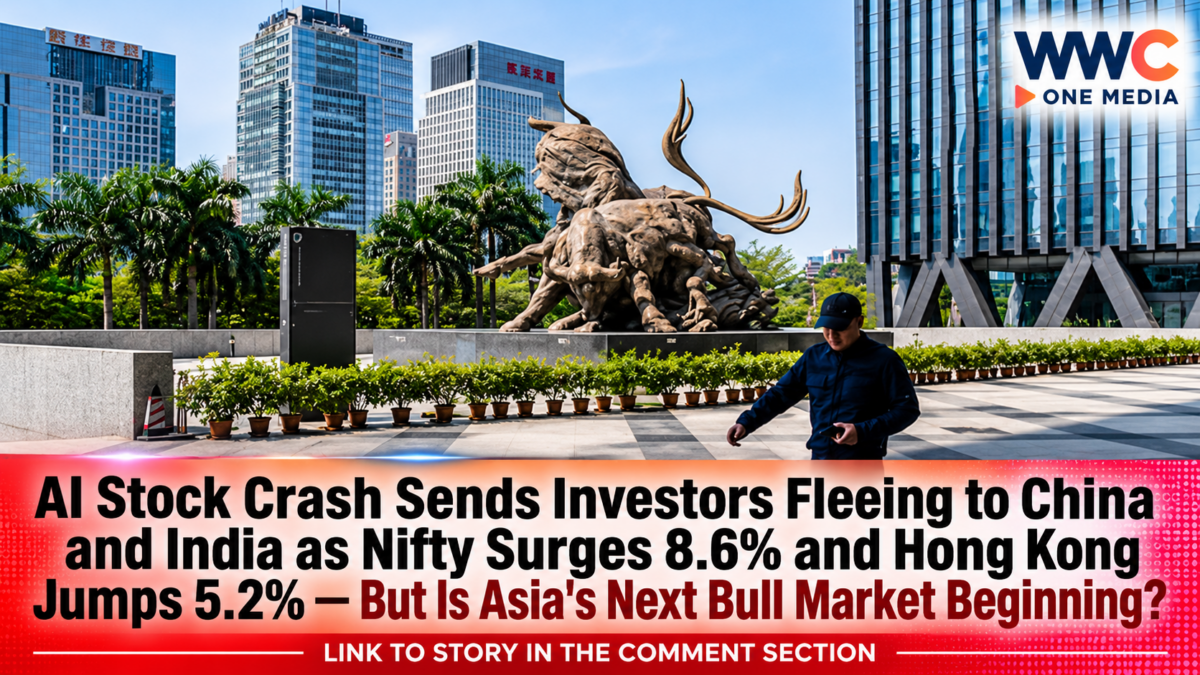
SINGAPORE / MUMBAI / HONG KONG — November 8, 2026 — The artificial intelligence investment boom that helped drive some of Asia’s biggest stock markets to extraordinary heights is suddenly facing a major reversal, and global investors are beginning to look for their next opportunities in two markets that had previously fallen out of favor: China and India.
A sharp selloff in AI-related companies following the November 3 US midterm elections has triggered a dramatic shift in investor sentiment, sending money managers searching for stocks that are less dependent on the increasingly expensive global race to build artificial intelligence infrastructure.
The consequences are already visible.
India’s benchmark Nifty 50 surged 8.6% during the week ending November 6, recording its strongest weekly performance since February 2021.
Meanwhile, a Hong Kong index tracking mainland Chinese companies jumped 5.2%, its best weekly gain since March 2025.
The gains contrast sharply with the turmoil affecting semiconductor-heavy markets in South Korea, Taiwan and Japan.
According to Bloomberg’s November 8 report, international fund managers are rediscovering opportunities in Chinese equities, Indian financial companies, healthcare businesses, consumer brands and other sectors previously overshadowed by the global AI investment frenzy.
But the dramatic market reversal raises an important question.
Is this the beginning of a sustainable shift away from expensive AI stocks, or are investors simply searching for temporary shelter before another wave of market volatility?
Wall Street’s AI Selloff Forces Investors to Rethink Asia
The shift in Asian investment strategies follows a brutal technology-stock decline on Wall Street.
On November 5, the Nasdaq Composite plunged approximately 5.5%, while the S&P 500 dropped 4.4%.
The selling accelerated after the Democratic Party’s victory in the US midterm elections raised expectations of tighter oversight of artificial intelligence companies and energy-intensive data center developments.
Investors also questioned whether technology companies could generate sufficient financial returns from the enormous amounts being invested in AI chips, computing infrastructure and electricity networks.
The concern is no longer limited to whether artificial intelligence will transform the global economy.
It is increasingly about whether the companies financing that transformation can justify their market valuations.
For months, investors had concentrated heavily on businesses connected to AI infrastructure, including semiconductor manufacturers, memory-chip suppliers and equipment producers.
That strategy left many portfolios vulnerable when confidence weakened.
As previously examined by WWC ONE MEDIA, the selloff erased an estimated US$3.2 trillion in American equity-market value during the November 5 rout.
Related WWC ONE MEDIA report: Wall Street’s $3.2-Trillion AI Selloff Sparks Crash Fears as Nasdaq Plunges 5.5% — But Could a 30% Market Collapse Be Coming Next?
The estimated decline in market capitalization does not mean that an equivalent amount of cash was withdrawn from the financial system.
Instead, it measures the reduction in the stock market’s valuation of publicly traded companies.
Nevertheless, the scale of the losses has forced investors to reconsider their exposure to the AI sector.
India Emerges as Asia’s Unexpected Stock Market Winner
India has become one of the clearest beneficiaries of the recent market rotation.
Its Nifty 50 Index gained 8.6% during the week, while the benchmark Sensex advanced approximately 8.8%.
Reuters reported that both indexes recorded their strongest weekly gains since February 2021.
On Friday, November 6, the Nifty rose 2.01% to close at 25,030.35, while the Sensex increased 2.17% to 81,028.02.
The rally marked a striking turnaround for a market that had struggled to attract international investment earlier in the year.
A major reason is India’s relatively limited direct exposure to the companies building the world’s most expensive AI infrastructure.
Unlike South Korea and Taiwan, whose leading listed businesses are closely connected to advanced semiconductor manufacturing, India’s stock market has substantial representation from banking, consumer businesses, pharmaceuticals, industrial companies and domestic services.
That composition has become an advantage as investors reduce exposure to expensive AI-related companies.
Lower oil prices have also provided support.
India imports substantial quantities of crude oil, making its economy sensitive to fluctuations in global energy prices.
A decline in oil prices can help reduce import costs and ease inflationary pressures, although the final economic impact depends on currency movements, taxation and the duration of lower prices.
Foreign Investors Return to Indian Stocks
One of the strongest signals of changing sentiment has been the sudden return of international investors.
Bloomberg reported that foreign funds bought a net US$1.9 billion of Indian equities during the week through November 4.
Reuters separately reported that overseas institutional investors purchased approximately 147.96 billion rupees, or US$1.6 billion, on November 5 alone.
That was the largest single-day net purchase in nearly six years, according to provisional stock exchange data.
These figures refer to different reporting windows and should not be added together as though they measure the same period.
The renewed buying indicates that global investors are increasingly interested in markets that are less dependent on AI hardware spending.
Indian financial institutions have been among the beneficiaries.
Reuters reported that financial stocks gained approximately 10.4% during the week, while major lenders HDFC Bank and ICICI Bank registered substantial advances.
Reliance Industries also recorded a strong weekly gain after reporting encouraging quarterly results.
The rally was therefore supported by several factors, not simply by investors abandoning artificial intelligence.
Lower oil prices, changing foreign investment flows, domestic corporate earnings and the outlook for international trade all contributed to the improvement.
The critical issue is whether those supportive conditions will persist.
China Becomes an Alternative to Expensive AI Stocks
China has also attracted renewed attention.
Bloomberg reported that an index of mainland Chinese companies listed in Hong Kong advanced 5.2% during the week, its strongest performance since March 2025.
Before the latest recovery, Chinese equities had been among the weaker major stock-market performers during 2026.
That underperformance is now encouraging some money managers to reassess their portfolios.
Chinese markets offer exposure to a wider variety of businesses than the leading AI infrastructure companies dominating some regional indexes.
Investors can select from consumer companies, financial institutions, technology platforms, industrial manufacturers and other sectors with different earnings drivers.
Some international funds also view Chinese equities as relatively inexpensive compared with technology companies whose valuations surged during the AI investment boom.
According to Bloomberg, Aberdeen Investments sees potential in Chinese technology companies while favoring markets supported by stronger domestic economic growth.
Hedge fund Lotus Asset Management has established long positions in Hong Kong equity futures, reflecting expectations of further upside.
BNP Paribas strategist Jason Lui also identified interest among global investors in China’s domestic stock market as a way to diversify portfolios heavily exposed to AI.
However, China is not immune to artificial intelligence-related market pressure.
Its semiconductor, robotics and advanced manufacturing businesses have also experienced volatility.
As WWC ONE MEDIA previously reported, China has seen significant selling in AI hardware companies as investors reassessed valuations and earnings expectations.
Related WWC ONE MEDIA report: China’s AI Hardware Selloff Deepens as Valuation Fears Hit Tech Darlings — But the Earnings Boom Isn’t Over Yet
The new investment interest is therefore selective rather than an unconditional endorsement of every Chinese stock.
Investors remain concerned about economic growth, corporate profitability, geopolitical tensions and policy uncertainty.
South Korea and Taiwan Face Pressure From Their AI Exposure
While India and parts of China have benefited from the changing investment environment, semiconductor-heavy Asian markets have suffered substantial losses.
South Korea’s KOSPI plunged as much as 8.8% during trading on November 6, triggering a temporary trading suspension.
Japan’s Nikkei 225 and Taiwan’s TAIEX also experienced severe declines.
Major technology manufacturers, including Samsung Electronics, SK Hynix and Taiwan Semiconductor Manufacturing Company, were caught in the broader selloff.
These companies occupy critical positions in the global semiconductor supply chain.
Samsung Electronics and SK Hynix produce memory products used in computers, data centers and advanced AI systems.
Taiwan Semiconductor Manufacturing Company manufactures sophisticated chips for major global technology customers.
Their businesses are closely linked to expectations surrounding semiconductor demand and spending on AI computing infrastructure.
When investors become concerned that technology companies are spending too aggressively, semiconductor shares can face particularly intense selling pressure.
Reuters reported that South Korea’s market closed approximately 6% lower on November 6, while Japan’s benchmark also recorded a decline of roughly 6%.
Taiwan’s market fell around 4.5%.
The downturn highlighted the risks of concentrating too much investment capital in a relatively small number of technology-dependent industries.
WWC ONE MEDIA previously documented the regional market turmoil, including South Korea’s trading halt and the sharp declines across Japan and Taiwan.
Related WWC ONE MEDIA report: Asia’s AI Stock Crash Triggers South Korea Trading Halt as Japan Plunges 6% — But Could a Global Tech Meltdown Be Next?
However, falling share prices do not establish that semiconductor demand has permanently collapsed.
The declines largely reflect investors reassessing future growth expectations, valuations and policy risks.
Investors Rediscover Healthcare, Consumer Stocks and Traditional Businesses
The rotation is extending beyond China and India.
Bloomberg reported that international fund managers are increasingly examining healthcare, consumer staples, electronics, household products and other businesses with earnings sources less directly connected to AI infrastructure.
Allianz Global Investors has identified potential opportunities in healthcare and consumer-related companies, although its strategists also warned that defense and financial stocks could face pressure.
The differing views demonstrate that the shift is not a simple move from technology into every traditional sector.
Investors are selecting businesses based on earnings outlooks, valuations and exposure to changing economic conditions.
In South Korea, Fidelity portfolio manager Dale Nicholls sees early signs of investment rotation toward consumption-related industries.
These include wellness businesses, cosmetics, beauty brands and entertainment companies associated with Korean popular culture.
At ACG Management, Hui Ling Loh has identified Korean retailers and consumer businesses as potential beneficiaries of their relatively domestic business exposure.
These companies may be less directly affected by fluctuations in global AI capital expenditure.
But they still face normal commercial risks, including weaker consumer demand, currency changes and rising operating costs.
The attraction is diversification, not guaranteed protection.
Toyota, Hyundai and LG Electronics Enter Investors’ Radar
Traditional manufacturing companies are also attracting attention.
Some money managers believe that expectations of less restrictive US trade policies could support automobile manufacturers and consumer-electronics businesses.
Bloomberg identified Japan’s Toyota Motor and South Korea’s Hyundai Motor among companies benefiting from improved investor sentiment toward international trade.
Rayliant Global Advisors portfolio manager Phillip Wool also highlighted LG Electronics as a company he favors outside the most heavily traded semiconductor stocks.
LG Electronics sells household appliances, televisions and other consumer products in international markets, including the United States.
If trade tensions ease, companies with substantial overseas exposure could benefit from lower tariff-related costs or improved market confidence.
However, changes to US trade policy remain uncertain.
A Democratic majority in Congress does not automatically translate into lower tariffs or a less restrictive trade environment.
Trade measures depend on existing laws, executive authority and negotiations between governments.
The investment thesis therefore depends on future developments rather than confirmed policy changes.
Vietnam Could Also Benefit From the Search for New Growth Markets
Vietnam is another Asian economy drawing attention from international investors.
Bloomberg reported that Aberdeen Investments favors markets with strong domestic growth prospects, including India and Vietnam.
Vietnam offers exposure to manufacturing, domestic consumption, financial services and supply-chain diversification.
Its appeal is partly linked to the expansion of its industrial base and the growing role of Southeast Asia in international commerce.
Investors seeking alternatives to expensive AI infrastructure stocks may consider companies whose earnings depend more directly on consumer demand and industrial activity.
Nevertheless, Vietnam remains exposed to global trade conditions, foreign investment trends and currency fluctuations.
It is not insulated from international market volatility.
The broader significance is that investors are expanding their search beyond the handful of technology-heavy markets and companies that dominated earlier phases of the AI rally.
What the AI Investment Rotation Means for the Philippines
The renewed interest in Asian markets could also have implications for the Philippines.
The Philippine Stock Exchange has a different sector composition from the semiconductor-heavy markets of South Korea and Taiwan.
Banks, property developers, utilities, telecommunications companies, holding firms and consumer businesses have a significant presence in the Philippine equity market.
This may provide different sources of earnings exposure from those associated with AI semiconductor manufacturing.
However, it does not mean Philippine equities will automatically rise when global technology stocks fall.
Philippine shares remain sensitive to domestic corporate earnings, interest rates, inflation, currency movements and foreign investment flows.
A widespread international stock-market decline could also affect Philippine investor confidence.
Lower oil prices may offer some economic relief because the Philippines imports substantial amounts of petroleum.
But the impact on household costs and corporate margins depends on global prices, the peso exchange rate and domestic fuel pricing.
There may also be opportunities for businesses adopting AI technologies rather than manufacturing the hardware used to build them.
As companies increasingly use AI to improve operations, sectors such as banking, logistics, telecommunications and professional services could benefit from productivity gains.
Still, those benefits must be demonstrated through actual business performance rather than assumed from the technology’s popularity.
Goldman Sachs Is Also Looking Beyond Big Tech
The search for opportunities outside the AI investment boom is not limited to Asia.
Major international banks have been recommending a broader examination of companies whose earnings prospects are less dependent on semiconductor manufacturing or data center construction.
Goldman Sachs recently highlighted investment opportunities spanning defense, finance, travel and hospitality as market volatility encouraged a reassessment of highly concentrated technology positions.
As WWC ONE MEDIA reported, the investment bank identified five companies that it believes deserve attention as investors look beyond the most expensive technology shares.
Related WWC ONE MEDIA report: Goldman Sachs Names 5 Stocks to Watch as AI Selloff Wipes Trillions From Wall Street — But Could the Next Market Winners Be Hiding Outside Big Tech?
The development reflects a broader investment principle.
A market can continue experiencing economic growth even when the most popular companies stop outperforming.
Corporate earnings, dividends, business fundamentals and reasonable valuations can become more important when speculative enthusiasm weakens.
However, rotating into non-technology stocks does not eliminate risk.
Traditional industries can also suffer during an economic downturn.
Is the AI Boom Ending or Entering a New Phase?
The latest investment rotation should not be interpreted as proof that artificial intelligence is becoming economically irrelevant.
AI adoption continues across industries, and major technology companies are still investing in computing capacity, software and infrastructure.
The debate centers on how much those investments will ultimately earn.
Companies developing advanced AI systems may eventually generate substantial revenue through commercial applications.
At the same time, investors may have overestimated the speed at which those returns would materialize.
That distinction is especially important for semiconductor suppliers and data center developers, whose valuations can depend heavily on future spending expectations.
Some fund managers believe the recent selloff may eventually offer opportunities to purchase AI-related companies at lower prices.
Others expect investors to continue reducing exposure to highly concentrated technology trades.
According to Bloomberg, Emmer Capital Partners CEO Manishi Raychaudhuri expects foreign investors to keep selling some of Asia’s AI infrastructure suppliers.
He considers India and China particularly important alternatives because they offer large, liquid equity markets with a broad selection of businesses outside the AI hardware sector.
But no single forecast can establish how markets will perform in the coming weeks.
The outcome will depend on corporate earnings, US policy developments, commodity prices, financial conditions and investors’ willingness to return to technology shares.
The Bigger Picture: Could Asia’s Next Market Winners Come From Outside Artificial Intelligence?
For much of the global AI boom, investors concentrated on companies producing advanced chips, memory systems, data center equipment and other technologies essential to artificial intelligence.
That strategy helped drive extraordinary gains in some markets.
But the sharp downturn following the November 3 US midterm elections has exposed the risks of concentrating too heavily on a single investment theme.
India’s 8.6% weekly surge and the 5.2% advance in Hong Kong’s mainland-share index demonstrate how quickly investor preferences can change.
Businesses that previously attracted little attention are now being reconsidered because of their valuations, domestic earnings exposure and reduced dependence on AI infrastructure spending.
Healthcare companies, consumer brands, banks, household-product manufacturers and selected industrial businesses are returning to investors’ watchlists.
Yet the outlook remains uncertain.
A few strong trading sessions do not prove that a new bull market has begun.
Similarly, a sharp decline in semiconductor shares does not prove that the AI industry’s long-term prospects have disappeared.
The real story may be a transformation in how investors evaluate risk.
Rather than assuming that companies connected to artificial intelligence will always deliver the strongest returns, money managers are increasingly looking for sustainable earnings across a broader range of industries.
And as billions of dollars move toward previously overlooked Asian markets, one question could define the next chapter of global investing:
Are China and India emerging as the leaders of a new Asian stock-market rally—or will the world’s next financial shock reveal that even the most promising alternatives to artificial intelligence are not immune to market turmoil?