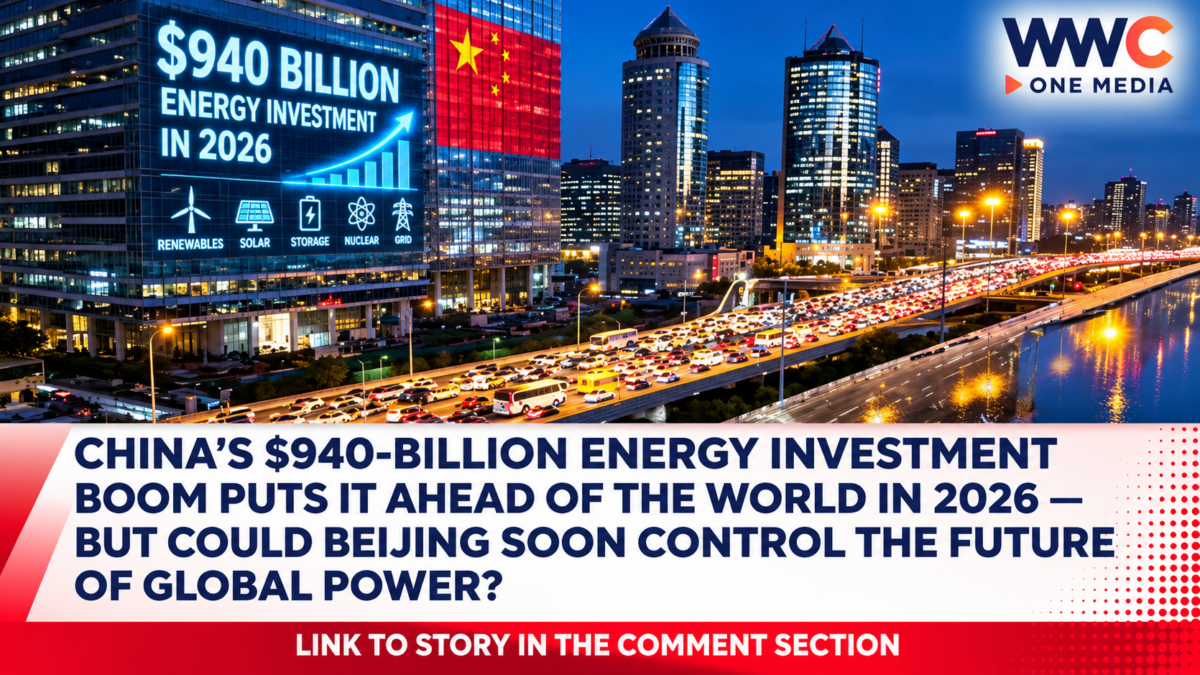
BEIJING, CHINA — November 8, 2026 — China is preparing to cement its position as the world’s largest energy investor, with spending projected to reach an extraordinary US$940 billion in 2026, highlighting Beijing’s expanding influence over renewable energy, electricity infrastructure and the technologies powering the global economy.
The forecast, reported by Bloomberg and China’s state broadcaster CCTV, comes from the Global Energy Transition Report 2026, released by the China Enterprise Reform and Development Society on November 7.
The figure places China ahead of every other country in projected energy investment, reinforcing its position as a dominant force in solar panels, wind turbines, battery technology and the infrastructure needed to support a rapidly electrifying economy.
But behind the staggering investment numbers lies a bigger question.
Can China turn its massive energy spending into a lasting competitive advantage, or will the enormous costs of expanding its power system expose new economic and technological vulnerabilities?
China Could Account for More Than a Quarter of Global Energy Investment
According to the Global Energy Transition Report 2026, worldwide energy investment is expected to reach approximately US$3.4 trillion this year, representing a 5% increase from 2025.
China’s projected US$940 billion represents approximately 27.6% of that total, based on the report’s estimates.
That means more than one in every four dollars of projected global energy investment could be associated with the Chinese market.
The International Energy Agency (IEA), in its own World Energy Investment 2026 report, separately forecasts worldwide energy spending of US$3.4 trillion.
The agency estimates that approximately US$2.2 trillion will flow into clean-energy technologies and infrastructure, including renewable power, nuclear energy, electricity grids, energy storage, energy efficiency and electrification.
Another US$1.2 trillion is expected to support fossil-fuel activities, including oil, natural gas and coal.
The numbers reveal an important transformation: investment in clean energy now substantially exceeds investment in traditional fossil-fuel supply.
However, China’s US$940-billion forecast covers overall energy investment, not exclusively renewable-energy projects.
That distinction matters because Beijing continues to invest in conventional energy security even as it aggressively expands cleaner electricity sources.
China’s Renewable Energy Capacity Has Reached an Extraordinary Scale
China’s position as the leading energy investor is supported by one of the largest renewable-power construction programs in history.
According to figures cited by CCTV, the country had approximately 2.337 billion kilowatts, or 2,337 gigawatts, of installed renewable-power capacity at the end of 2025.
That represented 60.1% of China’s total installed power-generation capacity.
The country also accounted for approximately 63.6% of newly installed renewable-power capacity worldwide, according to the same state-media report.
These figures illustrate the extraordinary speed at which China has expanded its energy infrastructure.
Renewable electricity generation reached approximately 3.99 trillion kilowatt-hours in 2025, representing 38.3% of total national electricity generation.
CCTV reported that the additional electricity generated from renewables was sufficient to cover the year’s increase in national power consumption.
The difference between renewable capacity and actual electricity generation is especially important.
Solar and wind projects do not operate continuously at full rated capacity, meaning a high share of installed generating equipment does not automatically translate into an equivalent share of electricity output.
Nevertheless, China’s expanding renewable-energy fleet is increasingly shaping its electricity system.
The development also comes as electricity consumption reaches unprecedented levels.
As previously reported by WWC ONE MEDIA, China’s electricity demand exceeded 1 trillion kilowatt-hours in August 2026, with electric vehicles, artificial intelligence and industrial activity contributing to growing power requirements.
Related WWC ONE MEDIA report:
China’s Electricity Demand Tops 1 Trillion kWh as Power Load Hits Record — And AI, EVs Are Driving the Surge
Coal’s Share of China’s Electricity Generation Falls Below 50%
One of the report’s most significant findings concerns China’s changing relationship with coal.
According to Peng Huagang, chairman of the China Enterprise Reform and Development Society, coal-fired electricity generation accounted for approximately 49.7% of China’s power output during the first half of 2026.
The figure marked the first time that coal’s generation share had fallen below 50% for that period, according to the report.
This is a notable development for a country that remains heavily dependent on coal and is the world’s largest greenhouse-gas emitter.
The shift does not mean China has abandoned coal.
Instead, coal-fired power is gradually taking on a greater role in ensuring electricity reliability and supporting grid flexibility, while renewable generation supplies a growing share of demand.
China’s energy transition therefore involves two simultaneous strategies: expanding low-carbon electricity and preserving dependable backup capacity.
Whether that approach produces sustained emissions reductions will depend on actual fossil-fuel consumption, electricity demand and the rate at which cleaner sources displace coal generation.
China Plans Hundreds of Billions of Dollars in Power-Grid Upgrades
China’s energy expansion is not limited to constructing additional solar panels and wind turbines.
Its next challenge is transporting electricity efficiently from renewable-rich regions to cities, factories and data centers.
State Grid Corporation of China has announced plans to invest approximately 4 trillion yuan, equivalent to US$574 billion, between 2026 and 2030 to modernize the electricity network.
Reuters reported in January that the planned spending represented an approximately 40% increase over the preceding five-year period.
Major priorities include long-distance electricity transmission, stronger distribution systems and infrastructure capable of integrating greater amounts of renewable power.
China’s western regions contain enormous solar and wind resources, while much of its industrial activity and electricity consumption is concentrated farther east.
That geographic imbalance creates a significant engineering challenge.
Without adequate power lines, batteries and flexible electricity markets, some renewable electricity can be wasted even while other regions require additional supplies.
The country’s massive investment in transmission and storage aims to address this problem.
A successful expansion could strengthen industrial competitiveness by making electricity supply more reliable and allowing China to utilize more of its renewable generation.
But grid modernization is expensive, complicated and dependent on effective coordination between utilities, regulators and power producers.
China Supplies Much of the World’s Solar and Wind Equipment
China’s growing influence extends beyond its domestic electricity market.
According to figures highlighted by CCTV, Chinese manufacturers supply approximately 70% of global wind-power equipment and 80% of photovoltaic equipment.
The report also credits technological development and industrial expansion with helping drive worldwide wind-power costs down by more than 60% and photovoltaic generation costs down by more than 80% over the longer term.
These advances have made renewable energy more competitive in markets across Asia, Europe, Africa and Latin America.
However, China’s industrial dominance also creates strategic concerns.
Countries seeking to develop domestic renewable-energy industries may struggle to compete with established Chinese manufacturers, particularly when those companies benefit from large production volumes, mature supply chains and extensive manufacturing infrastructure.
Reuters reported on November 6 that China’s exports and overseas investment in clean technologies are playing an increasingly important role in helping developing economies expand renewable-energy adoption.
The same expansion, however, has intensified concerns about industrial competition, trade barriers and dependence on Chinese technology.
The commercial implications are already visible in other major Asian economies.
Related WWC ONE MEDIA report:
India Is Racing Toward 500 GW of Clean Power — But Its Battery Boom Still Runs Through China
China’s Energy Boom Could Reshape the Global AI Race
The expansion of renewable electricity and energy infrastructure also carries implications for the competition over artificial intelligence.
AI data centers require substantial amounts of electricity to operate computing equipment, cooling systems and supporting infrastructure.
Countries capable of supplying reliable electricity at competitive prices may enjoy advantages when attracting energy-intensive technology investments.
China’s growing renewable-energy system could support the expansion of domestic AI infrastructure, particularly if electricity from its resource-rich western regions can be delivered efficiently.
But a large electricity surplus does not automatically translate into cheap, usable power for every data center.
Bloomberg reported in October that integrating China’s enormous wind and solar output remains a major challenge, with grid constraints and electricity-market inefficiencies preventing some available renewable generation from being fully utilized.
China must therefore strengthen its electricity transmission system, improve energy storage and coordinate demand with increasingly variable renewable output.
The same challenge is emerging across the world as AI infrastructure development accelerates.
Related WWC ONE MEDIA report:
MGEN and VITRO Explore Renewable-Powered Data Centers to Support Philippine AI Growth
What China’s Energy Investment Means for the Philippines and Southeast Asia
China’s projected investment leadership could have significant consequences for Southeast Asian economies seeking more affordable electricity and greater energy security.
The Philippines, Vietnam, Indonesia, Thailand and other regional markets are expanding their renewable-energy infrastructure while confronting rising power demand, investment requirements and electricity-grid limitations.
China’s large manufacturing base could help lower the cost of imported renewable-energy components.
Solar panels, batteries, inverters and related equipment are important inputs for developers throughout the region.
However, cheaper equipment alone does not guarantee affordable electricity.
Land acquisition, permitting requirements, transmission access, project financing and local market regulations can all influence the final cost of power.
For the Philippines, attracting sufficient financing for generation projects and infrastructure upgrades will remain essential.
As WWC ONE MEDIA previously reported, the Philippine Board of Investments recorded approximately ₱740.14 billion in energy-related investment approvals during the first nine months of 2026, representing more than 82% of the agency’s total approved investment value for the period.
Those approvals indicate substantial investor interest, although not every approved project has begun construction or entered commercial operation.
Related WWC ONE MEDIA report:
Philippine Investment Approvals Surge 53% to ₱900 Billion, Just ₱100 Billion Short of Target — But Will 21,524 Promised Jobs Become Reality?
For regional economies, China’s energy expansion presents both an opportunity and a competitive challenge.
Lower-cost technology could accelerate renewable-power deployment, but governments may also seek to diversify suppliers and support domestic manufacturing.
China’s Biggest Energy Challenge May Be Using What It Builds
Despite its impressive investment figures, China faces several structural risks that could complicate its energy ambitions.
One challenge is industrial overcapacity.
Chinese solar manufacturers have experienced intense price competition as production expanded faster than demand in some segments.
Another issue is electricity-grid integration.
A country can install enormous amounts of renewable generating capacity without necessarily being able to deliver all that electricity when and where it is required.
Financial sustainability is another concern.
Large infrastructure programs can create long-term economic benefits, but their commercial value ultimately depends on project utilization, operating costs and the returns generated over time.
Meanwhile, international tariffs and trade restrictions could limit Chinese manufacturers’ access to certain overseas markets.
These factors suggest that China’s next phase of energy development may be more complicated than the initial expansion of solar farms, wind turbines and manufacturing facilities.
The challenge is no longer simply building more energy infrastructure.
It is ensuring that the infrastructure is efficient, affordable and financially sustainable.
The Bigger Picture: Is China Building the Foundation of the Next Global Economy?
China’s projected US$940-billion energy investment in 2026 is more than a headline about infrastructure spending.
It highlights the growing strategic importance of electricity, energy storage, transmission networks and low-carbon technologies.
China is investing heavily in the systems that could support future industrial production, electric transportation, artificial intelligence and economic growth.
Its large domestic market and substantial manufacturing capacity give it advantages in scaling new technologies.
Yet the outcome remains uncertain.
The country’s energy sector must still confront grid bottlenecks, economic pressures, trade tensions and its continuing reliance on fossil fuels.
And while Beijing has established itself as the world’s largest projected energy investor, spending alone does not guarantee global technological or commercial control.
The defining question is whether China’s enormous investment will deliver lasting energy security and industrial competitiveness—or whether the next stage of its transition will prove far more difficult than the first.
With global energy investment expected to reach US$3.4 trillion in 2026, the contest to build the world’s next generation of power systems is intensifying.
And China is positioning itself at the center of that transformation.