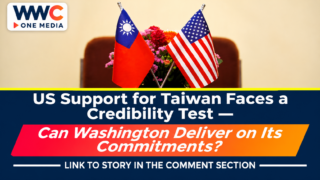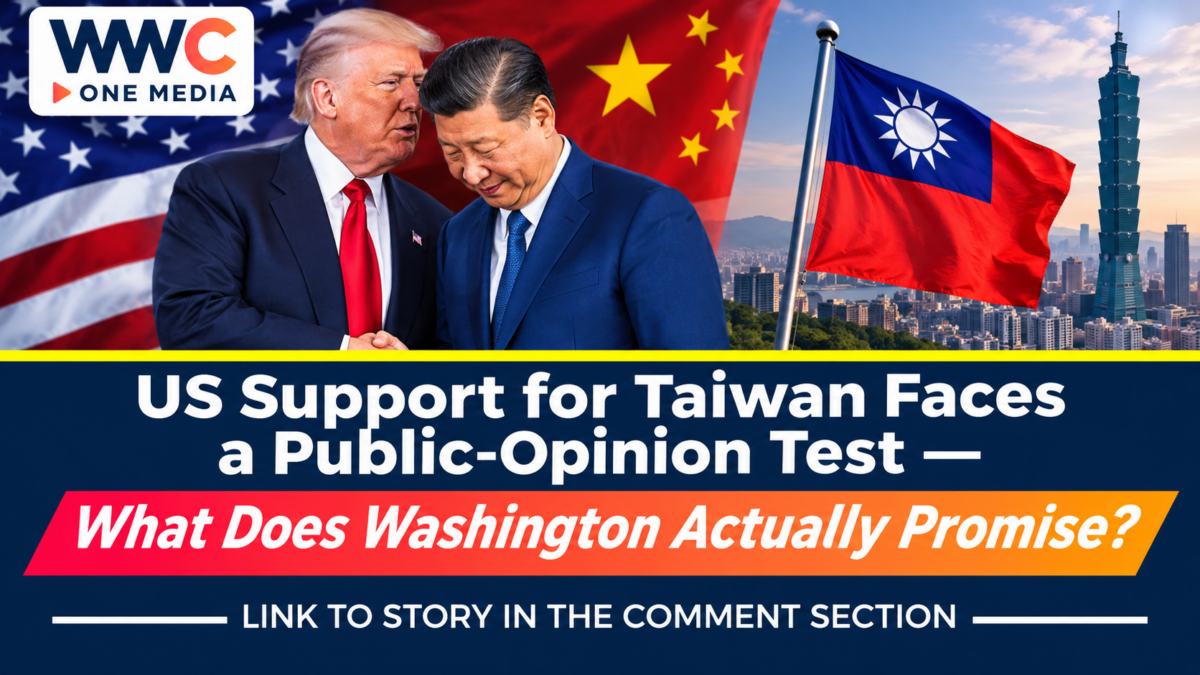
American support for Taiwan faces a test that is as much about public consent as military policy. In November 2026, the legal framework for US security assistance remains in place, but published opinion research shows Americans are divided on providing military aid to Taiwan in a conflict with China.
The distinction reaches beyond Washington and Taipei. US legislation supports Taiwan’s capacity to defend itself without automatically requiring American troops to enter a war, while a potential confrontation could disrupt regional trade, technology supply chains and security across the Western Pacific.
US Support for Taiwan: What the Law Guarantees
The Taiwan Relations Act, enacted in 1979, requires the United States to make available defensive articles and services needed for Taiwan to maintain sufficient self-defence capabilities. It also directs the president to inform Congress of threats to Taiwan’s security, with any US response determined through constitutional processes.
That is a durable legal commitment to assistance, not an automatic treaty obligation to fight. Whether US forces would intervene remains deliberately uncertain. A congressional research briefing describes this approach as strategic ambiguity.
Political rhetoric can imply guaranteed rescue or inevitable abandonment. Neither follows from the law.
The practical debate over assistance is already part of WWC’s earlier reporting on congressional pressure to uphold Taiwan security commitments. Authorised programmes, spending decisions, delivered equipment and direct military intervention are separate policy questions.
Americans Are Divided on Military Aid
A survey of 1,015 US adults conducted Sept. 19–26, 2025, found 32% favoured providing military assistance to Taiwan in a conflict with China, while 28% opposed it and 36% were unsure. A further 4% did not answer or declined.
Those results do not measure support for sending American troops. Providing weapons, financing or training is different from participating directly in combat. They also should not be presented as a November 2026 opinion poll: the underlying interviews occurred more than a year earlier.
Other research points to a gap between seeing Taiwan as strategically important and treating it as an immediate personal concern. A March 2025 survey found 66% of Americans regarded China–Taiwan tensions as important to US national interests, compared with 47% who said the issue was personally important.
What this could mean: Public willingness to bear costs may matter if Washington faces difficult decisions about military spending, equipment transfers or a prolonged regional crisis. The figures do not establish what Americans would support in a hypothetical invasion.
Warmer Views of China Do Not Equal Abandoning Taiwan
A separate survey conducted Sept. 14–20, 2026, found that Americans gave China an average rating of 37 on a zero-to-100 feeling scale, compared with 28 in 2021. Fifty-four percent gave China a cold rating, 27% were neutral and 19% were warm.
The survey involved 1,168 US adults who rated China, drawn from a larger study of 5,193 adults. It measures views of China, not willingness to defend Taiwan.
That difference is essential. A respondent may favour stable economic relations with Beijing while also backing arms sales to Taipei. Conversely, a negative opinion of China does not establish support for US combat involvement.
Security concerns remain distinct. WWC’s coverage of former Taiwan president Tsai Ing-wen’s US visit explored the pressure Taiwan says it faces across military and other domains. Public sentiment alone cannot measure military readiness or deterrence.
Why US Intelligence Still Sees a Serious Security Risk
The US intelligence community’s March 2026 threat assessment said Beijing probably would continue seeking conditions for eventual unification without a conflict, while retaining military options. It assessed that Chinese leaders did not then plan an invasion in 2027 and had no fixed timetable for unification.
That assessment is not a guarantee that confrontation cannot occur. It distinguishes military capability, possible political decisions and a specific forecast about timing.
The report also warned that a conflict could disrupt global semiconductor supplies, trade and financial markets. Taiwan’s location makes the issue particularly relevant for neighbouring economies, including the Philippines, even without a direct military confrontation.
Diplomatic efforts to manage tensions provide another part of the picture. WWC previously covered a multinational call for stability in the Taiwan Strait, illustrating that regional concern extends beyond the United States alone.
What Would Make US Commitments More Credible?
The Taiwan Security Cooperation Initiative, authorised by Congress, provides a framework for assistance aimed at strengthening Taiwan’s self-defence. Legislation permits up to US$1 billion to be made available for the initiative in fiscal year 2026; that ceiling is not evidence that the full amount has been spent or delivered.
The statute says this assistance authority does not specifically authorise US forces to enter hostilities. This reinforces the difference between equipping Taiwan and promising intervention.
Why it matters: Credibility depends on measurable implementation—equipment delivered, training completed, readiness improved and clear coordination—not solely on speeches. More effective defensive capacity could reduce the probability that any side believes a rapid military victory would be achievable.
At the same time, policymakers must weigh deterrence against escalation, and consider the interests of Taiwan’s population and neighbouring countries. There are legitimate debates about which capabilities and diplomatic approaches best lower the danger of conflict.
What Happens Next?
Three developments deserve scrutiny: whether authorised US assistance translates into deliveries, whether fresh polling directly tests different forms of Taiwan support, and whether activity around the strait alters regional risk.
No primary record reviewed for this article establishes a November 2026 decision to abandon Taiwan, a new American guarantee to intervene militarily, or a fixed Chinese invasion date. Those would be fundamentally different stories requiring their own documentary evidence.
The clearest conclusion is that Washington’s commitments are real but limited in specific ways, while public opinion is more complicated than a simple yes-or-no verdict on Taiwan’s future.
Frequently Asked Questions
Is the United States legally required to defend Taiwan with troops?
No. The Taiwan Relations Act provides for defensive assistance and a US capacity to resist coercion, but it does not automatically require military intervention. Any response would involve constitutional decision-making.
How many Americans support military aid to Taiwan?
A September 2025 survey found 32% supported it, 28% opposed it and 36% were unsure. Those figures are not a measure of support for sending US troops.
Has Washington stopped supporting Taiwan?
The reviewed US statute still authorises security cooperation and defence assistance. A change in those commitments should not be inferred from an opinion survey alone.
Does US intelligence predict a Chinese invasion in 2027?
No. Its March 2026 assessment said Chinese leaders had no fixed invasion timetable and did not then plan an invasion in 2027.
Why does Taiwan’s security matter to the Philippines?
Taiwan lies north of the Philippines, near important sea and air routes. Regional instability could affect security planning, shipping and technology supply chains, although the scale and form of any impact would depend on events.