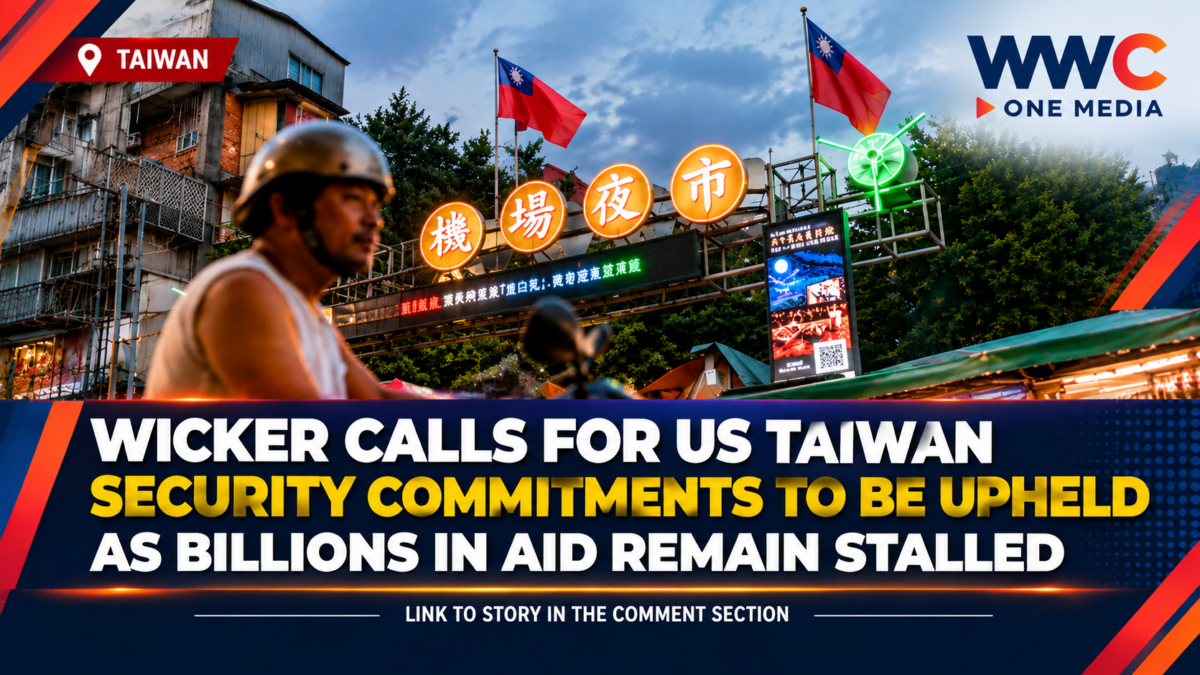
WASHINGTON — U.S. Senator Roger Wicker, chairman of the Senate Armed Services Committee, has called for Washington to uphold its security commitments to Taiwan, adding fresh pressure over delayed U.S. security assistance to the island.
Wicker made the remarks after meeting Taiwan’s representative to the United States, Alexander Yui, amid continuing debate in Washington over arms sales and security assistance to Taiwan.
The Republican senator said Congress has a responsibility to ensure that the Taiwan Relations Act of 1979 is followed and that decisions concerning Taiwan’s defense needs are based on military requirements.
More than $15 billion in assistance under scrutiny
Wicker’s statement comes after four other Republican senators urged the Trump administration last week to release more than $15 billion in stalled national security assistance for Taiwan.
The United States does not maintain formal diplomatic relations with Taiwan but remains its major international security partner and weapons supplier. Under the Taiwan Relations Act, Washington is required to make defensive capabilities available to Taiwan, although the law does not establish an automatic U.S. military response to an attack.
Wicker said Congress has authorized additional resources for Taiwan covering training, security assistance and arms sales, arguing that those authorities should be used for the purposes approved by lawmakers.
The $14 billion package remains a major question
The debate comes as a separate U.S. arms package worth about $14 billion remains on hold, according to Reuters and Taiwan’s defense minister.
China has repeatedly opposed U.S. arms sales to Taiwan and has called for Washington to stop supplying weapons to the island. President Donald Trump previously said the package was being kept in abeyance.
Following Trump’s recent meeting with Chinese President Xi Jinping, Taiwan Defense Minister Wellington Koo said Taipei had received reassurances that U.S. policy toward Taiwan had not changed. Existing arms-sale discussions between Taipei and Washington are continuing.
Wicker invokes a Reagan-era precedent
Wicker also pointed to a precedent from the administration of former President Ronald Reagan, when Washington maintained that it would not consult Beijing over arms sales to Taiwan.
The issue remains particularly sensitive because Beijing claims Taiwan as part of China, while Taiwan’s government rejects Beijing’s sovereignty claim and maintains that the island’s future should be decided by its people.
For Washington, the latest dispute therefore centers on how existing U.S. commitments, congressional authorizations and broader relations with Beijing will be handled as discussions over Taiwan’s defense continue.
The immediate question is whether the delayed security assistance will move forward and how the Trump administration will balance its Taiwan policy with its broader engagement with Beijing.
WWC ONE MEDIA G,A