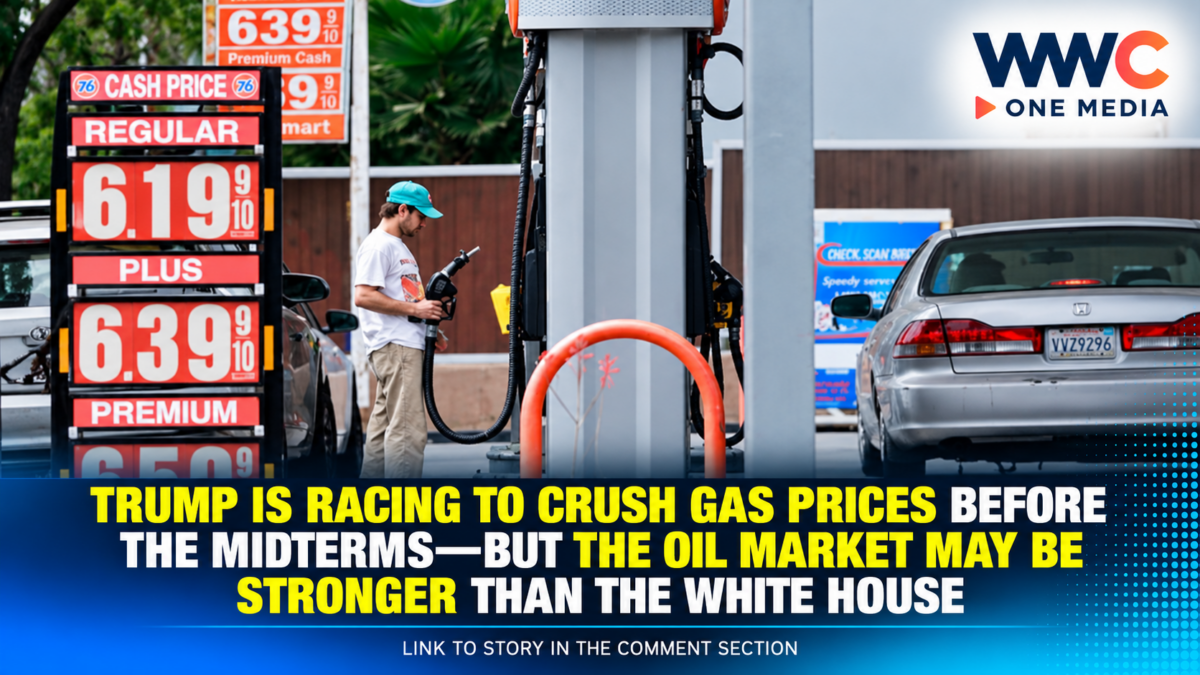
WASHINGTON — Donald Trump wants Americans to see cheaper gasoline and diesel before they vote in November.
The problem is that the White House can influence fuel prices—but it cannot simply order the global oil market to cooperate.
With the 2026 midterm elections only weeks away, gasoline and diesel prices have become an increasingly dangerous political issue for President Trump and Republicans.
The administration has already eased restrictions on dyed diesel, considered a ban on diesel exports, discussed releasing strategic fuel reserves and floated suspending the federal gasoline tax.
But the underlying problem is much bigger.
Global oil and refining markets are under pressure from war, disrupted supply routes and tight fuel inventories.
And that means Trump’s race to lower prices could come down to something Washington has limited power over:
how much oil and refined fuel the world can actually deliver.
Gas prices have come down—but remain painfully high
The latest federal data provides a mixed picture.
The U.S. average retail price for regular gasoline was $4.354 a gallon for the week of October 5, according to the Energy Information Administration.
That’s down from $4.478 two weeks earlier and $4.465 the previous week.
But it was still about $1.23 a gallon higher than a year earlier.
Diesel is an even bigger political headache.
EIA data shows U.S. retail diesel averaged $6.29 a gallon in September, after rising sharply as crude costs and refining margins increased.
Diesel matters far beyond the highway.
It powers:
- Trucks
- Farm equipment
- Construction machinery
- Mining equipment
- Ships
- Backup generators
- Industrial transport
That means a diesel shock can eventually show up in food prices, freight costs and consumer goods.
Trump has already taken one unusual step
Trump signed an executive order temporarily easing restrictions on red-dyed diesel, a fuel normally reserved for off-road uses such as agriculture and construction.
The move allows qualifying dyed diesel to be used more broadly on highways under the temporary rules, with the administration arguing that it can reduce fuel costs for truckers and other users.
The political message is obvious:
Trump wants voters to see Washington doing something about fuel prices.
But the economic impact may be much smaller than the headline suggests.
Industry groups have warned that the dyed-diesel change does not solve the underlying supply shortage, while tax and implementation questions could limit the benefit.
In other words:
Changing the tax treatment of some diesel is not the same thing as creating more diesel.
Trump is now considering a gas-tax holiday
The administration is also revisiting a much bigger idea:
suspending the federal gasoline tax.
Trump said this week that his administration was considering suspending the federal gasoline tax, which currently stands at 18.4 cents per gallon.
But there is a major obstacle.
Congress would have to approve it.
And lawmakers are already back on the campaign trail ahead of the November elections.
Even if Congress approved a suspension, consumers would not necessarily receive the full 18.4-cent reduction.
Research cited by Bloomberg estimates that a suspension could reduce retail gasoline prices by roughly 10 to 16 cents per gallon, depending on how much of the tax cut is passed through to consumers.
That is meaningful for drivers.
But compared with a gasoline price above $4 a gallon, it is hardly a revolution.
And that is Trump’s problem
The administration can cut taxes.
It can alter fuel regulations.
It can pressure refiners.
It can release emergency reserves.
It can encourage more domestic production.
But none of those measures can instantly eliminate the global shortage of refined fuel.
The EIA says September’s higher U.S. gasoline and diesel prices were driven by higher crude oil prices and rising refining margins.
It expects diesel prices to remain above $6 a gallon during October, before gradually declining as crude prices and inventories improve.
That forecast is perhaps the most important number in the entire debate.
Relief may be coming—but not necessarily before voters head to the polls.
The Iran war is still haunting the fuel market
The biggest factor outside Trump’s direct control is the Middle East.
The conflict involving Iran has disrupted oil flows and threatened the Strait of Hormuz, one of the world’s most important energy chokepoints.
Although crude exports from the Gulf have begun recovering, global fuel markets remain extremely tight.
Reuters reported that the International Energy Agency agreed to accelerate the release of emergency oil stocks, potentially putting roughly 100 million barrels into the market, with a particular focus on diesel.
The intervention shows how serious the situation has become.
Strategic reserves are normally designed for precisely this type of emergency.
But they are a bridge—not a permanent source of supply.
Trump says the Strait of Hormuz isn’t the only problem
Trump has recently shifted his rhetoric over what is driving U.S. gasoline prices.
He has pointed to refinery disruptions, including Ukrainian attacks on Russian energy infrastructure and refinery closures in states such as California.
Reuters reported that Trump argued the problem was increasingly about refineries rather than simply crude moving through the Strait of Hormuz.
There is some economic logic behind that argument.
Crude oil is only one component of gasoline and diesel prices.
The oil must still be:
transported → refined → stored → distributed → sold.
If refining capacity becomes constrained, fuel prices can remain high even when crude supplies improve.
That is particularly important for diesel.
Diesel is the real emergency
Gasoline gets more political attention because millions of Americans see the price every time they fill their cars.
But diesel may be the more economically dangerous problem.
Diesel prices reached a record around $6.53 a gallon in September, according to the Financial Times, before easing somewhat.
And the consequences spread through the economy.
A truck carrying food from a farm to a supermarket burns diesel.
A tractor harvesting crops burns diesel.
A construction company moving equipment burns diesel.
A delivery truck bringing packages to homes burns diesel.
So when diesel rises sharply, businesses eventually have to choose:
absorb the cost, cut margins or raise prices.
That makes the fuel crisis an inflation problem as well as an election problem.
Trump has already threatened a diesel-export ban
In September, Trump backed the idea of restricting or banning diesel exports as domestic fuel prices surged.
The logic was simple:
Keep more diesel in America → increase domestic supply → lower U.S. prices.
But the policy carries serious risks.
The United States is deeply integrated into the international refined-fuel market.
Restricting exports can disrupt global supply chains and potentially provoke higher prices elsewhere, while U.S. refiners can also depend on international trade to balance regional shortages and surpluses.
Trump subsequently backed away from the threat after European allies agreed to release additional refined-fuel stocks as part of a broader effort to stabilize markets.
That episode illustrates the central problem.
Fuel markets are global even when politicians campaign locally.
The refining bottleneck is harder to fix
Building an oil well is one thing.
Building a refinery is another.
Refineries require enormous capital investment, specialized equipment and years of permitting and construction.
And even if the United States wanted to dramatically expand refining capacity, it could not happen before the November election.
That leaves Trump with short-term options:
- Draw down inventories
- Encourage higher refinery utilization
- Increase imports
- Reduce taxes
- Temporarily relax fuel regulations
- Pressure foreign producers
- Encourage domestic production
- Reduce trade restrictions where possible
But none provides an instant structural solution.
More U.S. oil production won’t necessarily mean cheaper gasoline tomorrow
Trump has long championed increased domestic oil production.
That can improve energy security over time.
But gasoline prices are determined largely by global oil markets, not simply by how much crude the United States produces.
American producers can pump more oil while global prices remain high if geopolitical disruptions elsewhere continue to constrain supply.
And crude oil is only one piece of the gasoline price.
That is why the administration’s ability to influence the pump price is much more limited than political rhetoric sometimes suggests.
The market is already sending Trump a warning
The EIA’s October outlook expects gasoline and diesel prices to ease eventually as crude prices decline and inventories recover.
But the agency also expects refining margins to remain unusually elevated.
That means the market’s likely path is:
high prices → gradual relief → continued volatility.
Not:
Trump announces policy → gasoline immediately collapses.
That distinction could matter enormously before the election.
The midterms turn fuel prices into a political countdown
The timing could hardly be worse for Republicans.
The 2026 midterm elections are approaching as Americans remain sensitive to the cost of living.
A Wall Street Journal report says energy prices—including gasoline, diesel and electricity—have become a major source of financial pressure and political anxiety for voters.
Another recent report highlighted how high diesel prices are particularly damaging in rural communities, where agriculture, trucking and transportation play an outsized role.
That creates a political vulnerability for Trump.
The president has repeatedly promised that his policies would improve affordability.
If voters instead see $6-plus diesel and gasoline above $4, opponents can argue that the promised economic relief has not arrived.
Republicans are feeling the pressure
The fuel problem is already showing up in Republican politics.
Texas Attorney General Ken Paxton, who is running for Senate, was reportedly heard in a leaked recording acknowledging that high diesel prices and the Iran conflict are hurting Republicans politically.
The comments underline the fear inside the party that voters may punish Republicans for economic pain they experience at the pump.
That does not mean fuel prices will determine the election.
But in competitive races, a few dollars more at every fuel stop can become a powerful political symbol.
Can Trump actually lower gasoline prices?
Yes—but only partially and probably not entirely through presidential action.
There are several paths toward lower prices.
1. More global oil supply
This is the biggest potential game changer.
If the Iran conflict eases, the Strait of Hormuz becomes fully accessible and global crude flows normalize, oil prices could fall substantially.
That would eventually feed into U.S. gasoline prices.
2. Higher refinery output
If U.S. and foreign refineries return to normal operations, gasoline and diesel supply could improve.
This could reduce refining margins and lower pump prices.
3. Strategic reserve releases
The IEA’s coordinated reserve release can provide temporary supply.
But it cannot permanently solve a structural shortage.
4. A federal gas-tax suspension
This could provide a relatively immediate reduction at the pump.
But Congress must approve it, and the full 18.4-cent tax would not necessarily be passed through to drivers.
5. More domestic production
More U.S. drilling could strengthen supply over time.
But new production does not appear overnight, and its effect on retail gasoline prices would be indirect.
What Trump cannot control
This is where the political promise collides with economic reality.
Trump cannot directly control:
Iran’s oil exports.
The Strait of Hormuz.
Russian refinery disruptions.
Global refinery capacity.
OPEC+ production decisions.
European fuel demand.
Asian refinery operations.
Hurricane damage to U.S. energy infrastructure.
And all of these factors can affect what Americans pay at the pump.
Reuters reported that a storm developing in the Gulf of Mexico could threaten U.S. oil production infrastructure at a time when markets are already unusually tight.
That is the nightmare scenario for the White House:
Trump can announce relief while another global shock pushes prices higher.
The biggest danger is promising more than the market can deliver
This may ultimately be Trump’s biggest fuel-price problem.
If prices fall, the administration can claim credit.
But if prices remain high, voters may not care whether the cause was Iran, Russia, Ukraine, refineries or global markets.
They simply see the number on the pump.
And that number is currently far above the levels Americans enjoyed before the latest energy shock.
The EIA’s forecast offers some hope: diesel prices should gradually decline as inventories recover and crude prices ease.
But “gradually” is a dangerous word when an election is only weeks away.
The bottom line
Trump can reduce some of the pressure on gasoline and diesel prices—but he cannot guarantee cheap fuel before the midterms.
His administration has already eased restrictions on dyed diesel and is considering a federal gasoline-tax suspension. It has also explored measures involving diesel exports and emergency fuel supplies.
But the biggest forces driving today’s fuel crisis remain global: the Iran conflict, disrupted oil flows, tight refining capacity and elevated fuel-market premiums.
The latest EIA data shows gasoline averaging about $4.35 a gallon, while September diesel averaged $6.29. The agency expects diesel to remain above $6 during October before gradually easing.
That leaves Trump with a race against both the oil market and the election calendar.
If fuel prices fall before November, Trump could claim a major political victory. If they don’t, the pump may become one of the most powerful anti-incumbent symbols of the 2026 midterms.
And the uncomfortable question for the White House is now unavoidable:
Can Trump make gasoline cheaper before voters make their decision—or will the global oil market beat him to the polls?