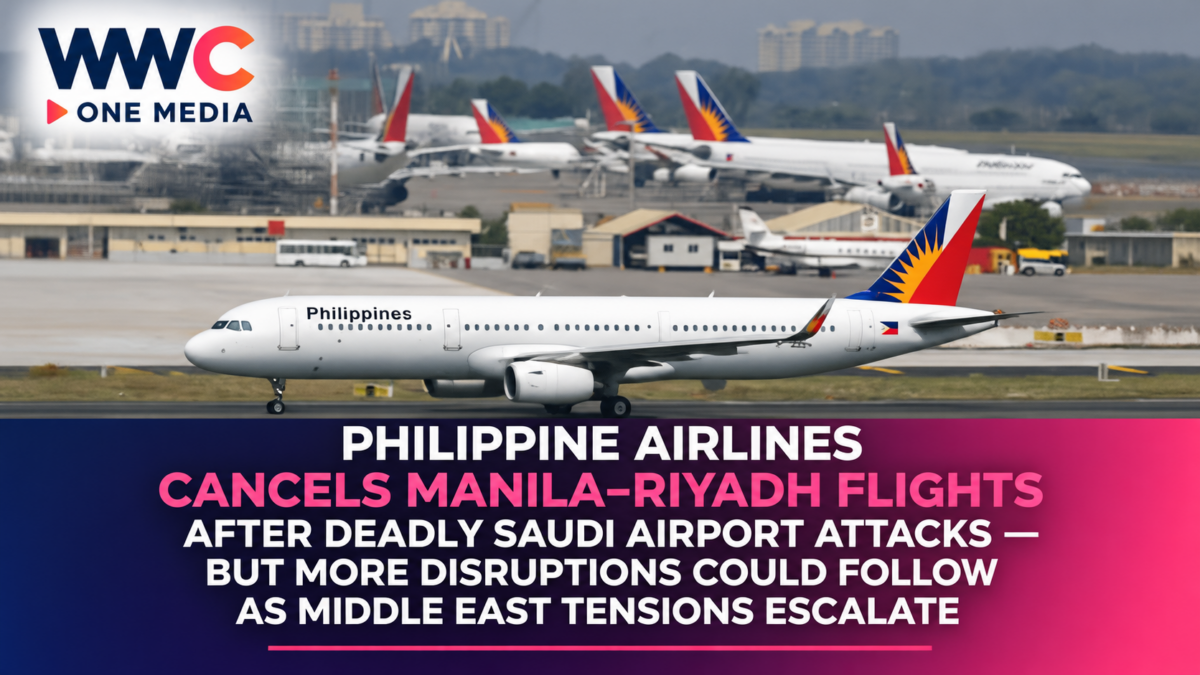
The Philippine flag carrier confirmed on Thursday, October 8, that it was canceling two flights serving the Manila–Riyadh route as security concerns intensified across the region.
The decision followed reported attacks on King Khalid International Airport in Riyadh and Abha International Airport in southwestern Saudi Arabia, which Saudi authorities said killed three people and injured 36 others.
Yemen’s Iran-backed Houthi movement claimed responsibility for the airport attacks, adding another dangerous dimension to an already volatile Middle East security situation.
PAL said its operational teams were assessing airport conditions and evaluating potential consequences for upcoming flights, with passenger and crew safety remaining its highest priority.
PAL Confirms Two Canceled Flights Between Manila and Riyadh
According to reporting by GMA News and Context.ph, the affected flights are:
Philippine Airlines flight advisory
Canceled
| PR654Manila → Riyadh | October 8, 2026Thursday |
| PR655Riyadh → Manila | October 10, 2026Saturday |
Flight dates are based on the PAL advisory quoted by GMA News and independently reported by Context.ph. Future flights remain subject to airline updates.
The airline said it was continuing to evaluate conditions at airports and their potential effects on subsequent operations.
PAL acknowledged the disruption and uncertainty facing travelers.
“We recognize the inconvenience and concern these cancellations may cause our passengers.”
The airline assured affected passengers that they would be informed about available travel arrangements as conditions evolve.
The announcement does not establish an indefinite suspension of PAL’s Manila–Riyadh route. Only the identified flights have been confirmed canceled in the reports reviewed.
Deadly Airport Attacks Trigger Fresh Aviation Security Concer
The flight disruptions come amid escalating hostilities involving the Houthis, a Yemen-based armed movement aligned with Iran.
According to reporting by The Wall Street Journal, Houthi militants launched attacks against airports in Riyadh and Abha, resulting in three fatalities and 36 injuries.
The attacks reportedly occurred on Tuesday and Wednesday, October 6–7.
One person was killed and eight others were injured at the Riyadh airport, according to figures cited by InsiderPH.
The incidents have heightened concerns about the vulnerability of civilian aviation facilities during periods of military escalation.
Airport attacks can create risks beyond physical damage to runways and terminals. Airlines must also consider airspace restrictions, aircraft security, available diversion airports and the safety of passengers and crews.
In the case of Philippine Airlines, the carrier cited the developing regional situation and ongoing airport assessments rather than specifying a single technical problem that directly prevented its flights from operating.
The broader security situation remains uncertain, making further operational adjustments possible.
Why the Manila–Riyadh Route Matters to Filipino Workers
Saudi Arabia remains a major destination for overseas Filipino workers, many of whom are employed in healthcare, construction, engineering, hospitality, transportation and other essential industries.
For these workers and their families, direct air connections between Manila and Riyadh provide a critical link for employment, home visits and emergencies.
The cancellation of even a limited number of flights can create complications for passengers with fixed work reporting dates, connecting journeys, expiring travel arrangements or urgent family obligations.
Some passengers may need to reorganize accommodation, transportation and onward travel while awaiting confirmation of alternative flights.
However, the number of travelers directly affected by PAL’s October 8 and October 10 cancellations has not been publicly established in the reviewed reports.
There is also no confirmed announcement that all air travel between the Philippines and Saudi Arabia has been suspended.
The immediate disruption applies to the identified Philippine Airlines services, not automatically to every flight operated by other airlines serving the region.
The Bigger Risk: Middle East Conflict Is Testing Global Aviation and Energy Security
PAL’s decision comes at a time when renewed Middle East hostilities are having consequences well beyond the countries directly involved.
A Reuters report published on October 5 highlighted how the conflict involving the United States, Israel and Iran has intensified concerns about energy supplies across Southeast Asia.
ASEAN countries depend heavily on Middle Eastern crude oil, making disruptions to regional energy production and transportation a significant economic concern.
Rising fuel prices can increase operating costs for airlines, while security-related airspace restrictions can force carriers to reassess routes, flight schedules and fuel requirements.
For international aviation, the possible consequences include longer journeys, unexpected diversions, increased operating expenses and additional schedule uncertainty.
These are broader industry risks rather than confirmed outcomes of PAL’s two canceled flights.
The developing situation illustrates how military escalation in one part of the world can quickly affect travelers and businesses thousands of kilometers away.
What Affected PAL Passengers Should Do Now
Travelers with bookings on PR654 and PR655 should coordinate directly with Philippine Airlines before making alternative arrangements.
The airline has indicated that affected passengers will be informed about cancellations and available travel options.
Passengers should take the following precautions:
- Check flight status: Confirm whether the booking is affected through PAL’s official channels.
- Monitor airline notifications: Watch for emails, text messages or booking updates containing revised travel instructions.
- Request available alternatives: Ask PAL about applicable rebooking, refund or other arrangements.
- Review connecting flights: Contact other airlines or travel providers if the disruption affects onward journeys.
- Follow official travel advisories: Monitor announcements from relevant Philippine and Saudi authorities.
- Passengers should avoid assuming that a previously published flight schedule remains valid while airline assessments are ongoing.
Will More Manila–Riyadh Flights Be Canceled?
The most important unanswered question is whether the latest security concerns will affect additional services.
PAL has not announced a definite timeline for further cancellations or a broader suspension of the Riyadh route in the reports reviewed.
The carrier’s next decisions will depend on its assessment of operational conditions, airport safety and developments in the region.
The situation also highlights the difficulties airlines face when security threats emerge with limited warning.
Commercial carriers must balance the need to maintain vital international connections with their responsibility to protect passengers, employees and aircraft.
For overseas Filipino workers, the consequences may be particularly significant because travel disruptions can affect employment schedules and family commitments.
PAL’s cancellation of two Manila–Riyadh flights may be a limited precautionary response for now, but the larger concern is whether escalating attacks on civilian aviation facilities will force airlines to make more extensive changes to Middle East operations.
As security conditions develop, one question remains: Will Philippine Airlines be able to maintain regular services to Saudi Arabia, or will the regional conflict bring further disruptions for Filipino travelers?