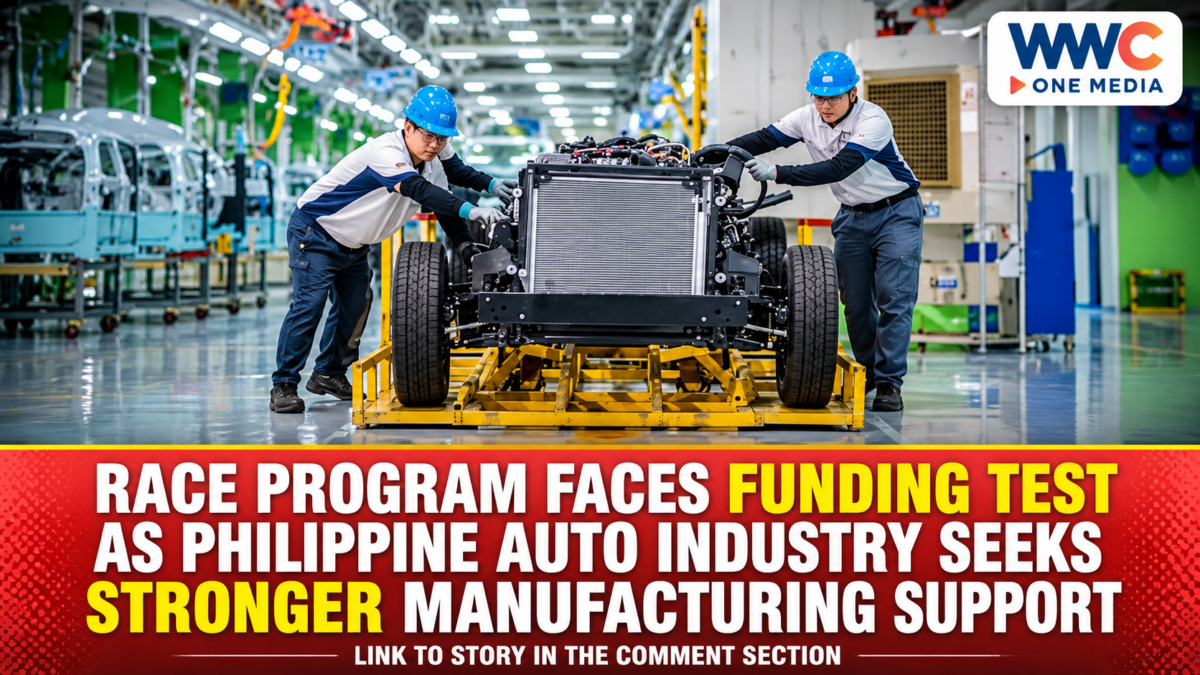
The Philippine automotive industry is looking for a more predictable government support system as manufacturers navigate changing consumer demand, electric-vehicle adoption and the cost of maintaining local production. One important test is the implementation of the Revitalizing the Automotive Industry for Competitiveness Enhancement (RACE) Program, whose proposed ₱250-million allocation under the 2026 Unprogrammed Appropriations was vetoed by President Ferdinand Marcos Jr. on Jan. 5, 2026.
The issue goes beyond whether automakers receive incentives. It concerns whether the Philippines can provide a stable policy environment that encourages companies to assemble vehicles locally, develop parts suppliers, invest in new technologies and create skilled manufacturing jobs.
The Chamber of Automotive Manufacturers of the Philippines Inc. (CAMPI) has identified RACE, the older Comprehensive Automotive Resurgence Strategy (CARS) Program and the Electric Vehicle Incentive Strategy (EVIS) as important components of automotive industry development. Its published policy agenda also places technology, workforce development and sustainability among the sector’s priorities. CAMPI
RACE Program Funding Remains an Important Question
The 2026 General Appropriations Act included a ₱250-million allocation for RACE under Unprogrammed Appropriations. The programme was intended to provide fiscal support to newly registered and qualified participating carmakers through non-transferable tax payment certificates or another appropriate mechanism.
However, the President directly vetoed the RACE allocation in his Jan. 5 budget message. The related provision governing the release of funds was also covered by the veto. Department of Budget and Management+1
This distinction matters because an appropriation under Unprogrammed Appropriations is not the same as money automatically released to an agency. Such funding is subject to specified conditions and government validation before it can be used.
The veto therefore removed that particular ₱250-million standby allocation from the available FY2026 funding authority. It should not automatically be interpreted as the cancellation of every automotive industry policy or incentive, but it does leave a significant question about how the proposed RACE support will be financed and implemented.
For manufacturers considering long-term investments, the availability of incentives is only part of the equation. They also need to know when programme guidelines will be issued, which investments qualify, how applications will be assessed and when approved benefits can be claimed.
Without those details, companies may find it difficult to include government incentives in their investment plans with confidence.
CARS and RACE Are Not the Same Programme
The funding debate also requires a clear distinction between RACE and CARS.
CARS is an existing government programme established to encourage domestic automotive manufacturing. Its implementation has involved fiscal obligations to participating manufacturers and eligible automotive parts producers.
In January 2026, the Department of Budget and Management, Department of Trade and Industry and Department of Finance issued a joint statement addressing the status of CARS payments after the veto of its proposed FY2026 funding item.
The agencies said validated obligations supported by issued Tax Payment Certificates could be settled using available FY2025 savings, subject to approval by the Office of the President and compliance with applicable budgetary requirements. They identified Toyota and Mitsubishi among the participating car manufacturers with validated dues, alongside eligible automotive parts makers. Department of Budget and Management
The same statement said remaining validated requirements that had not yet received Tax Payment Certificates could be considered for inclusion in the proposed FY2027 National Expenditure Program.
That assurance concerned existing CARS obligations. It should not be interpreted as confirmation that the separate RACE programme has received replacement funding or that its implementation guidelines are already complete.
The distinction is important for suppliers and investors. Settling obligations under an existing programme is different from providing incentives for new investments under a successor or complementary initiative.
CAMPI Wants Manufacturing and Workforce Development to Move Together
CAMPI’s published leadership agenda provides a broader picture of what the industry wants from government policy.
In his Jan. 27, 2026, ceremonial turnover speech, CAMPI President Jose Maria M. Atienza identified CARS, RACE and EVIS as important to automotive industry recovery and growth.
He also placed workforce development within the organisation’s industry-development priorities. CAMPI said it would continue supporting the Technical Education and Skills Development Authority in developing training regulations and competency assessment tools through its experts panel. CAMPI
That focus reflects a practical requirement of local manufacturing. Establishing an assembly operation is not simply a matter of bringing production equipment into the country. Manufacturers also need technicians, engineers, quality-control specialists and suppliers capable of meeting production standards.
A stronger domestic supplier network can create opportunities beyond the vehicle assembly line. Local businesses may participate in the production of components, materials, tooling and other manufacturing services, provided they meet the required quality, cost and delivery standards.
For the Philippines, this is where the value of industrial incentives should ultimately be measured: not only by the amount of financial support offered, but by the productive capacity and technical capability developed in return.
Electric Vehicles Add Another Layer to the Policy Challenge
The industry’s transition is also changing the type of manufacturing investment the country needs to attract.
Executive Order No. 121 established the Electric Vehicle Incentive Strategy, or EVIS, to support domestic manufacturing and assembly of hybrid and battery-electric passenger and commercial vehicles, as well as their parts and components.
The Department of Energy said the programme provides performance-based fiscal support for qualified investments and forms part of the manufacturing component of the Comprehensive Roadmap for the Electric Vehicle Industry under the Electric Vehicle Industry Development Act. Department of Energy Philippines
The policy comes as electrified vehicles gain a larger share of the local market. The DOE reported that 66,685 electric vehicles were sold in the Philippines from January to August 2026, including hybrid electric vehicles, plug-in hybrid electric vehicles and battery electric vehicles. The total represented approximately 24.7% of estimated vehicle sales during the period. Department of Energy Philippines
The figures show why manufacturing policy cannot focus only on conventional vehicles. Companies are adapting their product offerings while the country works to develop charging infrastructure, technical skills and local supply chains for electrified transport.
WWC ONE MEDIA previously examined the Philippine EV market’s expanding consumer base and infrastructure requirements.
However, EVIS and RACE should not be treated as interchangeable. They have separate policy frameworks and objectives, even though both support the development of domestic automotive manufacturing.
A clear relationship between these programmes could help manufacturers plan investments across conventional and electrified vehicle production. Uncertainty over eligibility, funding and implementation, on the other hand, could make it harder for companies to determine which projects qualify for support.
The Philippine Market Needs More Than Vehicle Sales Growth
The local automotive market is also changing because consumers have more choices, including vehicles from new manufacturers and brands.
That creates opportunities for buyers, but stronger retail competition does not automatically translate into stronger domestic manufacturing. Imported vehicles can expand consumer choice without necessarily increasing local assembly, parts production or manufacturing employment.
The difference is central to the government’s industrial policy challenge.
The Philippines needs to attract investment that creates economic activity beyond vehicle distribution. This includes assembly operations, supplier development, technical training, research, after-sales services and the production of components that can compete in regional markets.
CAMPI’s published figures on the industry’s economic contribution point to the sector’s significance, while its policy agenda stresses the need for cooperation between manufacturers and government. CAMPI+1
For consumers, a stronger local manufacturing base could eventually support more competitive supply and service networks. But those benefits depend on actual investment and production rather than incentives announced on paper.
WWC has also explored how electric-vehicle incentives could influence the balance between imports and local manufacturing.
The question is whether the country can maintain a policy framework that encourages both vehicle adoption and domestic industrial development.
What Happens Next
The next important developments will involve the publication and implementation of clear programme rules, confirmation of funding arrangements and the identification of eligible investments.
For RACE, manufacturers need clarity on the programme’s current status, its funding mechanism and the guidelines governing participation. For CARS, the government must continue addressing validated obligations under the applicable budgetary and legal requirements.
EVIS will face its own implementation test as agencies work to attract qualified investments in electric-vehicle and component manufacturing.
The government’s challenge is to make these programmes work together without confusing their separate funding arrangements and eligibility requirements.
For CAMPI members and other automotive investors, the real measure of support will be whether announced policies become predictable, accessible and properly funded programmes.
The Philippines has an opportunity to develop a stronger automotive manufacturing base as vehicle technologies evolve. But turning that opportunity into long-term industrial growth will require more than incentives: it will require consistent implementation, skilled workers, capable suppliers and confidence that government commitments can be delivered.
Frequently Asked Questions
What is the RACE Program in the Philippines?
The Revitalizing the Automotive Industry for Competitiveness Enhancement Program is a government initiative intended to provide fiscal support to qualified participating carmakers to encourage domestic automotive manufacturing.
Was the ₱250-million RACE allocation approved for 2026?
The FY2026 General Appropriations Act listed a ₱250-million RACE allocation under Unprogrammed Appropriations, but President Marcos vetoed that item on Jan. 5, 2026.
Is RACE the same as the CARS Program?
No. RACE and CARS are separate programmes. CARS has existing obligations involving participating manufacturers and eligible automotive parts makers, while RACE is intended to support newly registered and qualified participating carmakers.
What is the Electric Vehicle Incentive Strategy?
EVIS is a programme established under Executive Order No. 121 to provide performance-based fiscal support for qualified domestic manufacturing and assembly investments involving hybrid and battery-electric vehicles and their components.
Why does automotive manufacturing support matter to the Philippines?
A stronger domestic industry can encourage investment in assembly facilities, automotive parts suppliers, technology and workforce development. The long-term benefits depend on actual production, investment and employment rather than incentives alone.