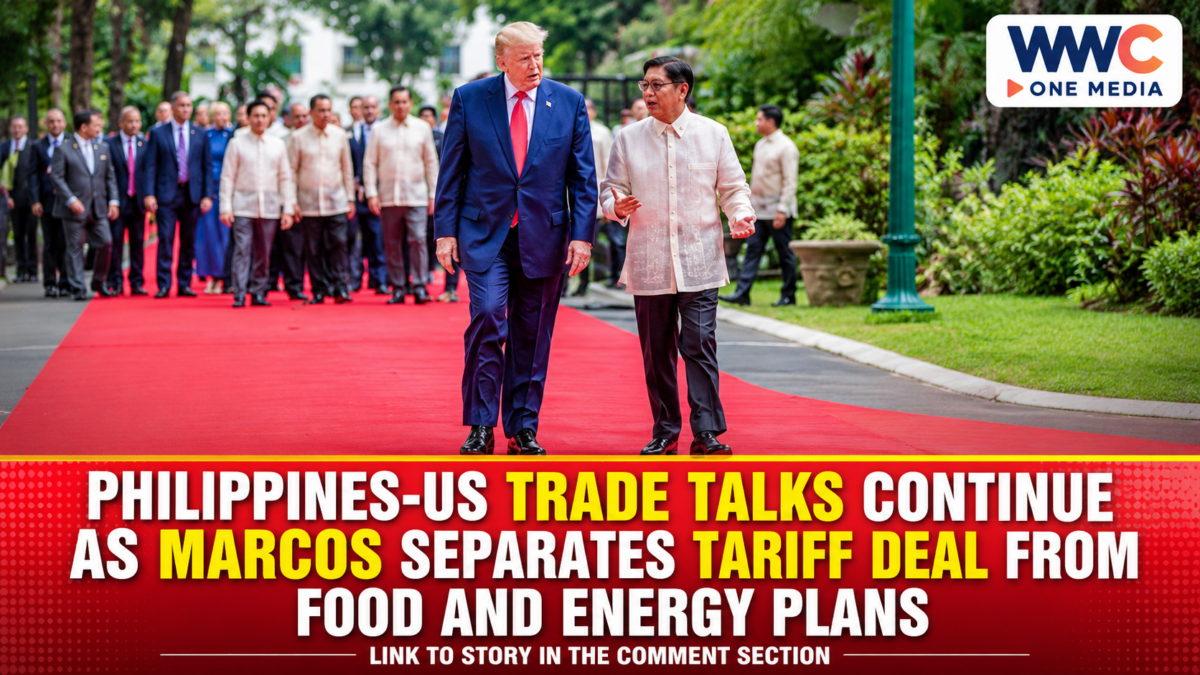
The Philippines and the United States are still working out the terms of a proposed trade arrangement following President Ferdinand Marcos Jr.’s meeting with US President Donald Trump in Manila on Nov. 18, 2026. Marcos has clarified that the discussions involve two distinct tracks: addressing the US tariff issue and expanding the Philippines’ access to American food and energy supplies.
The distinction matters because a political announcement of a major deal does not automatically mean a signed agreement, a confirmed tariff reduction or an immediate change in import rules. For exporters, manufacturers and consumers, the practical effects will depend on the provisions that both governments eventually settle.
The developments should be treated as an update to WWC ONE MEDIA’s existing report, US–Philippines Trade: What the Official Records Confirm—and What They Don’t, rather than as a separate article on the same announcement.
Marcos Says the Trade Discussions Have Two Separate Tracks
In a press conference in Shenzhen, China, on Nov. 20, Marcos explained that the discussions with Washington should be understood as two related but separate initiatives.
The first concerns the tariff schedule the United States had sought to impose on Philippine goods. Marcos said that the US tariff action had been struck down in court, but that the episode had brought broader questions about bilateral trade back to the negotiating table.
The second initiative concerns access to American agricultural and energy products. Marcos said the Philippines wants to widen its sources of essential commodities, particularly after international disruptions exposed the risks of depending heavily on a limited number of suppliers.
The President said the details still needed to be worked out and that government secretaries had already begun discussions after his meeting with Trump in Malacañang. He also said the government wanted to finalise the trade arrangement as soon as possible. Presidential Communications Office+1
That clarification is important. It indicates that the public description of a single large trade deal covers more than one policy objective, each of which may require different commitments and implementation steps.
The White House Describes the Economic Objective Differently
A White House fact sheet issued on Nov. 18 described the leaders’ economic commitment as an effort to eliminate the US trade deficit with the Philippines through increased Philippine imports of American energy and agricultural products.
The document did not publish a complete bilateral trade agreement, a tariff schedule for Philippine exports or a timetable for implementing new trade rules. It also did not specify that the Philippines would source 100% of its food or energy requirements from the United States.
The same fact sheet listed several commercial and strategic announcements made during Trump’s visit, including a US$12 billion sale by Boeing and GE Aerospace to Philippine Airlines for up to 20 Boeing 787 aircraft. That transaction is a separate commercial development and should not be treated as proof that the broader trade negotiations have been completed. The White House
The difference between the two governments’ public descriptions makes the eventual written terms particularly important. The White House emphasised reducing the US trade deficit, while Marcos highlighted the Philippines’ need to diversify supply sources and obtain more competitive prices.
Those objectives can overlap, but they are not automatically identical. A larger purchase of American products could benefit US exporters, while the Philippines would need to establish that the purchases are commercially competitive and consistent with its domestic supply requirements.
The 12.5% US Tariff Remains a Separate Issue
The tariff question also requires careful treatment because the United States has more than one trade measure affecting imports.
A July 2026 action by the Office of the United States Trade Representative (USTR) imposed additional Section 301 duties following investigations into whether economies had prohibited and effectively enforced restrictions on imports produced through forced labour.
The Philippines was among the 60 economies covered by the investigations. The final US action placed economies outside specified categories under a 12.5% additional duty rate, subject to product exemptions. The measure applied to covered goods entered for consumption from July 24, 2026. public-inspection.federalregister.gov+2
This measure should not be confused with the separate tariff schedule Marcos referred to when discussing the trade negotiations. The President’s statement that a tariff action had been struck down in court does not, by itself, establish that the separate Section 301 duties have been cancelled.
For Philippine exporters, the distinction is commercially important. A broad announcement about negotiations does not change the customs treatment of a shipment unless the relevant US government action is amended or replaced.
WWC has previously examined the 12.5% US tariff and the Philippine government’s forced-labour import controls. The next development to watch is whether the negotiations produce a specific change in the applicable tariff rules.
Food and Energy Imports Must Still Meet Philippine Needs
The food and energy component could have direct consequences for procurement decisions, but it should not be interpreted as a confirmed commitment to buy exclusively from one country.
Marcos described the objective as widening the Philippines’ options for sourcing essential commodities. The government has been looking for alternative suppliers amid disruptions in international food and fuel markets.
Agricultural products mentioned in the President’s public discussion included soybeans and wheat. He also referred to rice, while expressing uncertainty about the United States’ ability to supply it.
For the Philippines, greater access to American agricultural products could provide another source of imported commodities. Whether that translates into lower prices would depend on the purchase price, shipping costs, exchange rates, import requirements and the availability of supplies when they are needed.
The same considerations apply to energy. A supplier may offer competitive prices at the point of sale, but the delivered cost also includes freight, insurance, storage and other logistical expenses.
The country’s broader effort to secure alternative petroleum supplies is explored in WWC’s report on Philippine plans to access oil reserves held abroad.
Diversification is useful because it gives buyers more options when one supplier faces disruption. It does not require the Philippines to abandon existing suppliers or purchase from a new source regardless of price.
Domestic Producers and Exporters Need the Fine Print
A trade arrangement can create opportunities for some businesses while exposing others to stronger competition.
For Philippine exporters, improved access to the American market could support sales if the final terms reduce tariffs, simplify customs procedures or remove specific barriers. But the public documents available so far do not establish which Philippine products would receive preferential treatment or the exact conditions they would need to meet.
For farmers and food producers, increased imports could improve availability and provide additional supply during periods of shortage. At the same time, imported products could compete with locally produced goods, depending on their prices, volumes and timing.
That makes safeguards, procurement rules and consultation with affected sectors important parts of any eventual arrangement.
The Philippines’ recent trade negotiations with other partners offer a useful comparison. In its proposed agreement with Canada, the government announced the conclusion of negotiations but identified 2027 as the target for signing. The final tariff schedules and implementation provisions still matter before businesses can calculate the benefits. WWC examined what the Philippines-Canada FTA could mean for Filipino exporters.
The same standard should apply to the US discussions. A trade announcement becomes commercially meaningful when companies can identify the products covered, the applicable duties, the rules of origin and the date the changes take effect.
What Happens Next
The immediate task is for Philippine and US officials to turn the leaders’ broad commitments into specific terms.
Marcos said government secretaries had begun working on the food and energy initiative after the Nov. 18 meeting. The next important public developments would be an official negotiating update, a published agreement or implementing documents that explain the obligations of both sides.
For exporters, the priority is confirmation of any changes to US tariff treatment. For importers, it is clarity on product eligibility, pricing and procurement conditions. Farmers and local manufacturers will also need to understand whether safeguards or adjustment measures are included.
Until those details are published, businesses should not treat the announcements as confirmation that tariffs have already been reduced or that the Philippines has committed to source all its food and energy from the United States.
The potential opportunity is significant, but the outcome will be determined by the terms—not the size of the announcement.
Frequently Asked Questions
Has the Philippines signed a new trade agreement with the United States?
The public records reviewed establish discussions and broad economic commitments, but do not provide a signed bilateral trade agreement with complete terms.
What did Marcos say the negotiations cover?
Marcos separated the discussions into two tracks: the tariff issue and a separate initiative to widen Philippine access to US agricultural and energy supplies.
Will the Philippines buy all its food and energy from the United States?
The official White House fact sheet describes increased Philippine imports of American agricultural and energy products, but does not specify a 100% sourcing commitment. Marcos described the objective as diversifying supply sources.
Does the 12.5% US tariff still matter?
The separate Section 301 measure established a 12.5% additional duty for covered goods from economies outside specified categories, subject to exemptions. Any change must be confirmed through an official US government action.
Could the trade discussions lower food and fuel prices in the Philippines?
They could create additional sourcing options, but lower prices are not guaranteed. The actual effect would depend on product prices, freight, exchange rates, supply availability and domestic market conditions.