LOS ANGELES — November 3, 2026
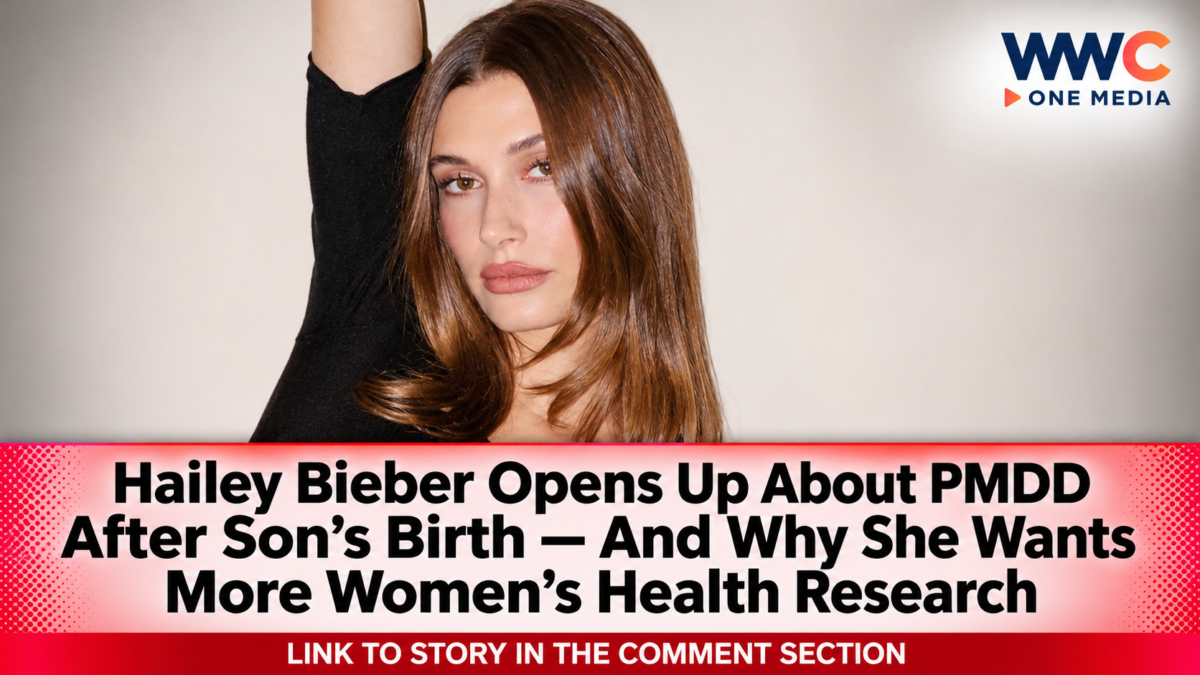
Hailey Bieber is opening up about a health issue she experienced after becoming a mother, revealing that she struggled with premenstrual dysphoric disorder (PMDD) following the birth of her son, Jack.
The model and Rhode founder discussed the condition in a recent interview with Women’s Wear Daily, explaining that she found there was not enough conversation or research surrounding PMDD.
Her disclosure comes as Rhode announces a US$5 million commitment over three years to the Foundation for Women’s Health, an initiative focused on addressing longstanding gaps in women’s health research.
For Bieber, the two developments are closely connected.
She says her own experiences with pregnancy, childbirth and postpartum recovery have made her increasingly aware of how much remains unknown — and under-discussed — about women’s health.
Bieber says PMDD became an issue after giving birth
Bieber welcomed her first child, son Jack Blues Bieber, with husband Justin Bieber in August 2024.
In her WWD interview, she said that after having her son, she struggled with PMDD.
“After I had my son, I struggled with that [PMDD] a bit,” Bieber said, adding that there is not enough conversation or research about the condition.
Her comments were not presented as a claim that childbirth itself caused PMDD.
Rather, she described experiencing the condition in the period after becoming a mother.
That distinction matters because PMDD is a recognised condition involving severe symptoms associated with the menstrual cycle, while the postpartum period involves a much broader range of physical, hormonal and emotional changes.
What is PMDD?
Premenstrual dysphoric disorder is a severe, cyclical condition related to the menstrual cycle.
It can involve significant emotional and physical symptoms before menstruation, and its symptoms can be substantially more disruptive than those associated with typical premenstrual syndrome, or PMS.
The SHE MD episode featuring Bieber also discussed her experience with PMDD months after pregnancy, alongside other aspects of postpartum recovery.
PMDD can affect mood, relationships, daily activities and overall quality of life.
Because symptoms occur in relation to the menstrual cycle, recognising the pattern can be important when clinicians evaluate the condition.
It is also important not to treat every emotional or physical change after childbirth as PMDD.
Postpartum experiences can involve many different conditions and circumstances, and an appropriate diagnosis requires professional assessment.
Why Bieber says talking about PMDD matters
Bieber said speaking openly about the condition has helped her feel less alone.
She told WWD that conversations about women’s health issues can help people identify with one another and recognise that they are not necessarily experiencing their struggles in isolation.
That is a major part of the significance of her disclosure.
Celebrity health disclosures can sometimes generate attention without producing deeper understanding.
In this case, Bieber is using her platform to highlight an issue she believes does not receive enough public discussion or research.
Her comments also come at a time when women’s health has increasingly become a focus of investment, advocacy and medical research.
Motherhood changed how Bieber viewed women’s health
Bieber said becoming a mother changed her perspective on women’s health.
In her WWD interview, she described pregnancy and childbirth as an intense and significant experience that made her more aware of how much happens physically during the process of having a child.
She also pointed to health challenges experienced by people close to her, including friends and family members dealing with conditions such as endometriosis and PCOS.
That combination of personal experience and exposure to other women’s health challenges has pushed Bieber toward advocacy.
She told WWD that she feels frustrated by gaps in research, awareness and conversation surrounding specific women’s health conditions.
Rhode announces a US$5 million women’s health commitment
Bieber’s comments coincided with a major philanthropic announcement from Rhode.
The beauty company is committing US$5 million over three years to the Foundation for Women’s Health.
The organisation focuses on medical research, education and care in areas where women’s health has historically received insufficient attention.
The initiative will include work involving pregnancy and postpartum health, autoimmune conditions and other areas of women’s health research.
The foundation’s founder and executive director, Katy Brodsky Falco, said the partnership could provide both financial support and visibility for women’s health research.
Part of the money will support women’s health innovation
The US$5 million commitment is not simply a single research grant.
According to WWD reporting, US$1 million will establish the Foundation for Women’s Health Evergreen Fund, a venture-philanthropy vehicle intended to invest in companies developing women’s health diagnostics and therapeutics.
Any proceeds generated by those investments are intended to support additional research.
The remaining funding will support research, education and care initiatives in areas identified by the foundation.
Research institutions have submitted proposals, with the organisations receiving funding expected to be announced in 2027.
Why women’s health research remains a major issue
For decades, researchers and health advocates have pointed to gaps in scientific knowledge involving conditions that disproportionately affect women.
These gaps can influence how quickly diseases are recognised, how treatments are developed and how symptoms are understood.
Conditions such as endometriosis and PCOS have received growing attention, but significant research needs remain.
Women’s reproductive health is also closely connected to broader areas including cardiovascular health, autoimmune disease, mental health and maternal care.
Bieber’s comments therefore arrive amid a much larger conversation about whether research funding adequately reflects the health needs of women.
Her own postpartum experience was more complicated than PMDD alone
Bieber has previously spoken about other aspects of her pregnancy and postpartum experience.
Earlier this year, she appeared on the SHE MD podcast and discussed her pregnancy, which she described as a surprise, as well as a uterine septum that doctors had identified.
She also discussed complications during delivery and postpartum recovery.
The podcast episode covered her experience with postpartum hemorrhage, anxiety, breastfeeding and pelvic-floor rehabilitation.
The discussion shows that her postpartum experience involved several separate health issues rather than one single condition.
That distinction is important when discussing celebrity health stories: one diagnosis should not automatically be used to explain every symptom someone experiences.
Bieber has also spoken about a previous health scare
Bieber’s history of discussing women’s health publicly predates her latest comments.
On the SHE MD podcast, she discussed experiencing a transient ischemic attack, or TIA, at age 25 and the subsequent testing that led doctors to identify and close a patent foramen ovale, or PFO.
The podcast episode also explored why the condition was initially difficult to identify.
Her willingness to discuss such experiences has contributed to her broader interest in encouraging conversations about women’s health.
Her message is about awareness, not self-diagnosis
One of the most important points surrounding Bieber’s disclosure is that a celebrity’s experience should not become a substitute for medical evaluation.
PMDD has specific diagnostic criteria, and symptoms can overlap with other physical or mental-health conditions.
Likewise, experiencing mood changes, fatigue or physical discomfort after childbirth does not automatically mean someone has PMDD.
Bieber’s message is primarily about visibility and conversation.
She has said that discussing her own experience makes her feel less alone and that she hopes greater awareness will encourage more attention to under-researched women’s health issues.
Rhode’s investment expands Bieber’s advocacy
The US$5 million commitment gives Bieber’s public advocacy a financial component.
Rather than only discussing research gaps, Rhode is now putting substantial funding behind an organisation whose goal is to address those gaps.
The initiative builds on Rhode Futures Fund programmes that have previously supported women and mothers.
Between 2025 and 2026, its Support for Moms Fund committed US$2 million to 10 organisations providing income and resources to mothers and caregivers, according to WWD.
The company also committed US$1 million toward relief for families affected by the 2025 Los Angeles wildfires.
The initiative comes after Rhode’s sale to E.l.f. Beauty
Bieber’s health advocacy is taking place alongside a major transformation of her business.
E.l.f. Beauty acquired Rhode in 2025 in a deal valued at up to US$1 billion.
According to WWD, Rhode generated more than US$500 million in annualised global retail sales and approximately US$390 million in net sales in fiscal 2026, with net sales up more than 80% year over year.
The acquisition also expanded Bieber’s responsibilities.
She now has a strategic advisory role at E.l.f. while continuing her work connected to Rhode.
That gives her a much larger platform from which to promote women’s health causes.
Bieber says she wants more honest conversations
The theme running through Bieber’s comments is not simply that women should know about PMDD.
It is that women should feel able to discuss health problems that may otherwise remain private.
She has described the lack of conversation around certain conditions as frustrating and believes visibility can help reduce the sense of isolation that sometimes accompanies poorly understood health problems.
That can be particularly relevant for conditions that are cyclical, difficult to identify or frequently misunderstood.
Why the research gap matters
Awareness can encourage people to ask questions.
But research is what can ultimately improve diagnosis and treatment.
That is why the Foundation for Women’s Health partnership is significant beyond its celebrity connection.
The organisation aims to support research and help move discoveries toward practical medical applications.
Its leadership has said the goal is not only to fund research but to help translate findings into diagnostics and treatments.
That is a longer-term process.
Research funding does not immediately produce a new treatment, and the success of any individual project cannot be guaranteed.
But advocates argue that sustained investment is necessary if historically underfunded areas are to make progress.
Bieber’s story also highlights the complexity of postpartum health
Postpartum recovery is often portrayed as a short period immediately following childbirth.
In reality, recovery can involve physical, hormonal and emotional changes that continue well beyond delivery.
Bieber’s own account illustrates that complexity.
Her SHE MD discussion covered postpartum anxiety, PMDD months later, breastfeeding and pelvic-floor therapy, alongside the complications surrounding childbirth itself.
The broader lesson is that postpartum health cannot be reduced to whether a mother appears to have physically recovered.
Different people can experience very different challenges.
The celebrity effect can bring attention — but accuracy matters
Bieber’s public profile gives her comments an enormous audience.
That can help conditions such as PMDD reach people who might never encounter information about them otherwise.
But celebrity stories can also simplify complicated medical issues.
That is why health professionals and credible medical sources remain important when discussing symptoms, diagnosis and treatment.
Bieber’s story is one person’s experience.
It is not evidence that every person who gives birth will develop PMDD, nor does it establish that pregnancy or childbirth causes the condition.
A bigger conversation about women’s health
Bieber’s disclosure comes at a time when women’s health is receiving growing attention from businesses, researchers, advocates and policymakers.
Her US$5 million initiative adds private-sector funding to that conversation.
The areas targeted by the Foundation for Women’s Health include conditions and stages of life that can have significant effects on women but have historically received less research investment than other areas.
That makes the announcement potentially more consequential than a conventional celebrity charity campaign.
What happens next?
For Bieber, the next stage appears to involve continuing to use her public platform to discuss women’s health while Rhode supports research through the new partnership.
For the Foundation for Women’s Health, the immediate priority will be selecting research projects and putting the pledged funding to work.
The first grant recipients are expected to be announced in 2027.
For people interested in PMDD and postpartum health, Bieber’s disclosure may also encourage broader conversations with qualified health professionals — particularly because symptoms can overlap with other conditions and should not be self-diagnosed based on a celebrity’s experience.
The Bigger Question: Can Celebrity Visibility Help Close the Women’s Health Research Gap?
Hailey Bieber’s disclosure is ultimately about more than one celebrity revealing a private health struggle.
Her experience with PMDD after becoming a mother has become part of a much larger discussion about how women’s health conditions are recognised, researched and discussed.
Her decision to speak publicly may help make PMDD more familiar to a wider audience.
But awareness alone is not enough.
The US$5 million Rhode commitment puts money behind the argument that more research is needed — particularly in areas involving pregnancy, postpartum health and conditions that have historically received less attention.
The bigger question is whether high-profile voices such as Bieber’s, combined with sustained research funding, can turn greater awareness of women’s health into better evidence, earlier recognition and more effective care for women in the years ahead.