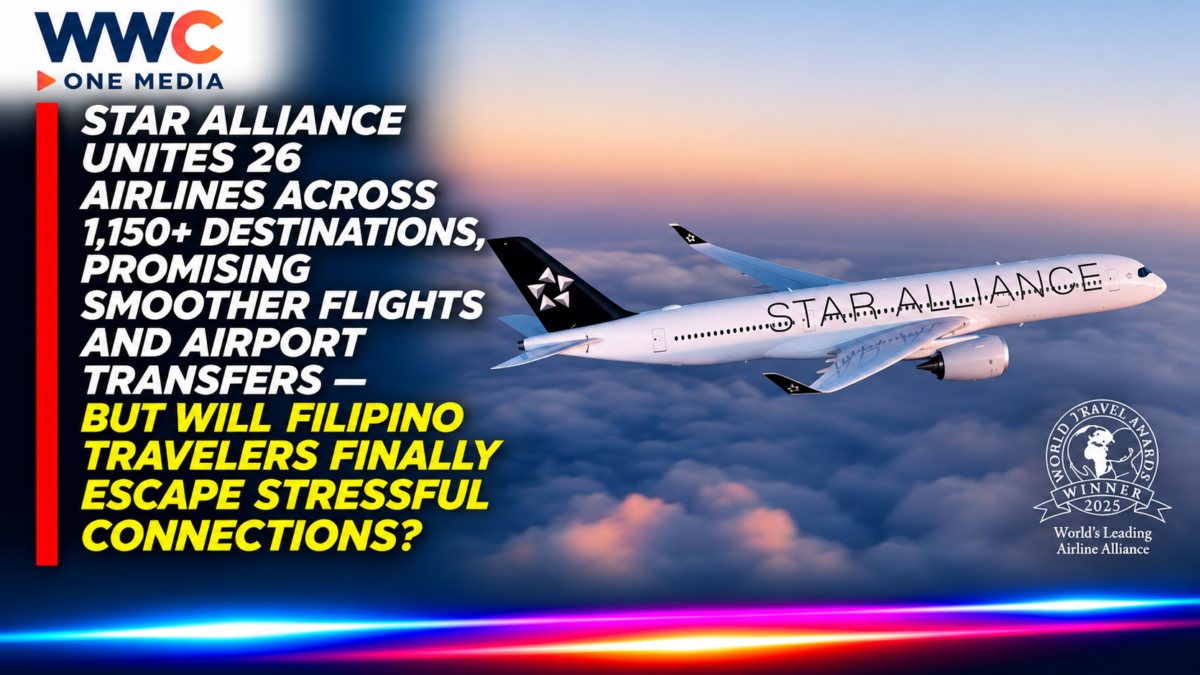
MANILA, Philippines — November 11, 2026 — International travel could become easier for millions of Filipino passengers as Star Alliance, the world’s largest airline alliance, intensifies its push to create a smoother flying experience across 26 member airlines serving more than 1,150 destinations worldwide.
From booking flights and navigating unfamiliar airports to switching airlines and collecting frequent-flyer rewards, the global aviation network wants passengers to experience a more consistent journey—even when their itinerary involves multiple carriers.
For the Philippines, the initiative is especially relevant.
Twelve Star Alliance member airlines currently operate in the country, offering Filipino travelers access to international connections through some of the world’s busiest aviation hubs.
These carriers include major names such as Singapore Airlines, United Airlines, Lufthansa, All Nippon Airways (ANA), Turkish Airlines, EVA Air and Thai Airways.
The effort comes as international travel continues to evolve and Philippine Airlines prepares to join rival oneworld in 2027, setting the stage for greater competition in airport connectivity, passenger benefits and loyalty programs.
But while Star Alliance is promising a more connected world, one important question remains: Can 26 independently operated airlines truly deliver the convenience of flying with a single carrier?
Star Alliance Wants to Make 26 Airlines Feel Like One Network
During a media gathering at Hilton Manila on November 10, Star Alliance Country Sales and Marketing Group Chairperson Malu Oclarence-Dueñas outlined the challenge of maintaining consistent service across a network of independently operated airlines.
The alliance is focusing on four critical stages of the passenger journey:
- Flight bookings: Making it easier to plan journeys involving multiple member airlines.
- Airport navigation: Helping passengers move through participating airports more conveniently.
- Flight connections: Improving coordination when travelers transfer between aircraft and carriers.
- Frequent-flyer benefits: Supporting eligible mileage earning, redemption and recognition across the network.
According to InsiderPH, Star Alliance has developed more than 50 common service requirements to encourage consistent passenger service among its members.
The requirements are intended to reduce the inconvenience that can occur when travelers move between different airline systems.
For passengers connecting through major airports in Singapore, Tokyo, Taipei, Frankfurt or other international hubs, the initiative could help make complicated itineraries more manageable.
However, specific services depend on the participating airline, airport, fare conditions and passenger eligibility.
Alliance membership does not mean every traveler automatically receives identical benefits on every flight.
Why Filipino Travelers Could Benefit
For Filipino passengers, international travel frequently involves connecting flights, particularly when traveling to destinations without nonstop service from Manila or Cebu.
An overseas Filipino worker traveling to a European city, for example, may need to connect through an international hub before reaching the final destination.
A tourist heading to a secondary Japanese city may also need to switch flights within Japan or connect through another Asian gateway.
Without effective coordination between carriers, passengers can encounter complicated check-in procedures, baggage concerns, unfamiliar airport terminals and uncertainty over missed connections.
Star Alliance aims to reduce those challenges through closer cooperation among member airlines.
The potential benefits include more convenient connecting itineraries, wider route choices and opportunities to earn or redeem eligible frequent-flyer rewards across participating carriers.
The alliance’s network connects travelers to major destinations in Asia, Europe, North America, Africa and Oceania.
Its reach is particularly valuable for travelers whose destinations are not directly served by Philippine airports.
The larger network can also offer alternative routing options, although the cheapest or fastest itinerary is not necessarily operated by an alliance member.
ANA Says Filipino Travelers Are Becoming More Independent
Fresh reporting by PhilSTAR Life offers another perspective on why Star Alliance’s focus on convenience matters.
During the November 10 media briefing, Jane Santos, sales manager of All Nippon Airways, said Filipino travelers are becoming increasingly confident in organizing international trips independently.
Instead of relying entirely on traditional travel agencies, experienced passengers are booking directly through airline websites, monitoring promotional fares and building their own itineraries.
Santos also observed growing interest in Japanese destinations beyond traditional gateways such as Tokyo and Osaka.
Cities including Fukuoka and Nagoya are becoming part of the broader travel conversation as Filipino passengers grow more comfortable exploring unfamiliar destinations.
Mobile applications, digital booking tools and better access to travel information are contributing to that shift.
For airlines, these developments suggest that travelers increasingly expect transparent booking systems, convenient transfers and reliable digital services.
Star Alliance’s investment in customer experience responds to those expectations.
The objective is not simply to offer more flights, but to make complex international itineraries easier for passengers to understand and manage.
Can Star Alliance Reduce Missed Connections and Lost Baggage?
One of the most important challenges in international aviation is handling passengers who are at risk of missing their connecting flights.
A delay on the first leg of a journey can create problems for the next flight, especially when two different airlines are involved.
Star Alliance has developed a Connection Service program to address such situations at selected major airports.
According to the alliance’s official information, the service operates at 11 major hubs, including Chicago O’Hare, Frankfurt, Munich, Toronto, Houston and Washington Dulles.
The system monitors certain passenger and baggage connections using real-time flight information.
When an inbound flight is delayed and a connection becomes tight, participating airport teams may take steps to help passengers or expedite baggage transfers.
Depending on the airport, these measures can include assisting travelers as they disembark or accelerating the movement of checked luggage between aircraft.
However, the service does not guarantee that every delayed passenger will make a connecting flight.
Its availability and capabilities also vary by airport.
That distinction matters because connecting passengers remain vulnerable to delays caused by weather, air traffic restrictions, security procedures and airport congestion.
In related coverage, WWC ONE MEDIA reported that more than 300 Philippine flights face cancellations or schedule changes during the November 16–18 ASEAN Summit.
Although those disruptions are a separate development, they illustrate why passengers increasingly value reliable flight information and effective coordination between airlines and airports.
Frequent-Flyer Miles Could Become More Valuable
Another major advantage of airline alliances is access to frequent-flyer benefits across multiple carriers.
Star Alliance supports reciprocal arrangements among participating loyalty programs, allowing eligible passengers to earn and redeem miles on qualifying flights.
The alliance also provides Star Alliance Silver and Gold recognition, with benefits determined by membership status and participating airline rules.
Eligible Star Alliance Gold passengers may receive privileges such as priority check-in, additional baggage allowances and access to participating airport lounges.
These privileges can be valuable for business travelers, overseas Filipino workers and frequent international tourists.
But the benefits are not universal.
The number of miles earned, the availability of reward seats, baggage entitlements and lounge access can depend on the specific program, booking class and operating airline.
The broader aviation industry is also experimenting with ways to make loyalty rewards more flexible.
As previously examined by WWC ONE MEDIA in its report on American Airlines’ cash-and-miles ticketing initiative, airlines are increasingly using loyalty innovations to attract and retain customers.
American Airlines belongs to rival oneworld, not Star Alliance, but the development illustrates how competition extends beyond ticket prices to the value and convenience of frequent-flyer programs.
For consumers, the most valuable benefit may be the ability to compare multiple airline networks and choose programs suited to their travel habits.
Philippine Airlines’ oneworld Entry Could Intensify Competition
Star Alliance’s renewed emphasis on seamless travel comes at an important moment for Philippine aviation.
Philippine Airlines announced in June 2026 that it had received an invitation to join the oneworld alliance.
PAL is expected to become the alliance’s 16th member, with its planned integration targeting 2027.
The move could significantly expand the international connections available to passengers traveling with the Philippine flag carrier.
Oneworld includes major airlines such as American Airlines, British Airways, Cathay Pacific, Japan Airlines, Qantas, Qatar Airways and Malaysia Airlines.
For Philippine travelers, PAL’s eventual participation could provide another option for international connections and qualifying loyalty benefits.
However, planned membership should not be confused with benefits that are already active.
The timing and availability of specific reciprocal services will depend on PAL’s completion of the required integration processes.
The development also creates an important competitive dynamic.
Star Alliance already serves the Philippines through 12 member carriers, while PAL’s planned oneworld membership could strengthen a rival global network’s presence in the country.
As WWC ONE MEDIA reported on Philippine Airlines’ November 9 launch of nonstop Manila–Chicago flights, the carrier is pursuing international expansion while managing the financial challenges of long-haul aviation.
Alliance participation could eventually complement that strategy by improving cooperation with overseas partners.
Whether it delivers lower fares, greater passenger convenience or stronger airline profitability will depend on how successfully those partnerships are implemented.
Cebu Airport’s Transfer-Hub Ambitions Highlight the Same Challenge
The Star Alliance initiative also reflects a wider shift in international airport competition.
Travelers increasingly judge airports not only by terminal quality but also by how easily they can move between flights.
In the Philippines, Mactan-Cebu International Airport has been pursuing a similar objective through its CEB Connects initiative.
The program aims to improve connections between international and domestic flights, helping Cebu develop into a more competitive transfer gateway.
According to WWC ONE MEDIA’s report on Cebu airport’s public-private partnership and transfer-hub ambitions, the airport’s transfer system has processed more than 500,000 passengers, with transfer traffic rising since its introduction.
The development highlights a common challenge facing airlines and airports worldwide.
Adding new routes is important, but travelers also need dependable connections, clear transfer procedures and efficient baggage handling.
Cebu’s airport strategy is distinct from Star Alliance’s global network, and it does not mean CEB Connects automatically provides the same services as the alliance’s Connection Service.
Nevertheless, both initiatives reflect growing demand for smoother journeys.
Star Alliance’s Nearly 30-Year Evolution
Star Alliance was established on May 14, 1997, originally bringing together five airlines: Air Canada, Lufthansa, Scandinavian Airlines, Thai Airways and United Airlines.
Its goal was to establish a global airline network through which passengers could access destinations served by different carriers while benefiting from coordinated services.
Over nearly three decades, the alliance has expanded into a network of 26 airlines.
Its members include major full-service carriers operating across six continents.
The network’s scale creates significant opportunities for route coordination and frequent-flyer cooperation.
Star Alliance also received the World’s Best Airline Alliance distinction at the 2025 Skytrax World Airline Awards.
Recognition has helped strengthen its reputation, but awards alone cannot eliminate the operational challenges involved in international travel.
Independent airlines continue to operate with different aircraft, reservation systems, airport arrangements and commercial priorities.
Aligning those systems remains a substantial undertaking.
The Real Challenge: Making Global Travel Simpler
As passenger expectations evolve, airline alliances face increasing pressure to demonstrate benefits beyond their extensive route maps.
Travelers now expect smooth digital booking, timely flight information, clear baggage rules and reliable assistance during disruptions.
They also want to understand their rights when flights are delayed or canceled, particularly when an itinerary includes several carriers.
Star Alliance’s service standards and shared technology initiatives aim to address these needs.
But successful implementation will depend on how consistently individual members deliver those services.
A passenger’s experience can still vary depending on the route, airport and airline operating each flight.
This means the alliance’s next major achievement may not be measured solely by adding new members or destinations.
It may depend on reducing the friction that travelers encounter between booking their ticket and reaching their final destination.
What Happens Next for Filipino Flyers?
With 12 Star Alliance member airlines operating in the Philippines, Filipino travelers already have access to an extensive international network.
The alliance’s push for more consistent service could make its member carriers more attractive to passengers who frequently connect through overseas airports.
At the same time, Philippine Airlines’ planned entry into oneworld could introduce stronger competition for frequent-flyer loyalty and international connecting traffic.
For consumers, that competition may encourage better services, more convenient travel options and improvements in digital passenger support.
However, cheaper tickets, guaranteed baggage transfers and disruption-free travel should not be assumed.
Passengers will still need to compare fares, verify connection times and check the conditions attached to airline benefits.
The bottom line: Star Alliance is trying to make international travel across 26 independent airlines feel more connected, predictable and convenient.
Its vast network offers Filipino passengers greater access to overseas destinations, while its coordinated service requirements and airport assistance programs aim to make complicated journeys easier.
But as global airlines compete for passengers and Philippine Airlines prepares to join rival oneworld, the bigger question is no longer simply how many destinations an alliance can reach.
Can Star Alliance deliver a genuinely seamless travel experience across 26 different airlines—or will complicated connections, inconsistent services and unexpected delays remain part of international flying?