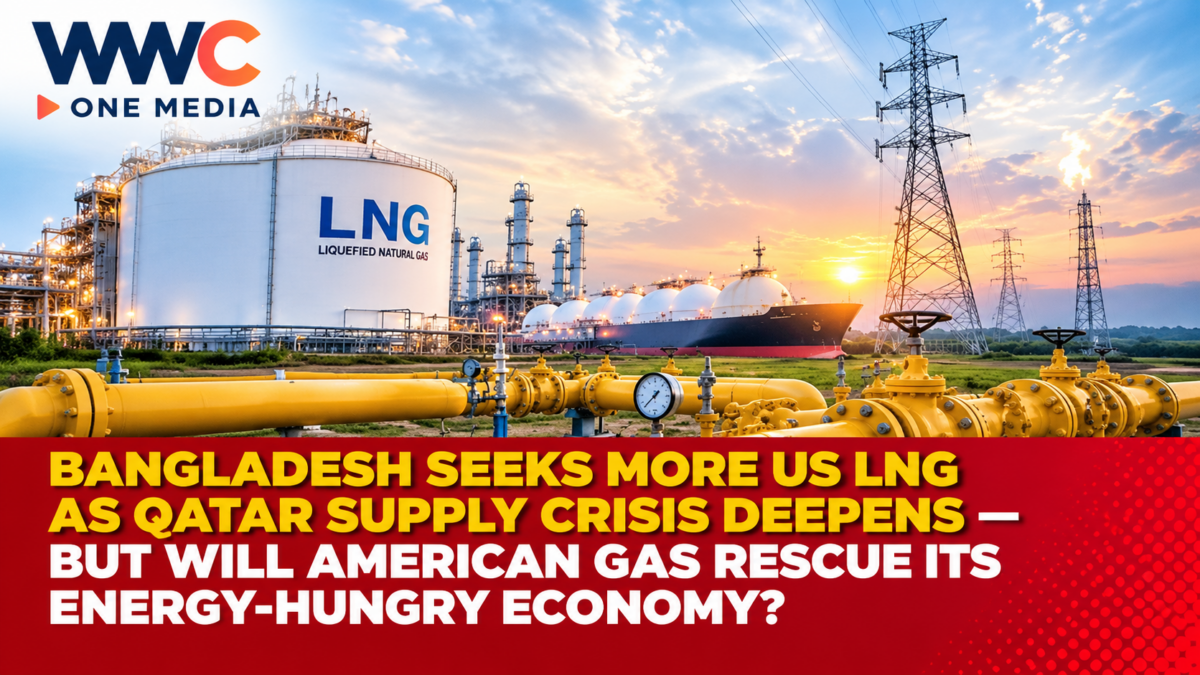
DHAKA, Bangladesh — October 30, 2026. Bangladesh is intensifying discussions to purchase more American liquefied natural gas (LNG), seeking to protect its economy from persistent Middle Eastern supply disruptions that have driven up fuel prices and strained electricity generation and industrial activity.
US Ambassador to Bangladesh Brent T. Christensen has indicated that additional agreements with American energy suppliers are being explored, according to Bloomberg’s October 30 report.
The discussions reflect a broader shift in Bangladesh’s energy strategy as the country tries to reduce its exposure to disrupted shipping through the Strait of Hormuz and unreliable deliveries from traditional Gulf suppliers.
The United States is positioning itself as an alternative source of fuel, building on a bilateral energy cooperation agreement signed in May 2026 and subsequent LNG procurement arrangements.
But securing gas from a different supplier will not automatically make it affordable.
Bangladesh has already faced exceptionally high prices for emergency cargoes, while its domestic gas production and import infrastructure remain under pressure.
The biggest question is whether closer energy cooperation with Washington can deliver dependable gas at manageable prices—or simply replace one form of dependence with another expensive long-term commitment.
US ambassador points to further LNG agreements
The latest diplomatic discussions highlight the growing importance of energy in Bangladesh–US economic relations.
Ambassador Christensen has been advocating stronger ties involving LNG, liquefied petroleum gas, energy infrastructure and American investment.
According to Bloomberg’s October 30 report, Bangladesh is discussing further purchases of US gas.
This builds on earlier negotiations rather than marking the beginning of an entirely new relationship.
On May 14, US Energy Secretary Chris Wright signed a memorandum of understanding on strategic energy cooperation with Bangladesh.
The framework covers LNG, petroleum products, LPG and other energy industries, as well as potential investment and infrastructure development.
The agreement was intended to support long-term energy security and strengthen bilateral commercial relations.
But the memorandum itself did not specify a binding price, cargo volume or delivery schedule for all future purchases.
Individual procurement agreements are still needed to determine those commercial terms.
Bangladesh previously approved 117 LNG cargoes from Gunvor
A major step came in August, when Bangladesh approved a long-term procurement arrangement involving US-based Gunvor USA.
Reuters reported that the government authorized the purchase of 117 LNG cargoes covering deliveries from 2026 through 2038.
The agreement was intended to reduce uncertainty over future fuel availability during a period of serious disruption in global LNG markets.
The initial delivery schedule included five cargoes in 2026, six in 2027 and six in 2028, with an additional supply schedule extending through 2038.
However, the agreement’s pricing became controversial.
Bangladeshi officials initially raised concerns about Gunvor’s proposed charges, and an earlier version of the arrangement was held up before later government approval.
The August authorization should therefore be distinguished from the October 30 discussions about possible additional contracts.
It would be inaccurate to describe the 117 cargoes as newly purchased on October 30.
Likewise, a government approval is not proof that every cargo has been delivered or that all payments have already been made.
LNG pricing could determine whether the strategy succeeds
One of the most important features of the Gunvor arrangement is its use of two pricing benchmarks.
Initial deliveries were linked to the Japan Korea Marker, commonly called JKM, which reflects the Asian LNG market.
Later deliveries were structured around the US Henry Hub natural gas benchmark, with additional charges.
The published terms identified a formula equivalent to 121% of Henry Hub plus $5.20 per million British thermal units for certain later years.
The pricing structure matters because the market value of US natural gas can differ substantially from LNG prices in Asia.
However, buyers must also account for liquefaction, shipping, regasification and contractual premiums.
A lower US gas benchmark does not automatically translate into a cheaper delivered LNG cargo.
The commercial advantage depends on the complete contract price and the cost of getting the fuel to Bangladesh.
That makes price transparency especially important when the government considers large multiyear purchasing commitments.
Qatar’s continuing supply crisis increases the urgency
Bangladesh’s interest in US LNG has intensified because its established Middle Eastern supply network remains disrupted.
Qatar has traditionally been one of Bangladesh’s principal LNG suppliers.
But the conflict involving the United States, Israel and Iran has severely affected energy infrastructure and shipping routes in the Persian Gulf.
On October 27, Reuters reported that QatarEnergy had extended force majeure affecting customers in South Asia and Europe through the end of 2026.
The affected buyers included Bangladesh and Pakistan.
Force majeure is a contractual mechanism used when extraordinary circumstances prevent a party from performing certain obligations.
It does not necessarily cancel the underlying contracts permanently.
But the interruptions mean buyers may need to source replacement cargoes, potentially at much higher prices.
For Bangladesh, this creates a direct threat to the supply of fuel needed for electricity generation, industrial production and other economic activities.
Strait of Hormuz disruption changes Asia’s energy calculations
The Strait of Hormuz is one of the world’s most strategically important shipping corridors.
Before the current conflict, roughly one-fifth of global LNG trade moved through the waterway.
Disruptions have raised the cost and uncertainty of importing fuel from the Persian Gulf.
For Asian governments, the experience has strengthened the argument for diversifying suppliers and transportation routes.
WWC ONE MEDIA examined the regional issue in Middle East War Pushes ASEAN to Strengthen Energy Security Plans.
Although Bangladesh is not an ASEAN member, it faces many of the same vulnerabilities as neighboring energy-importing economies.
The crisis also highlights the difference between having a long-term supply contract and receiving fuel when it is urgently needed.
Contracts reduce some commercial uncertainty, but they cannot prevent every disruption caused by war, damage to export terminals or restrictions on shipping.
Emergency LNG prices approach $30 per MMBtu
Bangladesh’s struggle to secure replacement gas has already become expensive.
In September, the government approved spot purchases from international suppliers at prices approaching $30 per million British thermal units.
The Daily Star reported an approved cargo from TotalEnergies priced at $28.95 per MMBtu and another from Vitol Asia at $29.795.
Those figures were substantially higher than typical prewar import prices.
The difference has important consequences for the public budget and energy-intensive industries.
When the government purchases gas at unusually high prices, it must decide how much of the cost is passed to customers and how much is absorbed through public finances or other arrangements.
Higher energy costs can affect electricity generation, fertilizer production, industrial competitiveness and household living expenses.
This is why obtaining additional cargoes may ease physical shortages without immediately relieving financial pressure.
Bangladesh needs both security of supply and a sustainable purchasing cost.
Energy shortages have already disrupted Bangladesh’s economy
The country’s gas problems are not caused solely by international trade disruptions.
Bangladesh also faces declining domestic gas production and limitations in its LNG import infrastructure.
In August, a fire-related shutdown at an Excelerate Energy floating LNG terminal off Moheshkhali affected a substantial share of imported gas capacity.
Reuters reported that the facility normally regasifies approximately 500 million to 550 million cubic feet of gas per day.
A partial restart added around 115 million cubic feet per day to the national grid, easing some of the pressure.
But the incident demonstrated how vulnerable the energy system can become when a major import facility stops operating.
Reuters also reported that Bangladesh’s daily gas consumption requirement was approximately 3,800 million to 4,000 million cubic feet, while grid supplies averaged about 2,600 million.
The gap creates pressure on industrial consumers and electricity generation.
The figures are estimates for the reported period and should not be treated as a continuously updated measurement.
US companies are also seeking LNG terminal investments
Washington’s commercial interest extends beyond selling gas cargoes.
American businesses have expressed interest in Bangladesh’s floating storage and regasification infrastructure.
These facilities receive LNG from tankers, store it and convert the liquid back into gaseous form for delivery to consumers.
In September, Ambassador Christensen said US companies were interested in participating in additional floating LNG terminal projects.
He emphasized the importance of transparent and competitive procurement arrangements.
Bangladesh’s commerce minister indicated that capable American firms could receive serious consideration.
However, interest in an infrastructure project does not establish that a contract has been awarded or construction has begun.
Additional terminals would require financing, permits, engineering work and eventual commissioning.
They would also need reliable downstream pipelines and demand from electricity producers and industrial users.
Without those complementary investments, expanding LNG imports may not fully resolve the country’s gas shortages.
Chevron and Excelerate Energy remain important US-linked players
American companies already have a significant presence in Bangladesh’s gas industry.
Chevron operates major domestic gas assets and, according to the US Embassy’s May reporting, supplies close to 60% of Bangladesh’s natural gas.
Excelerate Energy provides LNG infrastructure services that help Bangladesh receive imported fuel.
Ambassador Christensen met representatives of both companies earlier in the year to discuss expanding cooperation.
Their involvement illustrates that the United States can participate in Bangladesh’s energy sector through domestic gas production, imported LNG, infrastructure investment and technical services.
However, production from Bangladeshi gas fields and shipments of US-origin LNG are different activities.
Gas produced locally by a US company should not automatically be described as American LNG imports.
That distinction matters when evaluating trade balances and the government’s effort to diversify overseas fuel supplies.
Bangladesh–US trade ties add a political dimension
The energy negotiations are also connected to wider economic relations between Dhaka and Washington.
A bilateral trade framework has encouraged greater purchases of American products.
The Daily Star reported that Bangladesh had signaled approximately $15 billion in US energy purchases over 15 years as part of its trade-related commitments.
That reported figure represents a broader long-term framework, not a new contract announced on October 30.
Some Bangladeshi economists and political figures have questioned whether major purchasing commitments are commercially advantageous, particularly if they are influenced by tariff negotiations.
Supporters of stronger US energy ties argue that diversifying supply sources reduces exposure to Gulf disruptions and creates opportunities for investment.
Critics argue that imported fuel must still be evaluated on price, contractual flexibility and long-term economic value.
The government must balance its diplomatic objectives with the practical requirements of consumers and businesses.
Asian economies face competing choices over energy security
Bangladesh is not the only Asian economy seeking alternatives to disrupted Middle Eastern fuel supplies.
The crisis has encouraged governments and utilities across the region to revisit LNG sourcing strategies.
South Korea, for example, has examined US energy infrastructure opportunities while weighing their commercial costs.
WWC ONE MEDIA covered the debate in Trump Wants South Korea to Put Billions Into Alaska LNG — But Seoul Is Hesitating Over One Massive Risk.
The report highlighted the difference between the strategic benefits of diversifying suppliers and the economic challenge of financing expensive infrastructure.
Singapore has also strengthened its energy preparedness through international fuel partnerships and infrastructure planning.
WWC ONE MEDIA reported on Singapore Secures Major Saudi Oil Storage Deal as Jurong Island Prepares to Store Crude From 2027.
That arrangement involves crude oil rather than LNG, but it illustrates the region’s broader effort to increase resilience against global supply shocks.
For Bangladesh, the lesson is that energy security requires more than identifying new suppliers.
It also depends on affordability, infrastructure reliability and the flexibility to respond to future disruptions.
Singapore’s gas supply concerns offer another regional warning
Another illustration of Asia’s energy vulnerabilities emerged in October when Indonesia reduced natural gas exports to Singapore.
Although Singapore said the immediate impact was manageable, the episode raised questions about regional supply reliability.
WWC ONE MEDIA examined the development in Indonesia Slashes Natural Gas Exports to Singapore as Electricity Price Fears Rise.
The disruption involved pipeline gas rather than an LNG shipment.
Nevertheless, both cases show how energy-importing economies can be affected by changes in supplier priorities and infrastructure availability.
A diversified supply portfolio can reduce dependence on individual sources, but it may also expose buyers to different contract structures and market prices.
For Bangladesh, greater access to American LNG could provide flexibility, provided the new arrangements are commercially sustainable.
Longer-term demand must also be considered
Bangladesh’s energy strategy cannot focus exclusively on replacing the next missing cargo.
The country needs to consider how gas demand may evolve as it expands electricity generation, manufacturing and domestic energy production.
Long-term LNG contracts can provide supply certainty, but they can also create payment commitments that extend for many years.
If future demand falls below expectations, the country could face expensive contracted volumes.
If demand increases faster than supply infrastructure, shortages could persist despite additional purchase agreements.
The government must therefore align import contracts with realistic forecasts for consumption, domestic production and regasification capacity.
It also needs to evaluate how natural gas fits within its wider energy strategy, including renewable power, electricity-grid improvements and energy efficiency.
LNG generally has a lower carbon dioxide combustion intensity than coal, but it remains a fossil fuel and can carry significant lifecycle emissions, particularly when methane leakage is considered.
Long-term energy policy must account for both reliability and environmental consequences.
Could American LNG help stabilize global energy markets?
The United States has become a major supplier of liquefied natural gas to international buyers.
Additional exports can give countries more sourcing options and reduce reliance on particular regions.
But there are limits.
US LNG facilities require sufficient production, processing capacity, shipping access and commercial agreements.
New export projects can take years to develop.
Likewise, global prices respond to competition among buyers, not simply to the nationality of the supplier.
During a shortage, exporters may benefit from higher prices even as importers face financial stress.
The global significance of Bangladesh’s negotiations lies in the changing pattern of energy trade.
The more Asian buyers seek supplies outside the Persian Gulf, the greater the potential importance of US exporters.
But the real benefit to importing countries depends on what they pay and whether the fuel arrives reliably.
What should Bangladesh negotiate next?
Several issues will determine whether additional US LNG purchases strengthen Bangladesh’s economy.
The first is the price formula.
Contracts linked to Henry Hub may offer different cost characteristics from those tied to Asian spot prices, but the full delivered price must include all relevant charges.
The second is delivery flexibility.
Bangladesh needs to ensure that cargo schedules can accommodate fluctuations in demand and infrastructure availability.
The third is supplier concentration.
Replacing excessive dependence on one region with excessive dependence on another would create new risks.
The fourth is import capacity.
Additional purchases will offer limited relief if domestic facilities cannot receive and process the fuel when needed.
Finally, the government must consider transparency and public accountability when entering large, long-term purchasing agreements.
These questions are especially important because Bangladesh’s energy procurement costs can affect the wider economy.
The bigger question: Can Bangladesh buy its way out of the gas crisis?
The October 30 discussions signal that Bangladesh and the United States intend to deepen their energy relationship.
Washington sees opportunities to sell more LNG and expand American investment in the country’s gas infrastructure.
Dhaka sees an opportunity to diversify supplies after months of disruption involving its traditional Middle Eastern sources.
But the strategy carries significant financial risks.
Bangladesh has already encountered costly emergency cargoes, interruptions at import facilities and uncertainty over long-term supplier commitments.
Additional contracts could strengthen its energy security if they provide competitively priced and dependable deliveries.
They could also increase financial pressure if prices remain elevated or the agreements prove inflexible.
Bangladesh may be moving closer to securing more American gas. But the decisive question is whether the new supplies will bring lasting relief to its factories, power plants and households—or lock the country into another costly chapter of Asia’s energy crisis.