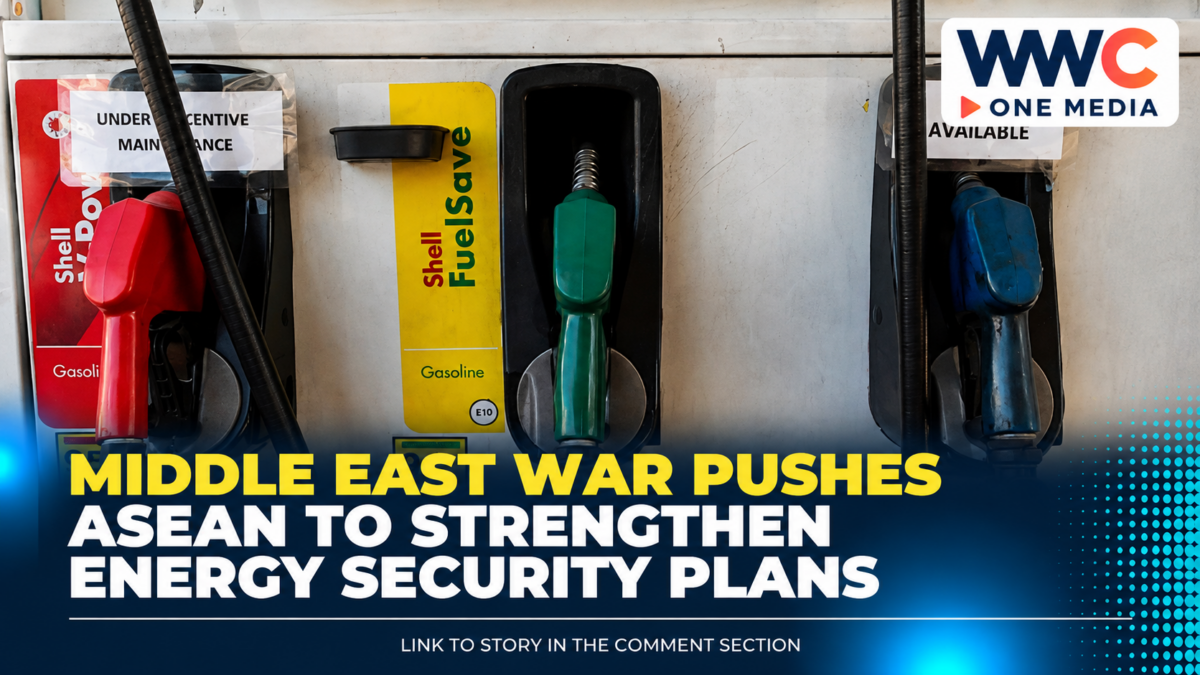
The prolonged conflict in the Middle East is forcing Southeast Asian countries to take a harder look at their dependence on imported energy, as disruptions to oil supplies and shipping routes expose vulnerabilities across the region.
Energy ministers from the Association of Southeast Asian Nations (ASEAN) are meeting in Manila this week, with energy security expected to be a major focus as the conflict involving the United States, Israel and Iran continues to affect global energy markets.
ASEAN relies on the Middle East for more than half of the crude oil used by its refineries. With global benchmark oil prices around US$100 a barrel, prolonged disruption could translate into higher fuel costs for households, businesses and transport operators across Southeast Asia.
The crisis has added urgency to plans for coordinated regional responses to fuel shortages while also highlighting the need for longer-term efforts to reduce ASEAN’s exposure to imported fossil fuels.
Ministers to review regional fuel-security measures
The ASEAN energy ministers are expected to review measures developed after emergency discussions earlier this year, including efforts to strengthen coordinated responses under the ASEAN Framework Agreement on Petroleum Security, or APSA.
The framework is intended to provide mechanisms for ASEAN members to cooperate during serious petroleum supply disruptions.
However, analysts have warned that putting an effective regional reserve system in place remains difficult because many Southeast Asian countries have limited fuel-storage capacity and inventories.
Alloysius Joko Purwanto, a senior energy economist at the Economic Research Institute for ASEAN and East Asia, has highlighted storage limitations as an obstacle to implementing the regional petroleum-security arrangements.
The issue is particularly significant because a major disruption to Middle Eastern supplies could affect oil volumes equivalent to nearly 28 per cent of ASEAN’s final oil consumption, according to a policy paper from the ASEAN Centre for Energy.
That figure illustrates the scale of the region’s exposure to disruptions originating far outside Southeast Asia.
Fuel prices put pressure on households and workers
The effects are already being felt through higher fuel costs.
In the Philippines, where the government remains under a national energy emergency, transport workers have faced sharply higher operating expenses.
Antonio Bandin, a Manila jeepney driver who joined a recent protest over rising fuel prices, told Reuters that his daily fuel bill had more than doubled to around 2,400 pesos, or about US$38.
Higher energy costs can spread through an economy because transportation is closely linked to the prices of food, manufactured goods and other everyday products.
For governments, the challenge is also complicated by the need to balance consumer relief with the cost of fuel subsidies and other measures designed to shield households from global price increases.
Philippine Energy Secretary Sharon Garin has said the country is exploring regional fuel-stockpiling arrangements and could potentially host future storage facilities.
But analysts caution that new reserves would primarily strengthen preparedness for future disruptions rather than provide an immediate solution to the current crisis.
Christopher Len, a senior fellow at the ISEAS-Yusof Ishak Institute, described reserves as a buffer rather than a complete strategy for dealing with energy insecurity.
ASEAN looks beyond emergency oil reserves
While emergency fuel supplies are part of the discussion, ASEAN ministers are also expected to consider ways to reduce the region’s structural dependence on imported fuels.
Renewable energy, electric vehicles, energy efficiency and greater regional electricity connectivity are expected to play important roles.
One of the major projects under discussion is the ASEAN Power Grid, which seeks to strengthen electricity connections between member states and allow countries to share power more efficiently.
The International Energy Agency estimates that cross-border links under the ASEAN Power Grid will require about US$27 billion in investment by 2040.
Greater electrification could also reduce the region’s dependence on imported oil, particularly in transportation and other sectors where petroleum remains dominant.
The IEA has said Southeast Asia’s energy import bill could rise from more than US$80 billion in 2024 to around US$245 billion by 2035 without structural changes.
It has recommended greater electrification, renewable energy, biofuels and diversification of energy supplies to reduce exposure to volatile international markets.
Energy demand is continuing to rise
The challenge is becoming more urgent because Southeast Asia’s energy needs are growing rapidly.
The IEA said energy demand per person in the region has increased by almost 30 per cent over the past decade, driven by economic development, industrialisation, urbanisation and improving living standards.
At the same time, regional crude oil production has fallen significantly from its peak in the 1990s, increasing reliance on imports.
The agency also expects electricity demand in Southeast Asia to rise by an average of about 5.4 per cent annually between 2026 and 2030.
Growing demand from cooling systems, industry and data centres will place additional pressure on electricity networks, making reliable and diversified energy supplies increasingly important.
Middle East disruption exposes a wider vulnerability
The conflict has demonstrated how developments in one part of the world can quickly affect economies thousands of kilometres away.
Disruptions to shipping through important Middle Eastern waterways can increase the cost and difficulty of transporting oil and other energy products to Asian markets.
Southeast Asia is particularly exposed because much of its crude supply originates in the Middle East.
The Strait of Hormuz has been especially important in the current crisis. Disruptions to energy flows through the waterway have highlighted the risks faced by Asian economies that depend heavily on imported fossil fuels.
The World Economic Forum has noted that around 80 per cent of crude oil passing through the Strait of Hormuz is destined for Asian markets, while about 55 per cent of ASEAN’s crude oil imports originate from the Middle East.
The disruption has therefore pushed energy security higher on the regional policy agenda, alongside concerns about food prices, supply chains and economic stability.
China adds another layer of uncertainty
ASEAN’s energy concerns have also been complicated by developments in China.
Chinese refiners have suspended oil-product exports for October, adding another potential source of pressure to regional fuel markets.
Because China is a major player in Asian energy markets, changes in its refining and export policies can influence the availability and pricing of petroleum products across neighbouring economies.
This means ASEAN countries are facing not only the direct risks associated with Middle Eastern supply disruptions but also possible knock-on effects from decisions made by major energy consumers and producers elsewhere in Asia.
Turning the crisis into a longer-term strategy
The immediate priority for ASEAN is to make sure member states can respond if energy supplies become severely disrupted.
But the longer-term challenge is reducing the vulnerability that made the current shock so damaging in the first place.
That means diversifying energy sources, expanding renewable generation, improving energy efficiency, increasing electricity interconnections and encouraging the adoption of electric vehicles.
The IEA’s latest regional review, released ahead of the ASEAN energy ministers’ meeting, calls for stronger national preparedness and deeper regional cooperation across oil, gas, coal, electricity and critical minerals.
The crisis has also reinforced the importance of regional coordination. ASEAN energy ministers had already held a special meeting in April to discuss the Middle East situation and its implications for regional and global energy security.
For Southeast Asia, the current conflict is therefore more than a question of fuel prices. It has become a test of how resilient the region’s energy systems are when global supply chains are disrupted.
As ministers meet in Manila, the focus is shifting from simply managing the immediate price shock to building an energy system that is less dependent on a single region and better prepared for the next major disruption.