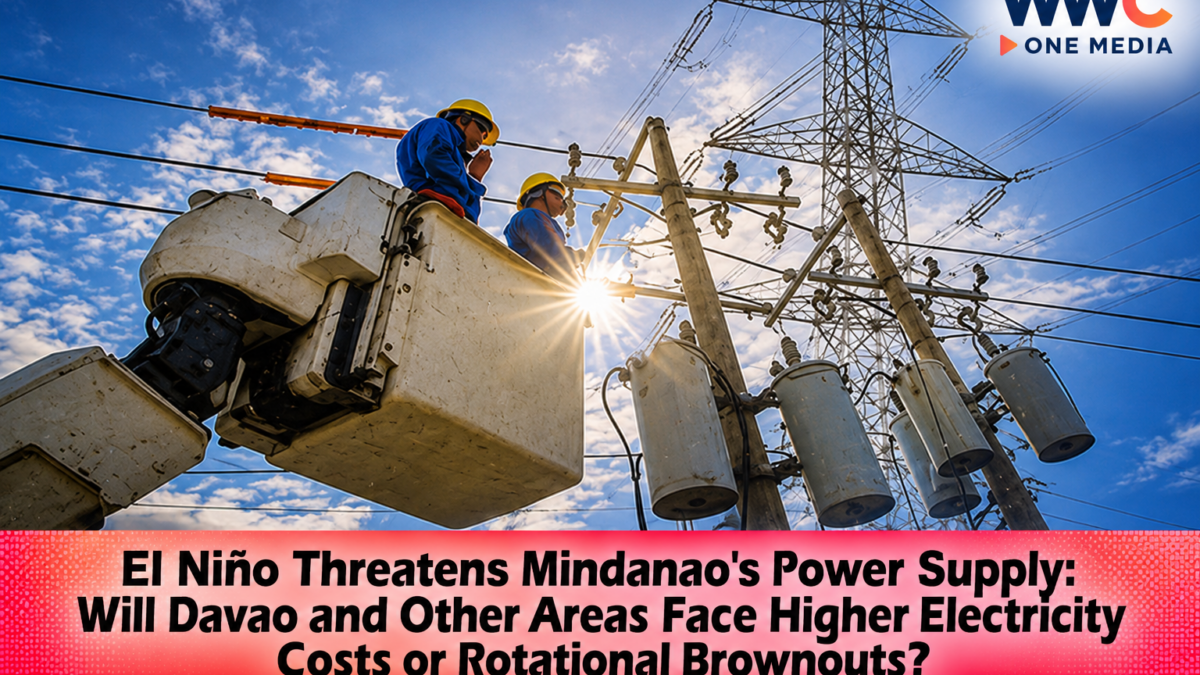
DAVAO CITY, Philippines — Mindanao’s electricity supply is facing another major test as the developing El Niño threatens to reduce water levels in hydroelectric facilities, raising concerns over power generation, grid stability and electricity costs across the region.
The concern comes as Mindanao continues to deal with recurring power supply alerts, generating-plant outages and increasing electricity demand.
Although Davao Light and Power Company (DLPC) has assured consumers that its franchise area currently has a stable electricity supply, energy officials and industry stakeholders are preparing for the possible effects of prolonged dry conditions.
The biggest concern is the potential reduction in electricity generated by the Agus-Pulangi hydroelectric complex, one of Mindanao’s important power sources.
With less rainfall and declining water availability, hydroelectric facilities may struggle to maintain their usual generation capacity, potentially increasing the region’s dependence on other electricity sources.
Why El Niño Could Put Mindanao’s Electricity Supply at Risk
El Niño is a climate phenomenon associated with warmer-than-normal sea surface temperatures in the central and eastern equatorial Pacific.
In the Philippines, it typically increases the likelihood of below-normal rainfall, prolonged dry spells and warmer temperatures.
These conditions can affect hydroelectric power generation because dams and reservoirs depend on sufficient water inflows to operate efficiently.
For Mindanao, the Agus-Pulangi hydroelectric complex is particularly important.
During an October 23 report by the Philippine Information Agency (PIA), Davao City Councilor Louie John Bonguyan said nearly 50 percent of Davao Light’s power supply comes from the Agus-Pulangi hydroelectric source.
He explained that under reduced water availability, generation that could reach approximately 100 megawatts under favorable conditions might fall to around 50 to 60 megawatts.
Such a reduction could force Davao Light to obtain additional electricity from the Wholesale Electricity Spot Market (WESM), where prices may be higher than those under existing power supply arrangements.
This could create additional pressure on electricity procurement costs, depending on the amount of power purchased and the utility’s supply contracts.
Davao City Pushes for Additional Power as El Niño Approaches
The potential impact of El Niño has already prompted action from the Davao City Council.
According to PIA, the City Council passed a resolution seeking additional electricity from Therma South Inc. (TSI) and urging the company to accelerate its authorized power plant expansion.
The existing Therma South coal-fired facility has a generating capacity of approximately 300 megawatts, with an authorized expansion that could increase capacity to 620 megawatts.
Councilor Bonguyan said obtaining additional electricity from TSI could reduce Davao Light’s exposure to potentially more expensive WESM purchases.
The proposed expansion is part of broader efforts to strengthen the city’s electricity supply as water-dependent generation faces potential limitations.
However, an approved expansion does not automatically mean the additional capacity is already operating or available to consumers. Its actual contribution will depend on construction, regulatory requirements and commercial operation.
Davao Light Assures Consumers of Stable Electricity Supply
Despite the concerns surrounding El Niño, Davao Light has sought to reassure its customers.
In an October 22 report by Mindanao Times, DLPC reputation enhancement head Fermin Edillon said the company’s franchise area continued to have a stable electricity supply.
He explained that major power plant outages experienced between August and September had mostly ended, with several facilities returning to operation by mid-October.
However, some generating units remained under scheduled preventive maintenance.
Edillon also explained that Davao Light relies on a diversified electricity supply mix, including renewable and non-renewable energy sources.
While hydroelectric generation can decline during prolonged dry conditions, other sources, including coal-fired power plants, can help maintain electricity availability.
Davao Light also has power supply agreements with generating companies to support its electricity requirements.
The company said it could activate contingency measures, including participation in the Department of Energy’s Interruptible Load Program (ILP), if supply conditions become more challenging.
Under the program, participating large commercial and industrial consumers can temporarily disconnect from the main electricity grid and operate their own generators or other available power sources.
This helps free up electricity for other consumers during periods of tight supply.
Mindanao Has Already Experienced Serious Power Grid Alerts
The El Niño threat comes at a time when Mindanao’s power system has already experienced several periods of tight electricity reserves.
In September 2026, the National Grid Corporation of the Philippines (NGCP) declared red and yellow alerts on the Mindanao grid after available generation fell below projected demand.
According to a September 2 report by the Philippine News Agency, the grid had approximately 2,526 megawatts (MW) of available capacity against projected peak demand of 2,545 MW.
This left a supply gap of approximately 19 MW.
NGCP cited the unavailability of major generating units, including GNPower Kauswagan Units 1 and 2 and Therma South Unit 2, alongside increasing demand and declining available generation.
Another September 8 report by the Philippine Daily Inquirer documented further red and yellow alerts caused by unexpected plant outages and rising electricity demand.
The developments demonstrated how quickly Mindanao’s electricity reserves can become strained when major generating facilities become unavailable.
A red alert is declared when available supply is insufficient to meet consumer demand and the transmission grid’s regulating requirements.
A yellow alert, meanwhile, indicates that the operating margin is insufficient to meet the grid’s required contingency reserves.
Neither alert automatically means that all consumers will experience brownouts. However, a red alert increases the possibility of controlled power interruptions if supply cannot meet system requirements.
DOE Prepares Contingency Measures for a Stronger El Niño
The Department of Energy (DOE) is also preparing measures to protect the country’s electricity supply.
In an October 13 report by the Philippine Information Agency, Energy Secretary Sharon Garin said contingency measures were being activated in anticipation of a potentially stronger El Niño.
These measures include:
- Activating standby generator sets.
- Fast-tracking battery energy storage projects.
- Preparing emergency power barges.
- Encouraging energy conservation.
- Expanding participation in the Interruptible Load Program.
- Promoting decentralized solar energy systems.
DOE officials also identified the Agus-Pulangi hydroelectric complex as vulnerable to reduced rainfall.
The agency’s preparations are intended to reduce the risk of electricity shortages as weather conditions become more challenging.
However, the effectiveness of these measures will depend on the timely availability of additional generation and energy storage capacity.
PAGASA Warns of Prolonged Dry Conditions Through Early 2027
The weather outlook adds another layer of concern.
In its October 2026 regional climate assessment, PAGASA warned that El Niño could persist through the first half of 2027 and potentially reach very strong levels toward the end of 2026.
Its September ENSO outlook indicated a greater than 90 percent probability of El Niño conditions continuing through the forecast periods extending into early 2027.
Parts of Mindanao, including the Davao Region and Soccsksargen, could experience extended periods of below-normal rainfall.
The potential consequences go beyond electricity generation.
Prolonged dry conditions may also affect agriculture, water availability, food production and household electricity consumption as temperatures rise.
Higher temperatures can increase the use of air conditioners, electric fans and refrigeration equipment, adding pressure to electricity demand.
This creates a difficult situation: water availability may decline at the same time that consumers need more electricity to cope with hotter weather.
Could El Niño Lead to Higher Electricity Bills?
One of the biggest concerns for households and businesses is whether the developing power supply situation could result in higher electricity bills.
The answer depends on several factors.
When hydroelectric generation declines, distribution utilities may need to obtain replacement electricity from other sources.
If additional electricity is purchased through the Wholesale Electricity Spot Market, procurement costs could increase when market prices are higher than those under existing supply contracts.
These costs may influence electricity rates, subject to applicable regulations, contractual arrangements and billing mechanisms.
Davao City Councilor Bonguyan specifically raised the possibility that obtaining additional power from Therma South could reduce Davao Light’s dependence on WESM purchases.
This is why the availability of sufficient generation capacity is important not only for preventing power interruptions but also for managing electricity costs.
Nevertheless, El Niño does not automatically guarantee higher electricity bills. Actual rates will depend on market conditions, fuel costs, supply agreements and other components of the electricity bill.
Mindanao’s Power Challenge Goes Beyond El Niño
While El Niño is an immediate concern, Mindanao’s electricity challenges are also connected to long-term generation capacity and plant reliability.
The recurring grid alerts recorded in September raised questions about whether the region has sufficient dependable generation to support increasing demand.
In a September 3 report, SunStar Davao cited concerns from the Davao Consumer Movement, which warned that repeated yellow alerts and declining reserves should not be dismissed as isolated incidents.
The group called for additional generating capacity before the region experiences another prolonged power shortage similar to the 2013–2015 Mindanao power crisis.
More recently, the Energy Regulatory Commission issued 24 show-cause orders against 13 generation companies over alleged violations of prescribed power plant reliability standards, according to a November 6 report by Newsline Philippines.
The regulatory action highlights the importance of ensuring that existing generating facilities operate reliably, particularly as the country prepares for potentially challenging weather conditions.
What Consumers Should Expect in the Coming Months
For now, Davao Light’s assurance of stable supply provides some reassurance to consumers within its franchise area.
However, the broader Mindanao power situation will require continued monitoring as El Niño develops.
The most important factors to watch include:
- Water levels and generation output at the Agus-Pulangi hydroelectric complex.
- The return to full operation of generating plants undergoing maintenance or repairs.
- The progress of the Therma South expansion.
- The availability of additional battery storage and emergency generation.
- NGCP’s daily grid advisories and available operating reserves.
- Changes in WESM prices and their potential impact on electricity procurement costs.
Households can also help reduce pressure on the electricity system by using energy-efficient appliances, switching off unused equipment and limiting unnecessary electricity consumption during peak-demand periods.
The bigger question is whether Mindanao can maintain a reliable and affordable electricity supply while El Niño threatens one of its major sources of renewable power.
Davao Light may currently be assuring consumers that supply remains stable, but the coming months will test the region’s generation capacity, contingency planning and long-term energy security.
For millions of electricity consumers across Mindanao, keeping the lights on is only part of the challenge. Making sure electricity remains affordable could be an equally important test.