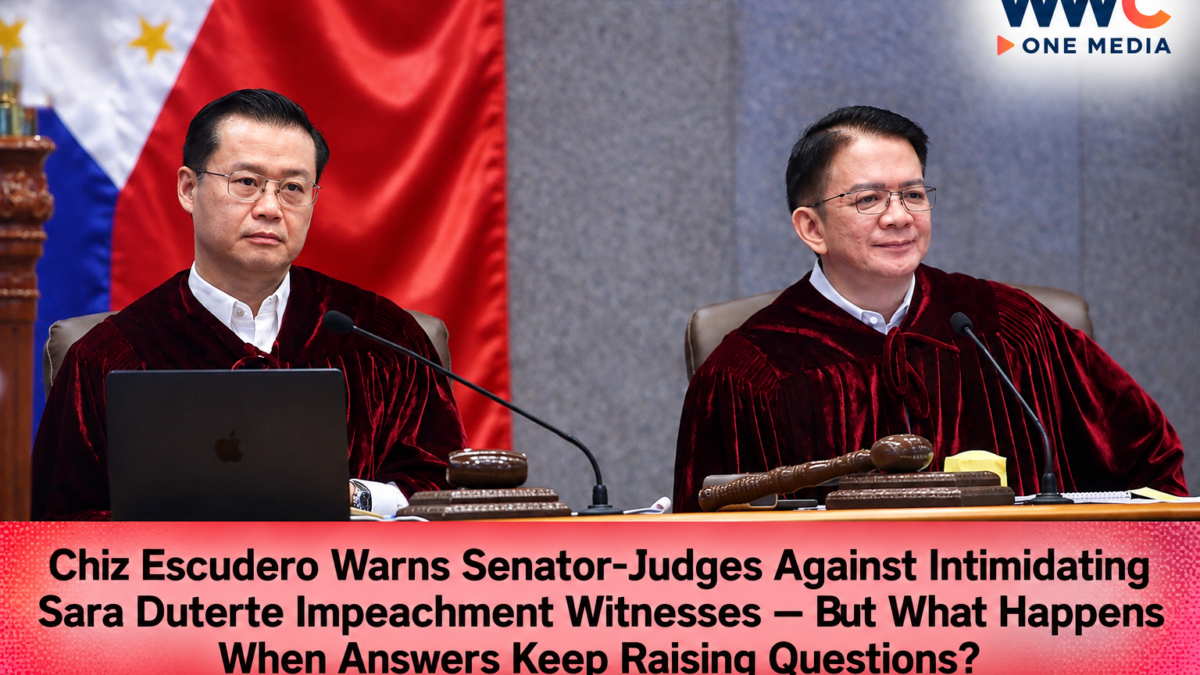
MANILA, Philippines — November 12, 2026 — Senate impeachment court Presiding Officer Francis “Chiz” Escudero has reminded fellow senator-judges and lawyers to exercise restraint when questioning witnesses in Vice President Sara Duterte’s impeachment trial, stressing that unsatisfactory answers do not automatically justify contempt.
Escudero delivered the reminder as the Senate impeachment court continued hearing the defense’s presentation of evidence. He emphasized that witnesses are obligated to tell the truth under oath, but they also retain legal protections against improper questions, insulting remarks and unnecessarily harsh treatment.
His message comes after tense exchanges in previous hearings, when some witnesses repeatedly answered that they did not know or could not recall certain details. Those responses frustrated members of the impeachment court and prompted questions about whether witnesses could face contempt sanctions.
But Escudero stressed that frustration with a witness’s testimony should not be confused with conduct that legally warrants punishment.
“An answer which may be unsatisfactory is not inherently contemptible,” he said, according to the Philippine News Agency’s report on Thursday.
Escudero: Senator-Judges Must Exercise Restraint
Escudero acknowledged that repeated answers such as “I do not know” and “I do not recall” can test the patience of senator-judges.
However, he said the court must assess the testimony based on its evidentiary value instead of immediately treating an unsatisfactory response as contemptuous.
He also cautioned members of the court and legal counsels against using questioning methods or making statements that could frighten witnesses rather than encourage them to provide candid testimony.
The presiding officer acknowledged that his own patience had worn thin during earlier proceedings, making clear that the reminder applied to him as well.
His statement highlights an important distinction in the trial: senator-judges may scrutinize a witness’s credibility, challenge inconsistencies and evaluate the answers given, but they must still observe the rules governing the treatment and examination of witnesses.
What Rights Do Witnesses Have Under Philippine Rules of Evidence?
Escudero cited Section 3, Rule 132 of the Revised Rules on Evidence, which outlines the rights and obligations of witnesses.
Under the provision, witnesses generally have a duty to answer questions, even when their answers may establish a claim against them. However, the rule also protects them from:
- Irrelevant, improper or insulting questions;
- Harsh or insulting treatment or demeanor;
- Being examined on matters unrelated to the issues in the case;
- Being compelled to give answers that could expose them to criminal penalties, subject to legal exceptions; and
- Being forced to give answers that could unnecessarily damage their reputation, except when the matter is directly relevant to the issue being tried or falls within the rule’s stated exceptions.
These protections do not give witnesses permission to lie, deliberately obstruct proceedings or disregard lawful orders.
Rather, they establish boundaries on how testimony may be obtained and how the court should exercise its authority.
The distinction matters because a witness’s inability to provide a satisfactory answer is not, by itself, proof of deliberate defiance or contempt.
Why the Warning Matters in Sara Duterte’s Impeachment Trial
The reminder follows several closely watched exchanges involving defense witnesses during the Senate proceedings.
On November 9, the impeachment court resumed hearings and began the defense’s presentation of witnesses. The court also addressed requests for subpoenas and adjustments to the witness schedule.
In the succeeding hearings, senator-judges questioned witnesses about matters connected to the remaining impeachment charge, including financial records, business interests and allegations of unexplained wealth.
Some exchanges became tense when witnesses struggled to recall details or provide explanations that satisfied the questioners.
The questioning placed the witnesses’ credibility under scrutiny and raised the possibility of contempt proceedings.
Escudero’s latest reminder does not prevent senator-judges from asking difficult questions. It reinforces that the court must distinguish between an answer that is unsatisfactory and conduct that legally warrants a contempt sanction.
For the impeachment proceedings to remain credible, both the evidence and the manner in which it is examined must comply with the applicable rules.
Panfilo Lacson Suggests Written Reminder for Senator-Judges
Following Escudero’s statement, Senator-Judge Panfilo Lacson suggested that the reminder be circulated in writing so all members of the impeachment court would receive the same guidance.
Lacson said a written copy would help ensure that everyone was properly informed.
Escudero agreed, saying the reminder would be distributed to the members and included in the official transcript of the proceedings.
The move could help reinforce a consistent standard for questioning witnesses throughout the trial.
It also places the court’s expectations on record, rather than leaving the reminder as an informal statement made during a hearing.
Impeachment Trial Is Focused on the Remaining Article
The Senate is currently hearing the remaining Article II of the impeachment complaint against Duterte, which involves allegations concerning unexplained wealth, financial disclosures and business interests.
The House prosecution has presented evidence to support its allegations, while Duterte’s defense has challenged the prosecution’s claims and presented witnesses and documents in response.
The allegations remain subject to the impeachment court’s evaluation. Neither the admission of evidence nor the testimony of an individual witness should be treated as a final determination of guilt or innocence.
The proceedings are particularly significant because the senator-judges must ultimately decide whether the remaining charge has been established under the Constitution and the applicable impeachment rules.
As the defense continues presenting its case, questions about witness credibility, documentary evidence and procedural fairness are expected to remain central to the hearings.
Why Escudero’s Reminder Could Shape the Next Hearings
The latest warning underscores the responsibility of the Senate impeachment court to balance two important duties: requiring witnesses to provide truthful testimony and protecting their rights during questioning.
Senator-judges are not barred from challenging testimony or examining inconsistencies. They must, however, avoid treating every unsatisfactory response as grounds for punishment.
That distinction may become increasingly important as the defense presents more witnesses and the court examines financial and corporate records tied to the remaining impeachment charge.
The reminder also sends a message that the credibility of the proceedings depends not only on the evidence presented but also on whether the court follows the standards it is expected to uphold.
The bigger question now is whether the Senate impeachment court can maintain that balance as the testimony becomes more contentious. With more witnesses and evidence still to be examined, the way senator-judges handle difficult answers could become just as closely watched as the answers themselves.