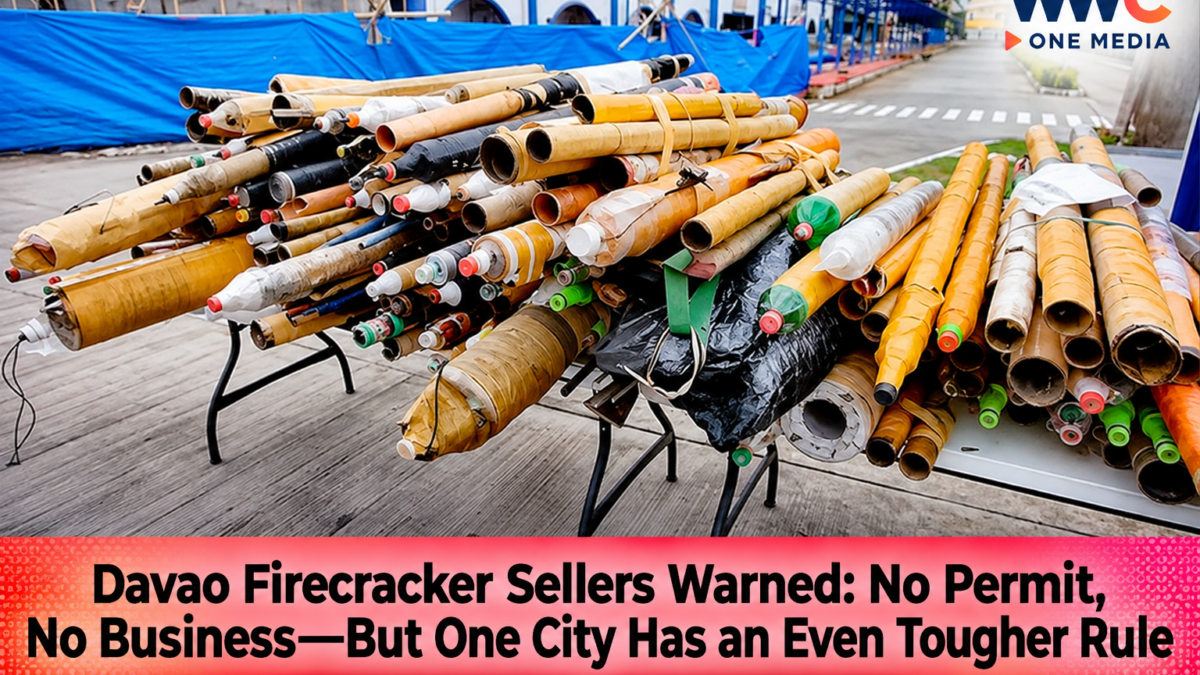
DAVAO CITY, Philippines — Firecracker and pyrotechnics sellers across the Davao Region are being urged to secure the necessary permits before the Christmas and New Year rush, as police prepare inspections and compliance meetings aimed at preventing illegal sales and unsafe handling of explosive products.
The warning was issued by Police Lieutenant Colonel Clarence Casiwen, officer-in-charge of the Regional Civil Security Unit 11 (RCSU-Davao), during a Davao Peace and Security Press Corps briefing at The Royal Mandaya Hotel on November 11.
Casiwen said authorities will meet with retailers, manufacturers and other industry stakeholders in the coming days to explain the licensing and permit requirements, including procedures for transporting firecracker stocks.
His message to dealers is straightforward: comply with the requirements before setting up business, because authorities will inspect stalls once they are established.
The initiative comes ahead of the busiest period for seasonal firecracker sales, when demand traditionally increases as families and communities prepare for year-end celebrations.
Police to inspect firecracker stalls and assist sellers with permits
Casiwen acknowledged that some dealers complain about the number of documents and requirements involved in securing permits.
However, he emphasized that the RCSU is prepared to help businesses understand the process and comply with the rules.
Authorities are not simply waiting for violations to happen. The planned meetings are intended to guide sellers before the holiday selling season reaches its peak.
Once stalls are established, police will conduct inspections to check whether businesses have the required documentation.
Casiwen warned against situations in which an accident occurs and authorities later discover that the seller was operating without the necessary permits.
The message is particularly important for temporary retailers who may enter the seasonal market without fully understanding the national licensing rules or local restrictions.
For dealers, securing the proper documents before opening is not merely an administrative step. It is part of ensuring that products are legally sourced, transported, stored and sold.
What permits do firecracker and pyrotechnics sellers need?
Firecracker and pyrotechnics businesses are regulated by the Philippine National Police through its Firearms and Explosives Office (PNP-FEO), particularly the Explosive Management Division.
The PNP-FEO’s official forms portal lists several categories of authorization, including:
- Manufacturer’s license
- Dealer’s license
- Retailer’s permit
- Permit to transport
- Fireworks display operator’s license
- Special permit for fireworks displays
The exact authorization required depends on the activity being conducted. A retailer selling products, a dealer distributing stocks and an operator conducting a public fireworks display do not necessarily fall under the same permit category.
Republic Act No. 7183, the law regulating the manufacture, sale, distribution and use of firecrackers and other pyrotechnic devices, requires the appropriate license or permit for covered commercial activities.
The law also prohibits the manufacture, sale, distribution and use of firecrackers and pyrotechnic devices classified as prohibited because of their explosive content and potential danger to life and limb.
Importantly, obtaining a permit does not make every type of firecracker legal. Prohibited products cannot be made legal simply because a seller has business authorization.
The PNP-FEO provides the official forms and permit categories through its website. Sellers should confirm the current requirements directly with the agency or RCSU-Davao rather than rely on informal advice or outdated application checklists.
Davao City has a strict firecracker ban—even as regional sellers prepare for the holidays
One of the biggest complications for dealers operating in the Davao Region is Davao City’s longstanding firecracker prohibition.
Under City Ordinance No. 060-02, Davao City prohibits the manufacture, sale, distribution, possession and use of firecrackers and pyrotechnic devices within its territorial jurisdiction.
The ordinance has been enforced since 2002 and covers improvised explosive devices such as bamboo or PVC cannons, commonly known as lantakas or boga.
This means sellers cannot assume that a national permit gives them permission to establish a firecracker stall inside Davao City.
During the November 11 briefing, Casiwen was asked how dealers could transport stocks intended for Davao del Sur when their route might involve Davao City.
He said the RCSU must respect the city’s existing regulations and coordinate with local authorities and dealers to address the transportation issue.
His response highlights the importance of distinguishing between national authorization and local government restrictions.
A seller may have the appropriate national documents but still need to comply with the rules of every local government unit involved in the business or transport arrangement.
The specific route and transport arrangements should therefore be coordinated with the relevant authorities before stocks are moved.
What penalties can firecracker sellers face in Davao City?
Violations of Davao City’s Ordinance No. 060-02 carry escalating penalties.
According to the ordinance penalties cited in the SunStar report:
- First offense: ₱1,000 fine or 20 days to one month of imprisonment.
- Second offense: ₱3,000 fine or one to three months of imprisonment.
- Third offense: ₱5,000 fine or three to six months of imprisonment.
- Business consequence: The business also loses its permit.
These are local ordinance penalties and should not be confused with the separate national penalties under Republic Act No. 7183.
Under Section 11 of RA 7183, violations of the national law may carry a fine of ₱20,000 to ₱30,000, imprisonment of six months to one year, or both, at the discretion of the court. Cancellation of the relevant license and business permit and government confiscation of inventory or stock may also apply.
The applicable charge and penalty depend on the particular violation and the law or ordinance involved.
Davao’s firecracker ban linked to its record of safer New Year celebrations
Davao City’s strict policy has been defended by local authorities as a public-safety measure.
The Philippine Information Agency reported in January 2026 that Davao City recorded no firecracker-related injuries during the 2026 New Year celebrations.
Police also reported no stray-bullet-related injuries or deaths during the period, attributing the outcome to the enforcement of Ordinance No. 060-02, police visibility, barangay cooperation and public information campaigns.
However, the absence of injuries did not mean there were no violations.
Authorities apprehended several individuals for allegedly violating the ban and confiscated prohibited firecrackers and improvised devices.
In a separate enforcement operation in December 2025, police arrested a suspected vendor in Toril Public Market and confiscated prohibited products, including Piccolo firecrackers, Roman candles and other pyrotechnic devices.
These incidents show why authorities continue to emphasize enforcement, even in a city where the prohibition has been in place for more than two decades.
More Davao Region communities have adopted firecracker restrictions
Davao City is not the only area in the region that has moved toward stricter firecracker regulation.
SunStar previously reported that several local government units had adopted firecracker restrictions, including municipalities in Davao del Sur, Davao del Norte, Davao Oriental, Davao de Oro and Davao Occidental.
Among the areas identified in that earlier report were Hagonoy, Sta. Cruz, Magsaysay, New Corella, Kapalong, Tagum City, Lupon, San Isidro, Governor Generoso, Tarragona and Boston.
The local rules are not necessarily identical, and the list should not be treated as a complete statement of every municipality’s current ordinance.
For retailers, the practical lesson is to verify the rules in the exact locality where they intend to operate. A permit or authorization issued under national regulations does not automatically override a local government prohibition.
Firecracker safety rules remain important beyond the permit process
The regulation of firecrackers is not only about business documentation.
Republic Act No. 7183 also provides safety requirements for manufacturers, distributors and users. Firecracker and pyrotechnic packages must carry identifying information and warning instructions in Filipino and English.
The law requires authorized parties covered by its recordkeeping provisions to maintain accurate information about the quantities and types of explosives and their intended use.
Executive Order No. 28, issued in 2017, further regulates the use of firecrackers and pyrotechnic devices. It provides for community fireworks displays under the supervision of a trained person licensed by the PNP and with permission from the concerned city or municipality.
This framework is intended to ensure that organized displays take place in approved locations under appropriate supervision.
The regulations also reflect the risks associated with improperly handled fireworks, including burns, blast injuries, fires and harm to people who are not participating in the celebration.
Police also remind airsoft groups to follow registration and permit rules
The November 11 briefing also covered another area regulated by the RCSU: airsoft activities.
Casiwen said airsoft guns used in games must be registered with the unit and that organizers must secure a permit for each game.
He added that authorities have been meeting with airsoft organizations and their leaders to explain the process.
Although the issue is separate from firecracker sales, the reminder reinforces the RCSU’s broader responsibility for regulating certain controlled equipment and activities.
Casiwen said authorities prefer to encourage compliance before violations lead to cases handled by the Davao City Police Office.
However, he stressed that businesses and organizations must also do their part.
What firecracker sellers should do before the holiday rush
For dealers preparing to enter the seasonal market, the safest approach is to verify the requirements before purchasing or transporting stocks.
They should:
- Identify whether they need a retailer’s permit, dealer’s license or another authorization.
- Confirm the requirements directly with the PNP-FEO or RCSU-Davao.
- Check whether the products they intend to sell are legally permitted.
- Secure the appropriate transport authorization before moving stocks.
- Verify local government restrictions in the intended selling location and any areas along the transport route.
- Keep the required documents available for inspection once their stalls are established.
Sellers should not assume that a temporary stall, a supplier’s assurance or an existing business permit is enough to satisfy all national and local requirements.
Will Davao Region sellers be ready before Christmas?
The RCSU’s planned meetings and inspections are intended to help legitimate dealers prepare for the holiday season while preventing unlicensed operations and unsafe handling of pyrotechnics.
For sellers, early compliance could help avoid interruptions, confiscations and legal consequences during the busiest selling period of the year.
For residents, stronger enforcement is part of a wider effort to reduce firecracker-related injuries and keep public celebrations safe.
But the challenge is more complicated in a region where local governments do not necessarily follow identical policies.
Davao City maintains a strict prohibition, while dealers operating in other parts of the region must check the applicable local rules and national permit requirements.
As the holiday rush approaches, the question is whether sellers will complete the necessary permits before inspections begin—or whether authorities will discover unlicensed stalls and prohibited products once the season is already underway.