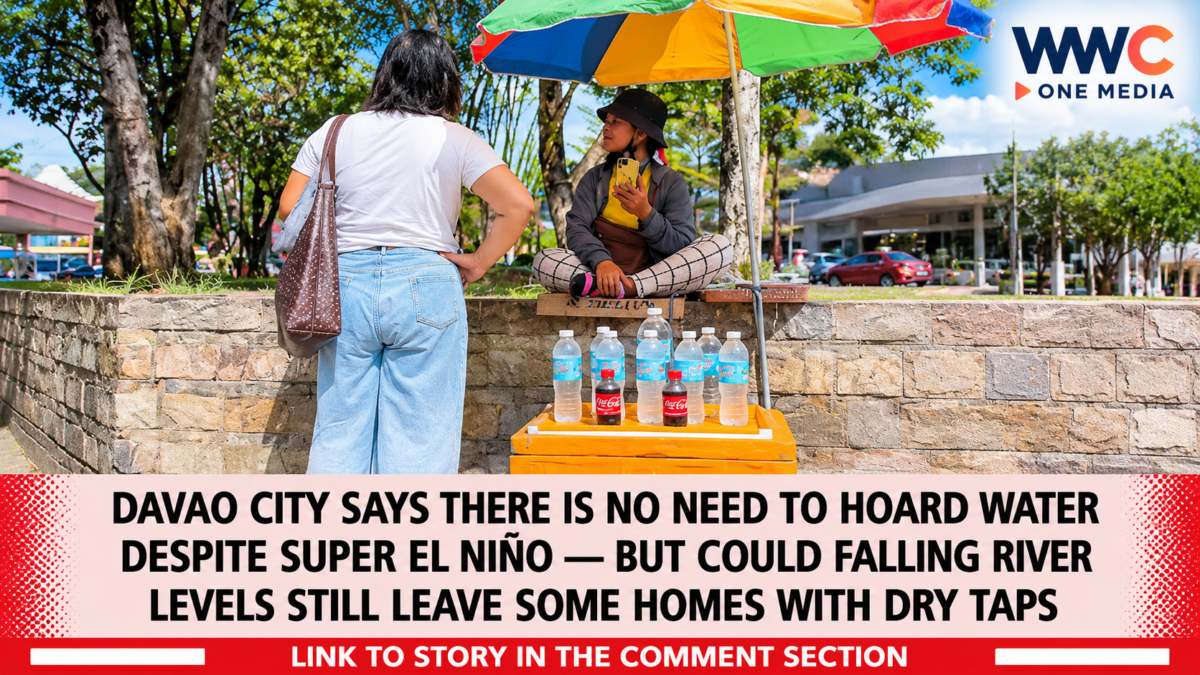
Davao City officials are urging residents not to panic-buy or hoard water as a very strong El Niño threatens to intensify dry conditions across the Philippines. The city’s water supply remains sufficient for current demand, but the Davao City Water District (DCWD) is warning that households could still experience reduced water pressure and temporary service interruptions if deliveries from its bulk water supplier decline.
The assurance comes as water levels in parts of the Panigan-Tamugan River system continue to draw attention, raising questions about how long Davao City can maintain stable water distribution if prolonged below-normal rainfall persists.
Councilor Temujin “Tek” Ocampo gave the latest assurance during the Pulong-Pulong sa Dabawenyos media forum on November 10. Citing information from bulk water supplier Apo Agua Infrastructura Inc., he said river levels had declined but remained manageable, with the company continuing to produce more than 300 million liters of water daily.
Ocampo also pointed to the city’s combined surface-water and groundwater resources, saying the available supply remains sufficient to meet present demand.
“We still have enough water to supply the city with the impending El Niño,” he said, as reported by SunStar Davao.
However, officials stressed that adequate supply should not be mistaken for permission to waste water. Residents are still being urged to conserve, prepare responsibly and avoid unnecessary stockpiling.
Davao Has More Available Water Than Its Current Daily Requirement
Figures presented by the DCWD on November 4 provide a clearer picture of the city’s current water position.
The water district reported approximately 688,000 cubic meters of available water per day. This consists of:
- 300,000 cubic meters of surface water supplied through Apo Agua.
- 388,000 cubic meters from groundwater sources.
The DCWD estimates that it needs approximately 381,000 cubic meters daily to serve its roughly 280,000 service connections.
Based on those figures, the utility has an estimated supply buffer of about 300,000 cubic meters per day, primarily supported by groundwater.
The difference is significant because it gives Davao City an alternative source if surface-water production declines. Rather than depending entirely on rivers, the utility can adjust its use of groundwater to help maintain distribution.
But the figures describe the water district’s reported available supply and operational requirements. They do not guarantee that every household will receive uninterrupted water at normal pressure under all conditions.
Why Residents Could Still Experience Low Water Pressure
Despite the reassuring supply figures, the DCWD has warned that the worsening El Niño could force it to operate under extraordinary conditions.
In a November 4 briefing, spokesperson Jovana Cresta Duhaylungsod explained that surface water is more vulnerable to prolonged heat and evaporation than groundwater. The district is therefore closely monitoring Apo Agua’s daily production and the condition of the river system.
If Apo Agua continues delivering around 300,000 cubic meters daily, the DCWD said it can maintain normal operations.
However, if deliveries fall to approximately 150,000 cubic meters per day, some areas could begin experiencing low water pressure or temporary service interruptions, particularly during periods of high demand.
That threshold does not automatically mean widespread rationing or prolonged outages. The district said it can use groundwater reserves to help compensate for reduced surface-water deliveries.
The most difficult scenario would be a complete halt in Apo Agua’s surface-water deliveries, which the DCWD classifies as Level 7 in its contingency plan. Groundwater could still help cover daily requirements, but consumers should not expect the same level of uninterrupted, 24-hour service.
The warning is consistent with an earlier report by Edge Davao, which detailed the 150,000-cubic-meter threshold and the utility’s contingency measures.
River Conditions Are Already Being Monitored Closely
The concern is not purely theoretical.
In an October 15 report, SunStar Davao said the DCWD had recorded approximately 77 instances of reduced flow in the Tamugan River since January 2026. The lowest reported production occurred in April, when output fell to around 233,000 cubic meters.
The utility said customers did not experience the full effect of that shortfall because groundwater helped cover the reduced surface-water supply.
The district was also preparing to install 24 inline booster pumps in elevated and hydraulically challenged areas. These facilities are intended to help push water through the distribution network where pressure could become a problem as available supply declines.
The planned infrastructure is important because water security is not determined by the total volume available alone. The utility must also be able to move that water through its network and deliver it to households at sufficient pressure.
For Davao residents, this means a citywide assurance of adequate supply does not necessarily rule out localized service problems.
DCWD Is Preparing for Possible Interruptions, Not Declaring a Water Shortage
The distinction between having enough water and maintaining normal service is central to the current situation.
The DCWD has said its groundwater resources provide a significant backup if Apo Agua reduces or stops surface-water deliveries. But using those reserves under more difficult conditions could require changes to normal operations.
Duhaylungsod said the district would exert its best efforts to provide water within a 24-hour period, while acknowledging that consumers could experience inconvenience as El Niño intensifies.
The utility is also identifying areas that may be particularly vulnerable to low pressure and is preparing measures to limit the duration and impact of possible interruptions.
This is not an announcement that Davao City is already implementing citywide water rationing. Rather, it is a warning that some households may encounter temporary service disruptions if surface-water production falls far enough.
Residents should therefore follow official DCWD advisories instead of relying on unverified claims about scheduled outages or impending citywide rationing.
El Niño Could Persist Into 2027, PAGASA Warns
The water-supply preparations come as the Philippine Atmospheric, Geophysical and Astronomical Services Administration (PAGASA) monitors a very strong El Niño event in the tropical Pacific.
In its November 4 assessment, PAGASA said the phenomenon could persist through the first half of 2027 and potentially reach its peak toward the end of 2026.
The weather bureau also forecast below-normal to way-below-normal rainfall over much of the country in November.
El Niño increases the likelihood of prolonged rainfall deficits, dry spells and drought in affected areas. It does not mean that every part of the Philippines will receive no rain, nor does it rule out episodes of heavy rainfall from tropical cyclones and other weather systems.
Nevertheless, the prospect of extended dry conditions raises concerns about rivers, groundwater, agriculture and household water access.
WWC ONE MEDIA has also reported on the wider regional implications in Davao Occidental Faces Possible Dry Spell by November’s End as Very Strong El Niño Raises Water and Food Security Concerns, where the rainfall outlook highlights the risks facing communities and agricultural producers across the Davao Region.
Manay’s Water Difficulties Show Why Preparedness Matters
While Davao City officials say the city’s current supply remains sufficient, other parts of the region are already experiencing more immediate water difficulties.
In Manay, Davao Oriental, the local government has used fire trucks to distribute water to residents as dry conditions affect available sources. Office of Civil Defense-Davao Regional Director Ednar Dayanghirang discussed the emergency response in a November 4 briefing.
The situation illustrates how water disruptions can affect communities differently. A locality may have water sources nearby but still struggle to obtain usable household water when river conditions, water quality or infrastructure become problematic.
WWC ONE MEDIA previously examined the situation in Manay Begins Emergency Water Rationing as El Niño Intensifies in Davao Region — Officials Warn of Possible Drought by 2027.
The experience in Manay is not proof that Davao City will face the same emergency. It does, however, underline why local governments and water utilities are preparing before dry conditions become more severe.
Davao City Government Strengthens Its El Niño Response
The city government has also directed offices and agencies to prepare for possible disruptions to essential services.
According to an October 15 update from the City Government of Davao, the DCWD and the Davao City Bulk Water Supply Project were instructed to maintain stable water delivery and prepare alternative sources should river levels and flows decline.
The city’s preparations extend beyond household water distribution.
The City Agriculturist’s Office has been tasked with securing water for farms, while health and veterinary offices are expected to monitor heat-related illnesses and protect livestock.
Davao City also operates seven solar-powered irrigation systems in Paquibato, Toril and Calinan, serving farms covering approximately 35 to 70 hectares. The city provides water pumps, power sprayers and water tankers to farmers upon request, according to city government updates.
These measures matter because prolonged dry conditions can affect more than household taps. Reduced water availability can disrupt farming, threaten livestock, increase health risks and place additional pressure on local economies.
What Dabawenyos Should Do Instead of Hoarding Water
Officials’ message is straightforward: residents do not need to panic, but they should use water responsibly.
Households can prepare without creating unnecessary shortages for other consumers.
Practical steps include:
- Store a reasonable emergency supply. Use clean, covered containers or properly maintained storage tanks. Avoid buying or storing excessive amounts that could deprive other households of access to essential supplies.
- Prioritize drinking, cooking and hygiene. Reduce unnecessary water use for activities that can be postponed.
- Check for leaks. Repair dripping faucets, damaged pipes and leaking toilet fixtures to prevent avoidable losses.
- Reuse water where appropriate. Water used for rinsing or cleaning may be suitable for certain non-drinking purposes, provided it does not create sanitation risks.
- Protect stored drinking water. Keep containers clean, covered and away from direct contamination. Follow safe storage practices and do not assume untreated alternative sources are safe to drink.
- Monitor official announcements. Follow advisories from the DCWD, barangay officials and the city government for confirmed service interruptions or conservation instructions.
Water conservation is especially important during prolonged dry conditions because even a city with adequate reserves must manage its resources carefully.
The same issue is emerging in other parts of the country. In Cebu, for example, local officials are preparing for possible rationing and emergency water deliveries as El Niño threatens supply. Read WWC ONE MEDIA’s report, Cebu Prepares Water Rationing as Super El Niño Threatens Supply, With Mountain Barangays First in Line for Emergency Deliveries, for a look at how another major urban area is preparing for the same climate threat.
The Bigger Question: Can Davao Maintain Reliable Water Service Through 2027?
For now, Davao City’s reported water resources provide a substantial buffer against declining surface-water deliveries. The combination of Apo Agua’s supply and the DCWD’s groundwater sources gives the city more options than communities that depend on a single vulnerable source.
But the coming months will test the strength of that arrangement.
The DCWD must monitor river conditions, manage groundwater reserves, strengthen distribution infrastructure and respond quickly if supply levels fall. Residents, meanwhile, must avoid waste and prepare sensibly without contributing to panic buying.
The city’s assurance that there is no need to hoard water should be reassuring, but it should not be interpreted as a guarantee that every household will avoid interruptions.
With a very strong El Niño expected to persist into 2027, the real test is not simply whether Davao has enough water today. It is whether the city can keep that water flowing reliably when prolonged dry conditions put its sources and distribution system under greater pressure.