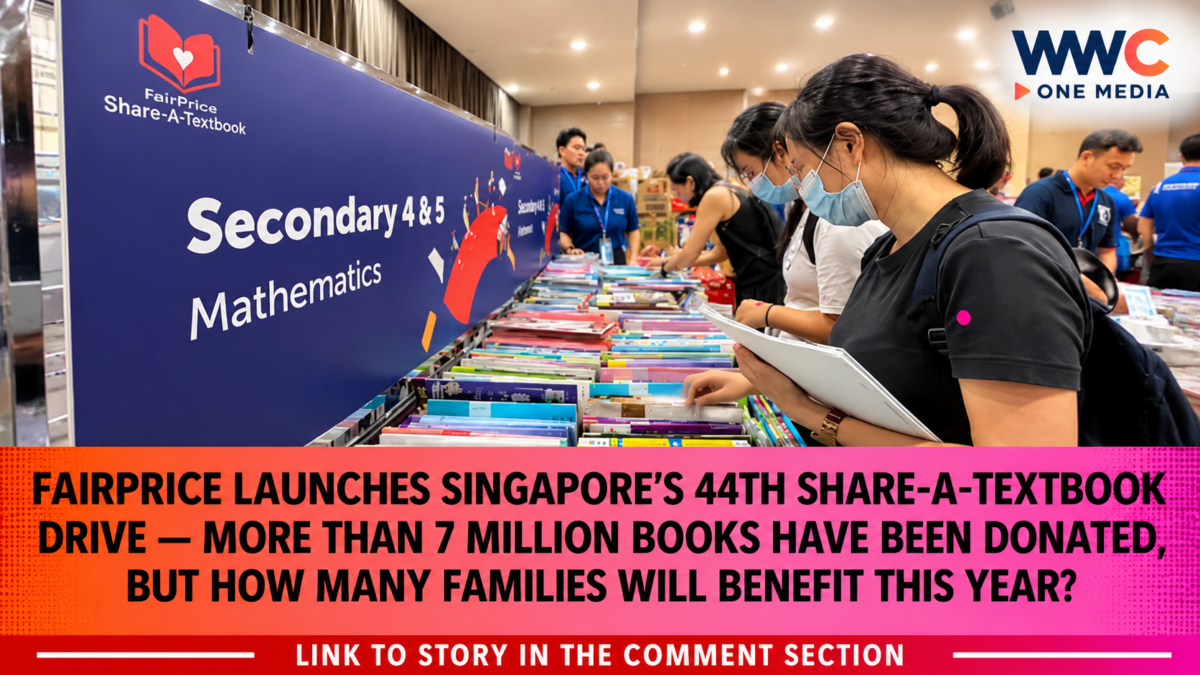
SINGAPORE — Parents preparing for the 2027 school year have another opportunity to reduce education expenses as FairPrice Group and the National Trades Union Congress (NTUC) launch the 44th edition of Singapore’s Share-A-Textbook initiative, inviting the public to donate pre-loved textbooks and study materials for students who need them.
The donation campaign will run from November 14 to November 28, 2026, with collection points established at eight FairPrice Xtra hypermarkets and the Tzu Chi Humanistic Youth Centre in Yishun.
Families and members of the public who need textbooks can collect available materials for free on December 4 and 5, from 9am to 7pm, at the Tzu Chi Humanistic Youth Centre. The last admission is at 6pm.
The campaign arrives as families prepare for the next academic year and look for ways to manage the cost of school essentials.
But this is more than an opportunity to pass on old books. It is part of a long-running community effort that has helped hundreds of thousands of students access educational resources while giving usable learning materials a second life.
MORE THAN 7 MILLION TEXTBOOKS DONATED SINCE THE INITIATIVE BEGAN
First launched in 1982, Share-A-Textbook has grown into one of Singapore’s longest-running community education initiatives.
According to FairPrice Group and NTUC, the programme has collected more than 7 million textbooks and benefited nearly 300,000 students since its introduction.
The 2026 edition is the initiative’s 44th drive, bringing together schools, community organisations, volunteers and members of the public to help make educational resources more accessible.
The organisers say the campaign is intended to support students who need textbooks and revision materials for the 2027 school year, while encouraging families to reuse books that remain in good condition.
The scale of the effort is not new. In 2022, Channel NewsAsia reported that the 40th edition made approximately 725,000 donated textbooks available to the public. That year’s operation involved thousands of volunteers who helped collect, inspect, sort and arrange books according to academic level and subject.
The process demonstrates how much work goes into turning donated materials into useful resources for another student.
WHERE CAN SINGAPOREANS DONATE THEIR USED TEXTBOOKS?
Members of the public can donate pre-loved textbooks and eligible study materials at the following nine locations from November 14 to 28:
- FairPrice Xtra Ang Mo Kio Hub — #B2-40, Singapore 569933
- FairPrice Xtra Changi Business Park — #01-51 and #02-51, Singapore 486018
- FairPrice Xtra Hougang 1 — #02-01, Singapore 538692
- FairPrice Xtra JEM — #B1-21/22 and #B3-01, Singapore 608549
- FairPrice Xtra Jurong Point — #03-01, Singapore 648331
- FairPrice Xtra NEX — #03-42, Singapore 556083
- FairPrice Xtra Parkway Parade — #03-28, Singapore 449269
- FairPrice Xtra VivoCity — #B2-23 and #01-23, Singapore 098585
- Tzu Chi Humanistic Youth Centre — 30A Yishun Central 1, Singapore 768796
Donors can place their books in the designated collection dropboxes or hand them to staff at the information counter, depending on the location.
The Tzu Chi Humanistic Youth Centre is open daily from 10am to 10pm.
WHAT BOOKS CAN YOU DONATE — AND WHAT SHOULD YOU AVOID?
Not every used textbook is suitable for redistribution.
FairPrice Group’s guidelines specify that donated books should be in good condition and aligned with the current Ministry of Education (MOE) syllabus.
Accepted materials include:
- MOE-approved textbooks
- Assessment books
- Supplementary learning materials
- Other relevant study resources that remain in usable condition
However, donors should avoid submitting:
- Books based on outdated syllabuses
- Damaged textbooks
- Books with excessive writing or heavy markings
- Used exercise books
The screening process is important because students receiving the materials need books that are still relevant and practical for their studies.
Donations that cannot be reused will not necessarily be distributed. FairPrice’s programme information says uncollected books will be sent to recycling centres for environmentally responsible processing.
WHEN AND WHERE CAN FAMILIES COLLECT FREE TEXTBOOKS?
Students and families who need pre-loved textbooks can attend the distribution event at:
Venue: Tzu Chi Humanistic Youth Centre, The Great Hall
Address: 30A Yishun Central 1, Singapore 768796
Dates: December 4–5, 2026
Opening hours: 9am–7pm
Last admission: 6pm
The distribution is conducted on a walk-in basis. Visitors must obtain a queue number on-site. If the venue reaches its hourly capacity, people may be directed to return during the next available hour.
The organisers encourage visitors to take only the books they need so that more families have an opportunity to benefit.
Those planning to attend should also remember that textbook availability depends on the donations received and the materials that pass the sorting process. The organisers do not guarantee that every requested title, subject or school level will be available.
MORE THAN A DONATION DRIVE: WHY REUSING TEXTBOOKS STILL MATTERS
Singapore’s education system increasingly incorporates digital learning resources, but printed textbooks continue to play an important role in classroom learning.
In a 2022 report, Channel NewsAsia highlighted how families valued the opportunity to obtain textbooks without paying for new copies. Parents also described the benefits of reusing books rather than discarding materials that remained in good condition.
The Ministry of Education has previously explained that printed textbooks, alongside digital learning materials and tools, remain part of the range of resources schools can use to support students.
That means second-hand textbooks can still have practical value, provided they match the relevant curriculum and remain suitable for use.
The initiative also reflects a wider concern about household affordability. Education-related expenses are only one part of the financial pressure families face, alongside food, healthcare, housing and other everyday costs.
WWC ONE MEDIA has previously examined how cost-of-living pressures are emerging as one of Singaporeans’ leading social concerns. For families managing multiple expenses, access to free educational materials can provide practical help, even if it does not address every financial challenge.
EDUCATION PRESSURE IS NOT ONLY ABOUT SCHOOL FEES
The cost of textbooks is one part of a much larger discussion about the pressures facing Singaporean families.
Education spending can extend beyond required school materials to include tuition, enrichment programmes, learning resources and extracurricular activities.
WWC ONE MEDIA previously reported on Singapore parents’ rising education-related stress and increasing tuition spending, highlighting the financial and emotional demands that can accompany the pursuit of academic success.
Share-A-Textbook does not replace school-based financial assistance, tuition support or other education programmes. Instead, it offers another way for families to access learning materials without having to purchase every book new.
The distinction matters: a community donation programme can help reduce specific expenses, but it should not be mistaken for a complete solution to education affordability.
MORE THAN 1,000 VOLUNTEERS WILL HELP PREPARE THE DONATIONS
The work does not end when the donation boxes are filled.
According to the organisers, more than 1,000 volunteers will come together between November 28 and December 3 to sort donated textbooks before the distribution event.
The volunteers will help prepare the materials so that they can be made available to families during the December 4–5 collection period.
This stage is essential. Books must be checked for condition and relevance before they are arranged for distribution.
The 2022 operation documented by CNA illustrates the scale of this work. Thousands of volunteers participated in sorting and organising hundreds of thousands of books, with materials separated by subject and academic level.
For the 2026 drive, FairPrice’s official programme page indicates that volunteer slots for the November 26–December 3 sorting and distribution period are already full.
The programme’s impact therefore depends not only on the number of books donated, but also on the people who make collection, sorting and redistribution possible.
WHAT HAPPENS TO BOOKS THAT ARE NOT COLLECTED?
Not every donated textbook will necessarily find a new owner.
Some books may be outdated, unsuitable for the current syllabus or left over after the distribution event.
FairPrice Group says uncollected textbooks will be sent to recycling centres for processing.
This approach supports the initiative’s environmental objective: extending the useful life of educational materials where possible and recycling those that cannot be reused.
The programme therefore connects two goals — making school resources more accessible and reducing unnecessary waste.
THE BIGGER QUESTION: CAN A SECOND-HAND TEXTBOOK MAKE A DIFFERENCE FOR A FAMILY?
For a student preparing for a new school year, a textbook is more than an old book passed from one household to another. It is a learning resource that can help make lessons, revision and preparation more accessible.
For a family, receiving usable books for free can mean one less expense to manage before school reopens.
And for donors, a book that might otherwise remain unused at home can become useful again in another student’s classroom.
FairPrice and NTUC’s 2026 Share-A-Textbook drive offers Singaporeans a straightforward way to contribute: donate suitable books between November 14 and 28, volunteer where opportunities remain available, or collect needed materials on December 4 and 5.
The initiative has already redistributed millions of textbooks over more than four decades. Its continued operation highlights how small contributions, when organised on a large scale, can support students and families across the country.
But the real measure of this year’s campaign will not simply be the number of books collected.
It will be how many useful textbooks reach students who need them — and how many families begin the 2027 school year with a little less financial pressure.