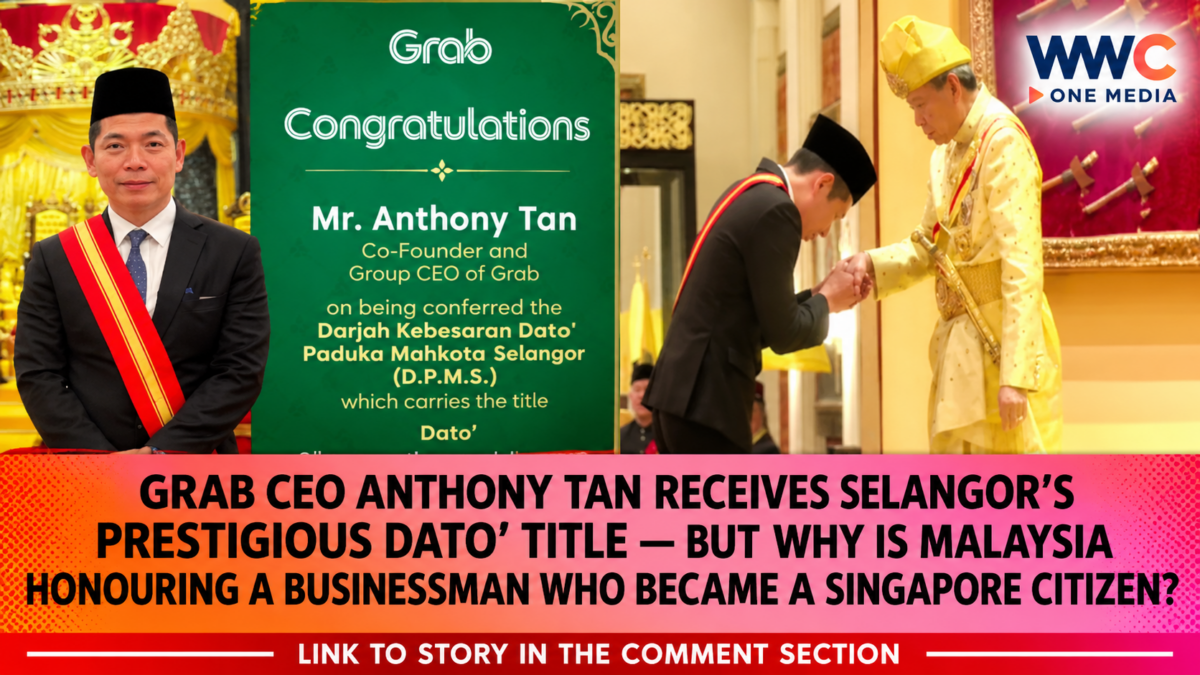
KLANG, MALAYSIA — Grab co-founder and Group Chief Executive Officer Anthony Tan has received one of Selangor’s prestigious royal honours, adding another major recognition to the career of the entrepreneur who helped transform a Malaysian taxi-booking startup into one of Southeast Asia’s most influential technology companies.
Sultan Sharafuddin Idris Shah conferred the Darjah Kebesaran Dato’ Paduka Mahkota Selangor (DPMS) on Tan during an investiture ceremony at Istana Alam Shah on November 7, 2026.
The ceremony was held in conjunction with the Sultan’s Silver Jubilee, marking 25 years of his reign.
Tan was among 19 recipients recognised during the ceremony, which included military commanders, senior government officials, diplomats and business leaders.
The honour has attracted attention in both Malaysia and Singapore for another reason: Tan was born in Malaysia but became a Singapore citizen in 2016.
His story reflects the increasingly interconnected business landscape of Southeast Asia, where entrepreneurs can build companies in one country, establish regional headquarters in another and operate across multiple national markets.
But the recognition also raises a broader question: what does Malaysia’s decision to honour one of its most successful business founders say about the country’s relationship with entrepreneurs who build their careers abroad?
WHAT AWARD DID GRAB CEO ANTHONY TAN RECEIVE?
Tan received the Dato’ Paduka Mahkota Selangor, commonly abbreviated as DPMS.
According to Bernama, the award was among the state honours presented by Sultan Sharafuddin during the November 7 ceremony.
The official Selangor honours website confirms that the DPMS is a second-class order established in 1961.
It is limited to no more than 20 recipients at any one time, with a maximum overall membership of 600.
Importantly, the official Selangor awards authority specifies that male recipients of the DPMS are entitled to use the title “Dato’” before their names, while female recipients receive the title “Datin Paduka”.
This distinction matters because the award is frequently described in regional headlines as a Datukship. The formal title attached to this particular Selangor order is Dato’.
Tan received the award alongside seven other DPMS recipients.
The ceremony also recognised six individuals with the Dato’ – Sultan Sharafuddin Idris Shah award, as well as other recipients of Selangor honours.
The total number of people recognised was 19.
The presentation was attended by members of Selangor’s royal family and state government, including Tengku Permaisuri Norashikin, Raja Muda of Selangor Tengku Amir Shah and Selangor Menteri Besar Amirudin Shari.
WHY IS A SINGAPORE CITIZEN RECEIVING A MALAYSIAN ROYAL HONOUR?
One detail has made Tan’s recognition particularly interesting.
Although he was born in Malaysia and launched his business there, he is now a Singapore citizen.
Profiles of Tan, including reporting by The Independent Singapore, state that he took up Singapore citizenship in 2016 after renouncing his Malaysian citizenship.
That has prompted discussion online about the significance of a Malaysian-born entrepreneur receiving a royal honour from the state where his business journey began, despite subsequently becoming a citizen of another country.
However, the award is not restricted to Malaysian citizens.
The recognition is conferred by the Selangor ruler under the state’s honours system, and the official award information describes the eligibility and titles attached to the order without imposing Malaysian citizenship as a requirement for every honorary recipient.
It is therefore important not to confuse Tan’s Singapore citizenship with his eligibility to receive the honour.
The award recognises an individual’s contribution and standing; it does not restore Malaysian citizenship or change his nationality.
The debate also reflects a wider regional reality: talent, capital and business ownership increasingly cross national borders, while national identity and economic contributions remain politically sensitive subjects.
FROM MYTEKSI IN KUALA LUMPUR TO A REGIONAL SUPER-APP
Tan’s career began with a problem familiar to many Malaysians: finding safer and more reliable taxi services.
In 2012, he and fellow Harvard Business School graduate Tan Hooi Ling launched MyTeksi in Kuala Lumpur.
The original idea was to improve the taxi-booking experience by making journeys safer, more reliable and easier to arrange.
The company subsequently expanded beyond Malaysia and developed into Grab, a regional platform offering transport, food delivery, parcel services, digital payments and financial products.
The National Library Board of Singapore’s company profile traces the company’s development from its early taxi-booking service to its expansion across Southeast Asia.
Today, Grab operates as a technology platform serving millions of customers, driver-partners and merchants across the region.
Its growth has also made Tan one of the most prominent business figures in Southeast Asia.
According to Grab’s official investor relations profile, Tan is the company’s co-founder, chairman and chief executive officer.
His leadership has helped steer the business through intense competition, international expansion, the arrival of new digital services and its eventual listing on Nasdaq.
The company is no longer simply a ride-hailing service. It has become a multi-service platform competing across several parts of the digital economy.
For a closer look at how Grab’s business is performing, see WWC ONE MEDIA’s report, Grab Raises 2026 Revenue Forecast to US$4.2 Billion After Record User Growth — Is Its Super-App Strategy Finally Paying Off?.
GRAB’S GROWTH HAS ALSO CREATED A BIGGER RESPONSIBILITY TO DRIVERS AND RIDERS
While Tan’s royal recognition celebrates his business achievements, Grab’s expansion has also brought renewed attention to the people who make its platform work.
Across Southeast Asia, driver-partners and delivery riders have raised concerns about earnings, operating costs, platform commissions and the difficulty of maintaining predictable incomes.
These issues have become particularly important as ride-hailing companies face pressure from investors to improve profitability while governments demand stronger worker protections.
WWC ONE MEDIA previously examined this tension in Grab and GoTo Face Driver Backlash Across Southeast Asia — But the Bigger Threat Is to Ride-Hailing’s Business Model.
The issue is relevant to Tan because Grab’s success depends not only on technology and customers but also on the large network of drivers, delivery partners and merchants operating on its platform.
Malaysia has also announced a joint government-Grab support package worth RM160 million, scheduled to begin in 2027.
According to Bernama, the package is intended to improve the net income and welfare of e-hailing and parcel-hailing workers through measures including minimum earnings support, vehicle maintenance assistance, insurance costs and social security contributions.
The government expects the median monthly net income of e-hailing drivers to increase by up to RM227, while delivery riders could receive an increase of up to RM100, subject to the programme’s implementation.
The initiative highlights the growing importance of the gig economy to Malaysia’s labour market.
GRAB IS ALSO MOVING DEEPER INTO FINANCIAL SERVICES
Another major development in Tan’s business strategy is Grab’s expansion beyond transportation and delivery.
The company has been investing in financial services, including payments, lending and other digital financial products.
One of its biggest moves came in September 2026, when Grab announced plans to acquire a controlling 60% stake in Atome Financial for US$1.49 billion.
The deal covers financial products including buy-now-pay-later services and consumer lending across several Southeast Asian markets.
The proposed acquisition represents a significant expansion of Grab’s financial-services ambitions.
WWC ONE MEDIA examined the transaction in Grab Locked 60% of Atome for US$1.49 Billion — So Why Is Close Still a 2027 Story?.
The strategy could strengthen Grab’s ability to offer more services through one platform, but it also brings new challenges involving regulation, credit risk and responsible lending.
As Grab expands its financial products, its success will depend on whether it can grow those services sustainably while maintaining consumer confidence.
WHY MALAYSIA’S RM160-MILLION WORKER PACKAGE MATTERS
The government’s support arrangement with Grab is another important part of the story.
Malaysia’s 2027 Budget includes a RM160-million package jointly funded by the government and Grab to support e-hailing and delivery workers.
The initiative is intended to address concerns that have grown alongside the expansion of app-based transport and delivery services.
For many drivers, income is affected by fuel prices, vehicle maintenance, insurance, platform commissions and the number of bookings available.
The support package is expected to include improvements in earnings and assistance with operating costs, although individual benefits will depend on the programme’s rules and eligibility requirements.
The announcement is part of a wider effort to address living costs and the financial security of workers in Malaysia.
WWC ONE MEDIA explored the broader policy context in Malaysia Unveils RM459.8-Billion Election-Year Budget With Higher Wages and Tax Cuts — But Anwar Faces a Bigger Test as Living Costs and Political Pressure Rise.
The package does not mean every Grab driver will automatically receive the same amount, nor does it settle all concerns about platform work.
It does, however, show that the relationship between digital platforms, workers and governments is becoming a central issue in the region’s economic policy.
ANTHONY TAN’S LATEST HONOUR FOLLOWS ANOTHER MAJOR BUSINESS RECOGNITION
The Selangor award is not Tan’s first major recognition in 2026.
In May, he was named Businessman of the Year at the 41st Singapore Business Awards, organised jointly by The Business Times and DHL.
The award recognised his leadership in transforming Grab from a taxi-booking application into a major regional super-app.
The Straits Times and SPH Media reported that the judges recognised his role in advancing digital inclusion and economic empowerment across Southeast Asia.
The two honours come from different institutions and recognise different aspects of his career.
The Singapore Business Awards recognised his business leadership, while the Selangor honour places him among individuals recognised through the state’s royal honours system.
Together, they underline his position as one of the region’s most prominent technology entrepreneurs.
WHAT DOES THE DATO’ TITLE MEAN FOR GRAB?
Tan’s new title is a personal honour. It does not change Grab’s corporate ownership, headquarters, regulatory obligations or stock-market listing.
Nor does it mean that Grab has received a new government contract or special commercial privileges in Malaysia.
The company’s business operations remain subject to the laws and regulations of the countries where it operates.
Nevertheless, the recognition carries symbolic significance.
Grab began in Kuala Lumpur as a Malaysian startup before expanding into a regional technology company.
Its success has created business links across several Southeast Asian markets, including Malaysia, Singapore, Indonesia, Thailand, Vietnam and the Philippines.
For Malaysia, honouring Tan is also a reminder that the country’s entrepreneurial history is connected to the wider regional economy.
The bigger question is whether Malaysia can continue building an environment where future founders, investors and technology companies choose to establish and grow their businesses locally.
A ROYAL HONOUR — AND A MUCH BIGGER REGIONAL BUSINESS STORY
Anthony Tan’s Dato’ title is a personal milestone, but the story behind it goes far beyond a royal ceremony.
His journey from launching MyTeksi in Kuala Lumpur to leading one of Southeast Asia’s most influential digital platforms reflects how rapidly the region’s business landscape has changed.
The honour also illustrates that national borders do not always define the reach of an entrepreneur’s influence.
Yet Grab’s future will not be measured by awards alone.
Its ability to sustain growth, improve services, manage financial risks and maintain a workable relationship with drivers and delivery partners will remain central to its long-term success.
For Tan, the Selangor recognition adds another chapter to an extraordinary business journey.
For Malaysia, it raises a bigger question about how the country can continue attracting, developing and recognising the entrepreneurs who help shape Southeast Asia’s economy.