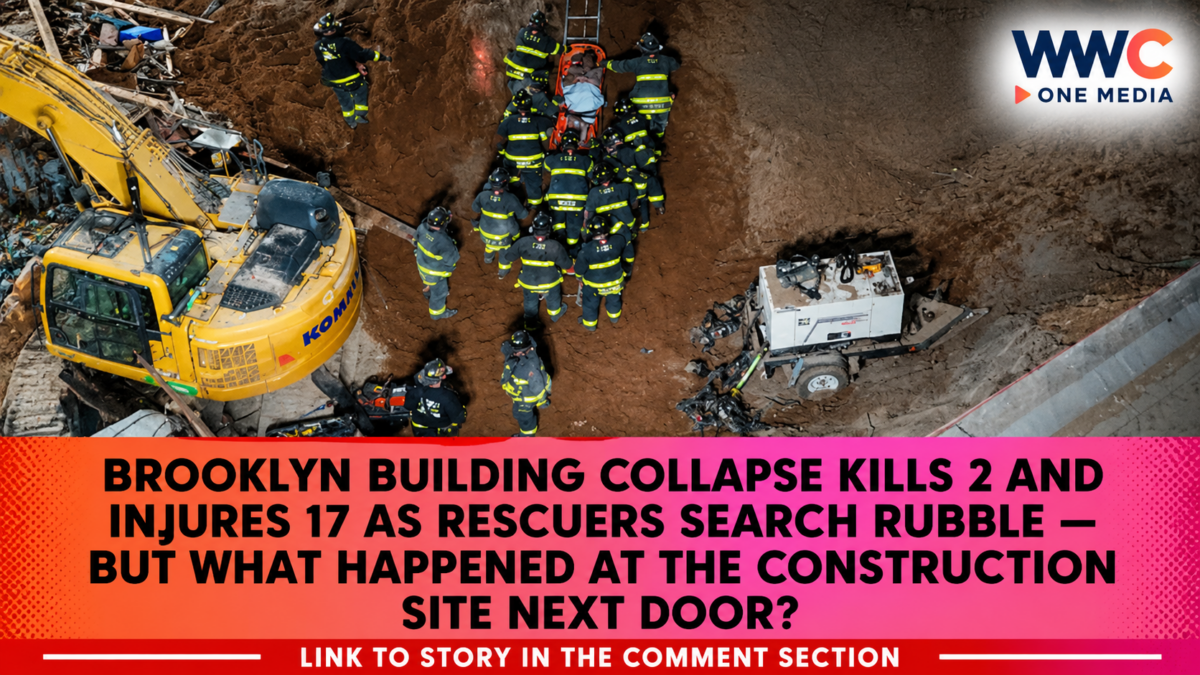
BROOKLYN, NEW YORK — A deadly building collapse in Brooklyn’s Flatbush neighbourhood has left two people dead and 17 injured, including children, after a three-storey residential and commercial structure toppled into an adjoining construction site where excavation work was underway.
The disaster happened shortly after 4pm on Wednesday, November 11, 2026, near the intersection of Flatbush and Bedford avenues.
New York City officials said firefighters and emergency personnel rushed to the scene as reports emerged that people were trapped beneath the debris. Rescue teams continued searching the wreckage into the night, using specialised equipment, drones and search dogs to locate possible survivors.
The latest reported toll stands at two fatalities and 17 injured people. Seven children were among those treated, while four victims were reported in critical condition.
The incident has raised urgent questions about building safety, construction-site operations and the risks posed by excavation work beside occupied structures.
However, authorities have not established what caused the building to collapse. Whether the neighbouring construction project contributed to the disaster remains a central question for investigators.
A THREE-STOREY BUILDING COLLAPSES INTO AN EXCAVATION SITE
The building that collapsed stood at 1321 Flatbush Avenue, next to a construction site at 2625 Bedford Avenue.
According to reporting by the Associated Press, Reuters and local New York media, the structure was a three-storey building dating back to 1930, with four residential units. It was situated beside a property undergoing redevelopment.
The building fell into the neighbouring excavation area, leaving a massive pile of bricks, timber and other debris.
Images from the scene showed the scale of the destruction, with parts of the building’s interior exposed. A neighbouring structure remained standing, but a section of its exterior wall was torn away, revealing rooms and personal belongings inside.
The collapse also created dangerous conditions for emergency responders, who had to navigate unstable debris and possible voids where survivors could be trapped.
The New York City Fire Department described the incident as a full building collapse at a construction and excavation site.
TWO DEAD, 17 INJURED — CHILDREN AMONG THE VICTIMS
New York City Mayor Zohran Mamdani confirmed that two people had died and more than a dozen others had been injured.
Fire Department Commissioner Lillian Bonsignore reported 19 known victims, including seven children. Four injured people were in critical condition, while others sustained injuries that were not considered life-threatening.
A firefighter also suffered minor injuries during the emergency response, according to Reuters.
Officials initially faced difficulties determining how many residents and construction workers were inside the affected areas when the building came down.
That uncertainty made the rescue operation especially challenging.
Authorities warned that additional victims could potentially remain beneath the rubble, although they had not confirmed how many people were still missing.
The final number of people affected may depend on the results of the ongoing search and subsequent accounting of residents, workers and visitors.
FIREFIGHTERS ARRIVED WITHIN A MINUTE
The emergency response began almost immediately.
A firefighting crew already operating in the neighbourhood reached the site within approximately one minute of the collapse and began helping victims trapped beneath the wreckage.
More than 250 firefighters and paramedics were eventually involved in the response, according to the New York Fire Department’s reported deployment.
Rescue teams used search dogs, drones and specialised equipment to examine the debris. Workers also removed rubble carefully, using buckets and other methods to avoid disturbing unstable sections.
Local television footage showed survivors being pulled from the wreckage and transferred to ambulances.
One reported rescue involved a pregnant woman, highlighting the desperate efforts to reach people who may have survived inside pockets of space beneath the collapsed structure.
But officials cautioned that the operation could take considerable time.
The debris was unstable, and moving it too aggressively could trigger further movement, potentially putting both trapped victims and rescuers at greater risk.
THE CONSTRUCTION SITE NEXT DOOR IS NOW UNDER SCRUTINY
One of the most important questions surrounding the tragedy concerns the excavation work taking place beside the collapsed building.
Construction workers were reportedly carrying out excavation activities when the structure fell into the adjoining site.
New York City’s Department of Buildings sent inspectors to the location to assist emergency personnel and examine the structural stability of nearby buildings.
Engineering News-Record reported that city records showed excavation and support-of-excavation permits had been issued for the redevelopment project on September 9.
The records described excavation-support methods, including shoring and bracing, and required special inspections of the excavation support system.
These details are significant because excavation near existing buildings requires careful engineering controls to maintain ground stability and protect neighbouring structures.
However, the existence of construction permits does not establish whether the work was properly performed, nor does it prove that excavation caused the collapse.
Investigators will need to determine whether the building’s structural condition, ground movement, construction activities or another factor contributed to the disaster.
At this stage, assigning blame would be premature.
A NINE-STOREY DEVELOPMENT WAS PLANNED FOR THE NEIGHBOURING PROPERTY
The adjoining construction site was undergoing redevelopment for a mixed-use project.
Engineering News-Record’s review of Department of Buildings records described plans for a nine-storey development with a cellar and 64 residential units.
Local reporting also indicated that the project had undergone changes in its development plans.
The distinction between a proposed development and an approved construction plan is important. Officials indicated that plans for a nine-storey building had not yet received the necessary approval at the time of the collapse, while construction-related excavation permits had been issued.
The precise scope of the authorised work and the conditions under which excavation was being carried out will be important parts of the investigation.
Authorities have not announced that the proposed development itself caused the collapse.
The central issue is whether the work underway beside the occupied property complied with all structural protection and safety requirements.
WHY EXCAVATION BESIDE AN EXISTING BUILDING CAN BE DANGEROUS
Excavation is a routine part of construction, particularly when developers prepare land for foundations, basements and underground infrastructure.
But digging close to an existing building can create serious engineering challenges.
Soil surrounding a building helps support the ground beneath and around its foundation. Removing soil nearby can change the pressure and support conditions, potentially causing ground movement if the excavation is not properly designed and controlled.
Engineers may use shoring, bracing, retaining systems and other support measures to stabilise excavation areas.
The design and installation of these systems must account for the depth of excavation, soil conditions, nearby structures and other site-specific factors.
That does not mean excavation automatically causes neighbouring buildings to collapse. Properly engineered and supervised projects are designed to manage these risks.
For the Brooklyn disaster, investigators will need to establish whether any ground movement or construction-related activity occurred and whether it had a connection to the building’s failure.
NEW YORK INSPECTORS ARE ALSO CHECKING NEARBY BUILDINGS
The danger did not necessarily end when the initial structure came down.
Part of the neighbouring building’s exterior wall was reportedly torn away, exposing interior rooms while the rest of the structure remained standing.
The Department of Buildings said inspectors were examining the stability of nearby structures as rescue and recovery operations continued.
Officials must determine whether adjacent properties have suffered structural damage that could make them unsafe for residents or emergency personnel.
The risk of secondary collapse is particularly serious at disaster sites where damaged walls, weakened foundations and unstable debris remain exposed.
Authorities urged members of the public to avoid the area while emergency teams continued their work.
A WIDER WARNING ABOUT CONSTRUCTION AND STRUCTURAL SAFETY
The Brooklyn tragedy adds to a series of incidents around the world that have placed renewed attention on construction safety and the consequences of structural failures.
In September 2026, WWC ONE MEDIA reported on a deadly New Delhi building collapse that killed six people as rescuers searched for survivors. That incident involved a five-storey building in the Satya Niketan area that collapsed during repair work in its basement.
Although the circumstances differ from the Brooklyn disaster, both incidents demonstrate the potentially devastating consequences when occupied buildings become sites of structural failure.
Construction safety is also a major concern in Singapore, where a 22-year-old worker died after falling at an HDB Tanjong Rhu construction site. The incident prompted a suspension of work while authorities investigated.
In the Philippines, a separate infrastructure failure raised questions about construction quality and engineering oversight after a newly built Tarlac dike collapsed just six months after its reported completion.
Another WWC ONE MEDIA investigation examined how South Korea’s data-centre disaster exposed safety-check failures and problems involving subcontracting.
These incidents involve different hazards and should not be treated as evidence of a common cause. Together, however, they illustrate why construction oversight, engineering standards, inspections and accountability matter.
THE INVESTIGATION: WHO WILL BE HELD RESPONSIBLE?
For now, the immediate priority remains the safety of survivors, rescue personnel and residents in nearby buildings.
New York City officials have not announced a final determination of what caused the collapse.
Investigators will need to examine the condition of the original building, the excavation site, engineering plans, construction permits, inspection records and the work being performed when the structure failed.
They will also need to establish whether any safety requirements were breached and whether those breaches, if found, contributed to the deaths and injuries.
The findings could have significant implications for the developers, contractors, engineers or other parties involved, depending on what the investigation establishes.
But no individual or company should be declared responsible before the evidence has been examined.
A DEADLY COLLAPSE LEAVES MORE QUESTIONS THAN ANSWERS
The collapse in Flatbush has devastated families and left an entire neighbourhood confronting the consequences of a sudden structural disaster.
Two people are dead, 17 have been injured, and seven children were among those treated. Emergency personnel have faced unstable debris and the possibility that additional victims could be trapped beneath the wreckage.
The proximity of the building to an active excavation site has made construction safety a central part of the investigation.
But the most important question remains unanswered: What caused an occupied three-storey building to collapse — and could the disaster have been prevented?
Until investigators complete their work, the relationship between the excavation and the collapse remains unproven.
For the families of those killed and injured, however, the search for answers is only beginning.