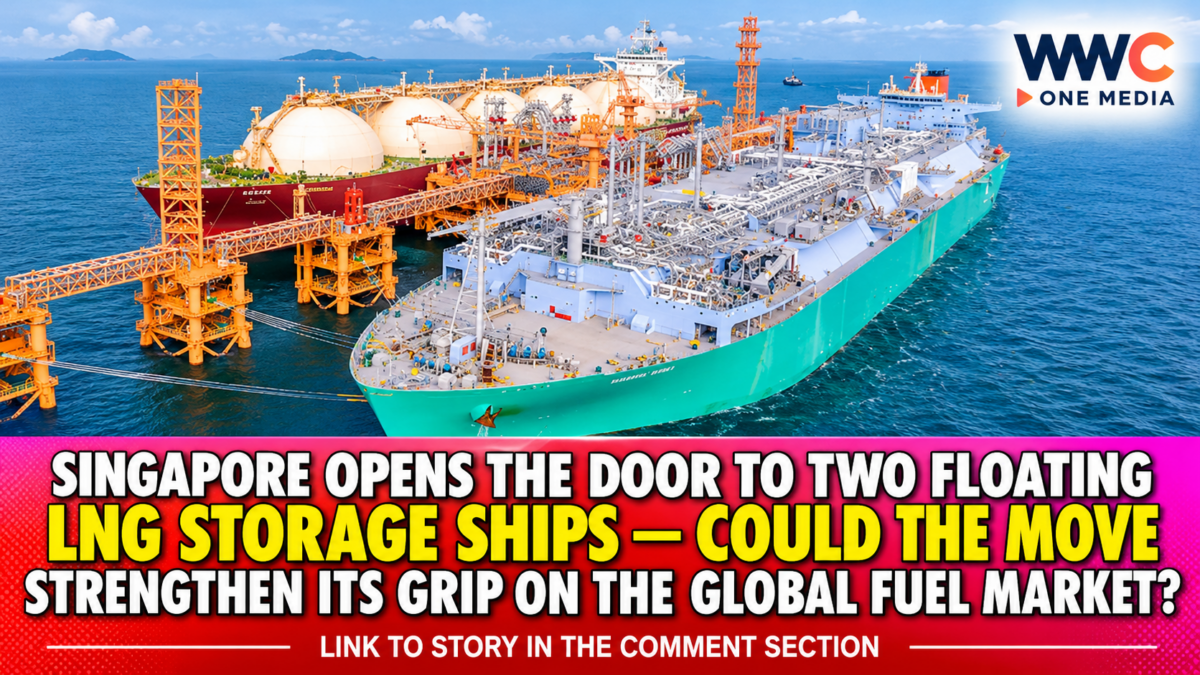
SINGAPORE, November 12, 2026 — Singapore is preparing to expand its liquefied natural gas (LNG) storage and marine-fuel capabilities, inviting companies to apply for licences to operate up to two floating storage units (FSUs) in its anchorages.
The Maritime and Port Authority of Singapore (MPA) announced the licensing opportunity on Thursday, November 12, as the country moves to strengthen its position as a major international bunkering hub and prepare for growing demand for alternative marine fuels.
The plan could give LNG suppliers more flexibility to store, reload and distribute fuel to ships, while reducing reliance on a limited number of storage and supply arrangements.
But the initiative is about more than adding storage capacity. It is also part of Singapore’s wider strategy to remain competitive as the global shipping industry explores alternatives to conventional marine fuels.
Under the new framework, existing LNG bunker licensees can apply independently or partner with third-party terminal operators. Successful operators will have to meet strict capacity, safety, accessibility and sustainability requirements.
Applications close on February 4, 2027, at 5pm Singapore time.
MPA Opens Applications for Up to Two Floating LNG Storage Units
The MPA has invited applications for licences covering a maximum of two LNG floating storage units in Singapore’s anchorages.
Unlike conventional land-based storage facilities, floating storage units are vessels used to hold LNG at sea. Their availability can provide additional flexibility for storing and transferring fuel, particularly when demand and shipping schedules fluctuate.
The proposed facilities are intended primarily to support LNG bunkering — the process of supplying marine fuel to ships.
According to the MPA, most of each floating unit’s storage capacity must be allocated to LNG bunkering. Operators must also make a minimum amount of capacity available to other LNG bunker suppliers under open-access arrangements.
This requirement is significant because it is designed to prevent the new storage infrastructure from becoming exclusively available to one operator.
The regulator also requires applicants to disclose the intended maximum fees they will charge for LNG reloading services, allowing it to assess the commercial arrangements associated with the facilities.
Each licence will be valid for five years.
The MPA said the new floating storage capacity would complement the eight LNG bunker supplier licences awarded in July 2026, diversifying storage and reloading options while strengthening supply resilience.
Who Can Apply — and What Are the Requirements?
The licensing opportunity is open to existing LNG bunker licensees, which may work with third-party terminal operators to provide the necessary storage and operational expertise.
Applicants must meet several conditions:
- Minimum storage capacity: Own or charter at least one floating storage unit with a capacity of 130,000 cubic metres.
- Singapore registration: The vessel must be registered with the Singapore Registry of Ships.
- Safety compliance: Operators must meet the MPA’s applicable safety and operational requirements.
- Open access: Most storage capacity must support LNG bunkering, with a minimum allocation made available to other LNG bunker suppliers.
- Fee disclosure: Applicants must disclose their intended maximum charges for LNG reloading services.
- Sustainability certification: The units must hold International Sustainability and Carbon Certification European Union (ISCC-EU) certification to handle bio-LNG and e-LNG.
The certification requirement is particularly important because Singapore wants its future LNG infrastructure to accommodate lower-emission alternatives as they become more widely available.
The MPA will hold an industry briefing on December 4, 2026, for companies interested in applying.
Applications must be submitted by email to greenport@mpa.gov.sg no later than February 4, 2027, at 5pm.
The official application information is available through the MPA’s LNG floating storage unit licensing announcement.
Why Singapore Wants More LNG Storage Capacity
The latest announcement follows a major expansion of Singapore’s LNG bunkering market.
In July 2026, the MPA awarded eight new licences to supply LNG as marine fuel. The successful companies were:
- Aramco Trading Singapore
- Equatorial Marine Fuel Management Services
- ExxonMobil Asia Pacific
- PetroChina International (Singapore)
- Shell Eastern Trading
- Sinopec Fuel Oil (Singapore)
- TotalEnergies Gas & Power Asia–Sembcorp Fuels joint venture
- Vitol Bunkers (S)
The licences took effect on September 1, 2026, and are valid until August 31, 2031, subject to continuing compliance with licensing conditions.
The expanded supplier base creates a greater need for reliable storage, cargo transfers and access to LNG supplies.
Floating storage units could help address that need by providing additional capacity and alternative reloading arrangements.
The MPA’s January 2026 licensing framework also requires LNG bunker suppliers to establish end-to-end supply arrangements, including sourcing, demand planning, storage, cargo transfers, safe handling and delivery to vessels.
This means the new floating storage licences are part of a broader effort to develop the entire LNG bunkering supply chain rather than simply adding more fuel suppliers.
LNG Bunkering Demand Is Growing in Singapore
The commercial opportunity is becoming increasingly visible in Singapore’s fuel sales figures.
According to Reuters, Singapore recorded 487,100 tonnes of LNG bunker sales between January and September 2026, representing growth of more than 21% compared with the same period a year earlier.
Marine fuel supplier Equatorial Marine Fuel Management is among the companies preparing for the expansion.
Reuters reported in October that the company planned to invest part of its 2026 profits in its LNG bunkering business, with stronger demand expected from 2028 as more LNG production capacity and dual-fuel vessels become available.
Its first purpose-built LNG bunker barge is expected to arrive in the third quarter of 2027.
The company’s expectations reflect a broader shift in the shipping industry. More shipowners are considering vessels capable of operating on LNG alongside conventional marine fuels.
The growth of this fleet could increase demand for LNG bunkering services and supporting infrastructure.
However, demand forecasts remain dependent on fuel prices, global LNG availability, shipping regulations and the pace at which shipowners invest in alternative-fuel vessels.
Singapore Is Competing to Remain a Leading Global Bunkering Hub
Singapore’s move comes as major ports compete to attract shipping companies and provide reliable access to marine fuels.
The city-state has long been one of the world’s most important refuelling locations. Its strategic position along major international shipping routes allows vessels to replenish fuel while moving between Asia, Europe and other global markets.
The port’s performance also demonstrates the scale of its maritime business.
According to the Maritime and Port Authority, Singapore’s total marine fuel sales reached approximately 56.77 million tonnes in 2025, while container throughput reached a record 44.66 million twenty-foot equivalent units.
Channel NewsAsia has reported that the maritime sector supports more than 170,000 jobs across approximately 5,000 companies in Singapore.
That makes the development of new marine-fuel capabilities an important economic issue, not merely a technical project involving ships and storage tanks.
The MPA is also preparing for stronger regional competition. Ports in Malaysia, China and Vietnam are investing in capacity and services that could attract shipping operators and transshipment activity.
For Singapore, maintaining reliable fuel availability, efficient port operations and a broad range of marine services remains central to its competitive position.
The Floating Storage Plan Is Also About Bio-LNG and e-LNG
One of the most notable features of the new licensing framework is the requirement for ISCC-EU certification.
The MPA wants the floating storage infrastructure to be capable of handling bio-LNG and e-LNG, two alternatives that could help reduce the lifecycle greenhouse gas emissions associated with shipping.
Bio-LNG is produced from biogenic sources, such as organic waste, while e-LNG is produced using synthetic processes involving hydrogen and carbon dioxide.
Both fuels can potentially use parts of the existing LNG supply chain, including storage and handling infrastructure.
This could make the transition easier if production and commercial availability increase.
However, certification alone does not guarantee that a fuel is widely available or automatically carbon-neutral. Its environmental performance depends on how it is produced, sourced, transported and used.
Methane leakage is another important concern.
LNG is primarily methane, and methane released during production, transport or combustion can undermine its climate benefits. This is why Singapore’s broader LNG licensing framework includes requirements for suppliers to explain how they will monitor and mitigate methane slip from LNG bunker vessels.
The country’s objective is to develop infrastructure that can support different fuel pathways as international shipping’s energy transition progresses.
LNG Is Not the Only Alternative Fuel Singapore Is Preparing For
Singapore’s strategy extends beyond LNG.
At the Singapore International Bunkering Conference in October 2026, the MPA announced several initiatives covering ammonia, ethanol, liquefied bio-methane and digital bunkering.
Among the developments:
- Ammonia: The MPA and Enterprise Singapore introduced Technical Reference TR 148, establishing requirements for safety, bunkering procedures, custody transfer and crew competencies.
- Ethanol: Singapore prepared for its first ethanol bunkering operation at PSA’s Pasir Panjang Terminal, involving Maersk, Golden Island and PSA Singapore.
- Bio-methane: The MPA, CMA CGM and Singapore LNG Corporation signed an agreement to explore liquefied bio-methane as a marine fuel.
- Electric harbour craft: A two-year early-adopter grant scheme is scheduled to begin on January 1, 2027, with grants of up to S$250,000 per eligible vessel.
These initiatives illustrate why Singapore is developing a multi-fuel bunkering system rather than relying on a single alternative fuel.
Different vessel types, shipping routes and operators may adopt different technologies depending on cost, availability, infrastructure and regulatory requirements.
The challenge is ensuring that the port can support those different fuels safely and efficiently.
Could More Floating Storage Strengthen Singapore’s Energy Resilience?
The new licences are intended primarily to strengthen LNG bunkering and reloading options, but they also raise a broader question about the resilience of Singapore’s energy infrastructure.
Singapore imports natural gas through pipelines and in the form of LNG. The Energy Market Authority has said that natural gas accounts for approximately 95% of the country’s electricity generation.
That makes reliable fuel supply an important national concern.
The government has taken steps to diversify LNG sources and strengthen fuel reserves. The Energy Market Authority has also explained that prolonged international supply disruptions could affect fuel availability and prices in Singapore.
Additional floating LNG storage could improve flexibility for the marine-fuel market, but it should not be confused with a direct replacement for the country’s electricity-generation supply arrangements.
The new FSU licences are specifically designed to support LNG bunkering and related reloading services. They do not, by themselves, guarantee additional LNG for households or power stations.
That distinction matters as Singapore balances its role as a major maritime refuelling hub with its need to maintain secure domestic energy supplies.
What Happens Next?
The next stage will be the application and evaluation process.
Interested companies will have an opportunity to attend the MPA’s December 4 briefing before submitting their proposals by February 4, 2027.
The regulator will need to assess whether applicants can meet the vessel-capacity requirements, maintain safe operations, provide open-access storage arrangements and comply with the certification framework.
The eventual operators could help expand Singapore’s LNG storage options and provide additional flexibility for marine-fuel suppliers.
But the commercial success of the programme will depend on whether demand continues to grow, whether LNG remains competitive against other marine fuels and whether the infrastructure can support lower-emission alternatives at scale.
Singapore is positioning itself for a shipping industry that may use several fuels simultaneously for years to come.
The floating storage initiative is another step in that direction.
The bigger question is whether Singapore can turn its expanding LNG infrastructure into a lasting competitive advantage — while preparing for a future in which the world’s ships may no longer depend on conventional fossil fuels.