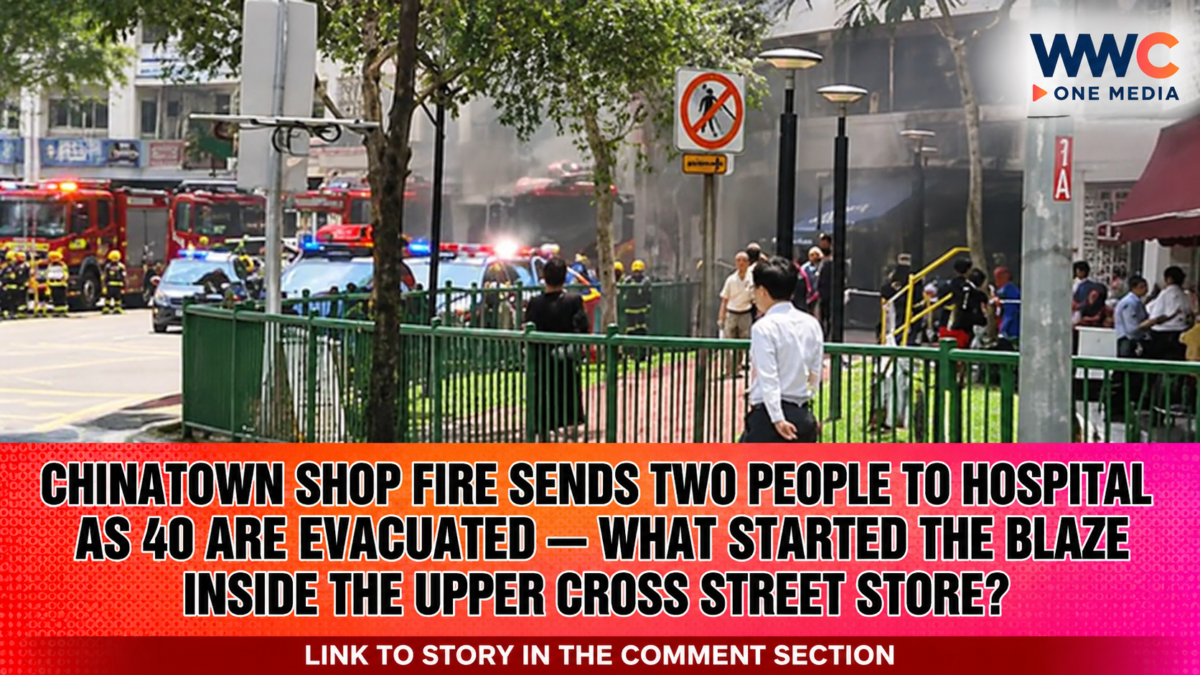
SINGAPORE — Thick grey smoke poured from a Chinatown shop on Wednesday afternoon, November 11, prompting an emergency response and the evacuation of approximately 40 people from a Housing and Development Board (HDB) block.
Two people were taken to Singapore General Hospital after experiencing suspected smoke inhalation following the fire at Block 34 Upper Cross Street, opposite the State Courts.
The Singapore Civil Defence Force (SCDF) said it was alerted to the incident at approximately 12.50pm. The fire involved contents inside the storage area of a commercial unit on the building’s first floor.
Firefighters had to force their way into the premises before extinguishing the blaze with a water jet.
Police officers evacuated around 40 people from the block as a precaution while emergency personnel dealt with the incident.
The cause of the fire remains under investigation.
The incident has raised fresh questions about fire safety in Singapore’s mixed-use buildings, where commercial units operate alongside residential spaces and smoke from a ground-floor emergency can affect people beyond the shop itself.
FIRE BREAKS OUT INSIDE CHINATOWN TRADITIONAL MEDICINE SHOP
The affected premises was identified by The Straits Times as Ming Tai Medical and Trading, a traditional Chinese medicine shop located on the first floor of Block 34 Upper Cross Street.
The shop sells Chinese herbs, with its website also listing liquor and wine products.
Eyewitness videos circulating online showed grey smoke rising from the ground-floor premises, while emergency vehicles gathered around the building.
When The Straits Times arrived at approximately 1.30pm, several SCDF vehicles, police cars and an ambulance were at the scene. A nearby bus stop had also been cordoned off.
A nearby worker, identified only as Zhang, told the newspaper that he noticed the shop owner’s wife running out of the premises at around 12.30pm.
After realising there was a fire, he borrowed a fire extinguisher from another shop and attempted to help.
However, he said the affected unit was already filled with smoke, making it difficult to see or breathe inside.
He eventually had to leave when the smoke became too overwhelming.
Another nearby shop worker, Amy Seow, said the smoke became increasingly thick and irritated her and her colleague’s eyes. They closed their shop and evacuated.
The eyewitness accounts illustrate how quickly smoke from a commercial-unit fire can affect neighbouring businesses, even before flames spread beyond the original premises.
TWO PEOPLE TAKEN TO SINGAPORE GENERAL HOSPITAL
Although the fire was confined to contents in the shop’s storage area, smoke exposure required medical attention.
SCDF assessed two people for smoke inhalation and conveyed them to Singapore General Hospital.
The approximately 40 people evacuated from the block were moved as a precaution while firefighters worked to extinguish the fire and secure the affected area.
Authorities have not publicly identified the two hospitalised individuals or disclosed further details about their medical conditions.
There has also been no confirmed public announcement establishing the extent of damage inside the shop.
Most importantly, investigators have not yet disclosed what ignited the fire.
FIREFIGHTERS FORCED ENTRY TO EXTINGUISH THE BLAZE
According to SCDF, firefighters conducted a forced entry into the affected commercial unit before using a water jet to put out the flames.
Forced entry is sometimes necessary when emergency crews cannot safely access a burning premises through its normal entrance.
The operation allowed firefighters to reach the affected storage area and deal with the fire.
Police officers meanwhile helped evacuate people from the block to reduce the risk of smoke exposure during firefighting operations.
There is currently no official confirmation that the fire spread into residential flats or caused structural damage to the HDB block.
The distinction is important: the reported fire involved the contents of a first-floor commercial unit, and the evacuation was a precautionary measure.
WHY THE FIRE IS RAISING CONCERNS ABOUT SINGAPORE’S COMMERCIAL PREMISES
The Chinatown incident comes amid a series of fire emergencies reported across Singapore in recent days.
On November 10, approximately 70 people were evacuated from Block 105A Edgefield Plains in Punggol after a fire broke out inside a 15th-floor HDB flat.
SCDF said preliminary findings indicated that the Punggol fire was likely electrical in origin. Two people were assessed for smoke inhalation but declined hospital treatment.
That incident was separate from the Chinatown shop fire, and authorities have not suggested that the two fires had a common cause.
WWC ONE MEDIA covered the Punggol emergency in its report, Punggol HDB Fire Forces 70 Residents to Evacuate After Blaze Erupts on 15th Floor at Edgefield Plains.
Another recent incident occurred at Kinokuniya’s Takashimaya flagship store on November 2, when a fire broke out in a fourth-floor locker room.
The bookstore temporarily closed while emergency personnel responded, but no injuries were reported and the store reopened later that evening.
The cause of that fire was also under investigation in the reports available at the time.
Read more: Kinokuniya Takashimaya Store Reopens After Locker Room Fire — But What Caused the Blaze?.
Earlier, a fire at Block 158 Mei Ling Street in Queenstown sent two people to hospital for smoke inhalation and prompted approximately 25 residents to evacuate.
That blaze involved combustible items outside a 10th-floor residential unit.
WWC ONE MEDIA reported the incident in Singapore HDB Fire Sends 2 to Hospital, Forces 25 to Evacuate — But What Sparked the 10th-Floor Blaze?.
These incidents happened at different locations and involved different circumstances. They should not be treated as evidence of a single underlying cause. However, they demonstrate why fire prevention, early detection and emergency preparedness remain important across residential and commercial properties.
SINGAPORE RECORDED 999 FIRES AT COMMERCIAL AND OTHER NON-RESIDENTIAL PREMISES IN 2025
The Chinatown fire also brings attention to Singapore’s wider commercial fire-safety record.
According to figures cited by AsiaOne from SCDF, Singapore recorded 999 fires at commercial, industrial and other premises in 2025, compared with 1,022 cases in 2024.
That represented a decline of 23 reported cases.
The figures cover a broad group of non-residential premises and should not be interpreted as the number of fires in retail shops alone.
Businesses are required to comply with Singapore’s Fire Safety Act and applicable fire-safety requirements. SCDF also conducts inspections to check compliance.
Commercial premises can contain storage rooms, electrical equipment, packaging materials, merchandise and other combustible contents. The combination of these materials and the movement of employees and customers makes appropriate fire-safety arrangements essential.
The Chinatown incident is a reminder that even when a fire is confined to one commercial unit, its consequences can extend beyond the business itself.
WHY SMOKE CAN BE AS DANGEROUS AS THE FLAMES
One of the most important details in the Chinatown incident is that the two people taken to hospital were assessed for smoke inhalation rather than reported burn injuries.
Smoke from a fire can contain gases, fine particles and other harmful substances produced by burning materials.
Exposure can cause coughing, eye irritation, breathing difficulties and more serious respiratory complications.
In buildings with multiple businesses and residential units, smoke may also travel through shared corridors and other connected spaces, depending on the building’s layout and ventilation.
This is why evacuations may be necessary even when firefighters have not reported flames spreading throughout the building.
The experience of nearby shop workers, who described worsening smoke and eye irritation, demonstrates how conditions can become difficult even outside the affected premises.
WHAT CAUSED THE UPPER CROSS STREET FIRE?
For now, the central unanswered question remains the ignition source.
SCDF has confirmed that the fire involved contents in the storage area of a first-floor commercial unit, but it has not publicly established whether the blaze began because of an electrical fault, equipment failure, an accidental ignition or another cause.
There is also no confirmed evidence that the shop’s merchandise, Chinese medicinal products or any particular stored item caused the fire.
The investigation must establish those details before responsibility or a specific safety failure can be identified.
The presence of emergency vehicles and the precautionary evacuation do not, by themselves, establish that the building had a fire-safety violation.
WHAT HAPPENS NEXT?
The immediate emergency has been brought under control, and the two people affected by smoke inhalation were transported to Singapore General Hospital.
The next important development will be the outcome of the investigation into the fire’s cause.
Authorities may need to establish what ignited the contents in the storage area, whether any equipment or materials contributed to the incident, and whether further safety measures are necessary.
For businesses operating in HDB blocks and other mixed-use buildings, the incident is also a reminder to keep storage areas properly managed, maintain appropriate fire-safety equipment and ensure that emergency access and escape routes remain clear.
The fire at Block 34 Upper Cross Street did not remain a private business emergency. It prompted the evacuation of dozens of people and sent two individuals to hospital.
The biggest question now is what started the blaze inside the Chinatown shop — and whether the investigation will uncover a preventable hazard that other businesses should take seriously.