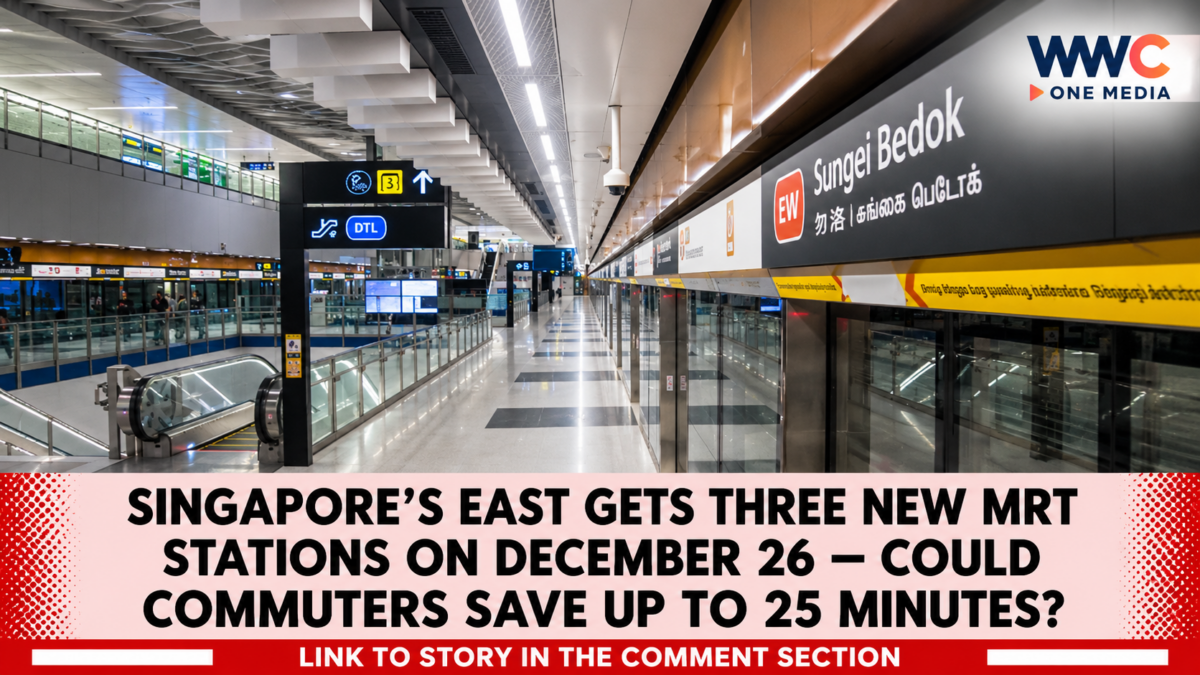
Singapore’s eastern transport network is preparing for a major upgrade, with three new MRT stations scheduled to open on December 26, 2026. The expansion will connect two major rail lines, improve access to employment centres and give commuters more options for travelling across the island.
The new stations are Bedok South, Sungei Bedok and Xilin. They form part of the Thomson-East Coast Line Stage 5 (TEL5) and the Downtown Line 3 Extension (DTL3e).
The biggest change will be at Sungei Bedok, where passengers will be able to transfer between the Thomson-East Coast Line (TEL) and Downtown Line (DTL).
According to Singapore’s Land Transport Authority (LTA), selected journeys could become significantly shorter. One example is the trip from Havelock to Changi Business Park, which is projected to fall from approximately 70 minutes to 45 minutes — a potential saving of up to 25 minutes.
But the benefits will not be identical for every commuter. The actual time saved will depend on where passengers start, where they are going and the route they choose.
Three New MRT Stations Confirmed for December 26
The LTA confirmed that the two rail extensions will begin passenger service on Saturday, December 26, 2026.
The three stations are:
- Bedok South (TE30): Part of the Thomson-East Coast Line, serving residents and nearby communities along Upper East Coast Road.
- Sungei Bedok (TE31/DT37): An interchange connecting the Thomson-East Coast Line and Downtown Line.
- Xilin (DT36): Part of the Downtown Line, improving access to Changi South and nearby employment areas.
Together, the extensions will add approximately 4.3 kilometres to Singapore’s rail network. TEL Stage 5 will extend from Bayshore to Sungei Bedok, while the Downtown Line 3 Extension will connect Expo to Sungei Bedok.
The two projects will meet at Sungei Bedok, creating another interchange between the two lines.
The LTA announcement was also reported by Channel NewsAsia and The Straits Times, which highlighted the expected travel-time improvements and better access to eastern employment centres.
Sungei Bedok Could Be the Biggest Game-Changer
Among the three stations, Sungei Bedok is particularly significant because it will provide a direct interchange between the TEL and DTL.
It will become the second station where passengers can transfer between the two lines, after Stevens.
The connection will give commuters more flexibility when travelling between eastern Singapore, the city centre and other parts of the island.
Instead of relying on existing routes or additional bus connections, passengers will have another rail interchange available to plan their journeys.
For people living and working in the East Coast corridor, the new connection could make daily travel more convenient and provide alternative routes when planning trips across the network.
Some Commuters Could Save Up to 25 Minutes
The most attention-grabbing figure in the LTA announcement is the projected reduction in travel time.
The authority cited the journey between Havelock and Changi Business Park as an example.
Currently, the trip takes around 70 minutes and involves a bus transfer. After the extensions open, the journey via the TEL and DTL is expected to take approximately 45 minutes.
That could save commuters up to 25 minutes.
Passengers travelling between Marine Parade and Tampines could also save up to 10 minutes compared with current travel options.
These are LTA estimates for specific journeys, not a promise that every passenger will experience the same reduction. Actual travel times will depend on the origin, destination, waiting periods and transfer arrangements.
Still, the projected savings demonstrate why the new interchange could matter to commuters who regularly travel across eastern Singapore.
Bedok South to Improve Access for East Coast Residents
Bedok South station will be located along Upper East Coast Road and is expected to improve access for nearby residential communities and schools, including the Bayshore precinct.
The station forms part of the final stage of the Thomson-East Coast Line.
For residents who currently depend on buses or longer journeys to reach an existing MRT station, the new facility could provide a more convenient connection to the wider rail network.
Its opening will also strengthen the TEL’s coverage along the eastern corridor, giving residents additional access to destinations served by the line.
Xilin to Improve Access to Changi South and Business Hubs
Xilin station will be part of the Downtown Line 3 Extension.
The station is expected to improve access to Changi South industrial estate, Changi Business Park and surrounding employment areas.
This could be especially useful for employees travelling to offices and businesses in the eastern part of Singapore.
The extension will provide another rail connection for commuters travelling between the East and the city centre, potentially reducing the need for some bus-to-train transfers.
Improved access to employment hubs is also important for businesses that rely on workers travelling from different parts of the island.
More Than 460,000 Household-Access Estimates — But Not Necessarily Unique Homes
The LTA expects the extensions to increase the number of households within a 10-minute walk of the two MRT lines.
Its estimates indicate:
- More than 240,000 households will be within a 10-minute walk of a TEL station after Stage 5 opens.
- More than 220,000 households will be within a 10-minute walk of a DTL station after the extension opens.
These are separate estimates for the two lines. They should not automatically be added together and described as 460,000 unique households, because some homes may fall within both service areas.
The broader objective is to make rail transport more accessible to residents and workers, particularly those living along the East Coast corridor.
Thomson-East Coast Line Reaches Its Planned Final Stage
The opening of Bedok South and Sungei Bedok will complete the TEL’s planned five-stage rollout.
The line began operations in 2020 and was progressively expanded to connect Woodlands, the Thomson area, the city centre and the East Coast.
Following the opening of Stage 5, the TEL will have 29 operational stations across approximately 42.8 kilometres.
The LTA also expects the line to serve around one million daily commuters in the longer term after its future extension to Changi Airport Terminal 5.
That is a longer-term projection, not an immediate ridership forecast for the December opening.
Downtown Line Will Expand to 37 Stations
The Downtown Line, which began operations in 2013, connects north-western and eastern Singapore through the city centre.
The addition of Xilin and Sungei Bedok will extend the line to 37 operational stations across approximately 44.6 kilometres.
The extension is expected to strengthen connections to eastern employment areas and give passengers more options when travelling between the city centre and the East.
The LTA has also outlined a future Downtown Line 2 Extension, which is expected to connect the line to the North-South Line in the north-western region by 2035.
Singapore’s MRT Expansion Comes With a Reliability Challenge
Building additional stations is only one part of improving public transportation. Maintaining reliable services as the network expands is another major challenge.
In September, WWC One Media examined Singapore’s record MRT reliability figures and the less straightforward commuter-performance indicators behind them.
The report discussed how record performance in mean kilometres between failures does not automatically mean every commuter experiences shorter waits or perfectly punctual services.
That distinction is relevant as Singapore adds more stations and integrates new infrastructure into its existing network.
The December expansion will create additional travel options, but the long-term benefit will also depend on how effectively the expanded system operates.
Future Singapore–Johor Bahru Rail Connection: An Important Distinction
The new stations also come at a time when Singapore and Malaysia are preparing for the Johor Bahru–Singapore Rapid Transit System (RTS) Link.
The RTS Link will connect Woodlands North in Singapore with Bukit Chagar in Johor Bahru. Passengers travelling on the Thomson-East Coast Line will be able to reach Woodlands North and transfer to the cross-border service once it begins operations.
However, the three new stations opening on December 26 will not provide a direct train service to Johor Bahru.
There is also an important update to the RTS timeline. Although earlier official planning had targeted service towards the end of 2026, AsiaOne reported on October 2 that the operator was then expecting passenger service to begin in February 2027, following the remaining testing, commissioning and approval work.
The RTS project is therefore separate from the December MRT opening.
WWC One Media has also examined the challenges surrounding the cross-border rail project, particularly whether Johor Bahru’s local transport network will be ready to handle the passengers it is expected to bring.
The connection between the two projects is important: the new MRT stations will strengthen access to Singapore’s rail network, while the RTS Link will provide a separate cross-border service from Woodlands North.
Rail Expansion Also Raises Questions About Planning and Public Trust
Singapore’s rail network expansion has also brought attention to how future station locations and transport plans are handled.
In October, Singapore’s government said eight public officers had been referred to police after a review of property transactions near locations later announced as MRT stations.
The referrals followed an examination of 191 officers’ property transactions. Authorities stressed that referral did not establish wrongdoing and that further investigation and due process were necessary.
WWC One Media previously covered the issue in its report on the investigation involving property purchases near future MRT stations.
Read: Singapore Investigates 8 Civil Servants Over Property Purchases Near Future MRT Stations.
The issue highlights another dimension of major transport projects: decisions about rail infrastructure can affect not only commuting patterns but also property markets, urban development and public confidence in planning processes.
What Commuters Should Know Before December 26
Here are the confirmed details of the upcoming opening:
- Passenger-service opening: December 26, 2026
- Bedok South: Thomson-East Coast Line
- Sungei Bedok: Thomson-East Coast Line and Downtown Line interchange
- Xilin: Downtown Line
- Combined extension length: Approximately 4.3 kilometres
- Potential travel-time savings: Up to 25 minutes on selected journeys
- Key employment areas: Changi Business Park and Changi South industrial estate
The LTA has confirmed the opening date. Commuters should monitor official LTA and train-operator announcements for operational details, including first-train schedules and updated journey-planning information.
The Bigger Picture: Will the New Stations Change Daily Commuting?
The December 26 opening represents a major milestone for Singapore’s eastern transport network.
Bedok South will improve access for nearby residents, Xilin will strengthen connections to Changi South and employment areas, and Sungei Bedok will provide a new interchange between two major MRT lines.
For selected commuters, the projected travel-time reductions could make a noticeable difference to daily journeys. The wider benefit will depend on how residents, workers and businesses use the new connections once passenger service begins.
Singapore’s rail network is continuing to expand, but the real test will be whether the additional infrastructure delivers convenient, dependable journeys over the long term.
The question is no longer simply when the three stations will open. It is how much they will change the way people move across Singapore’s East.