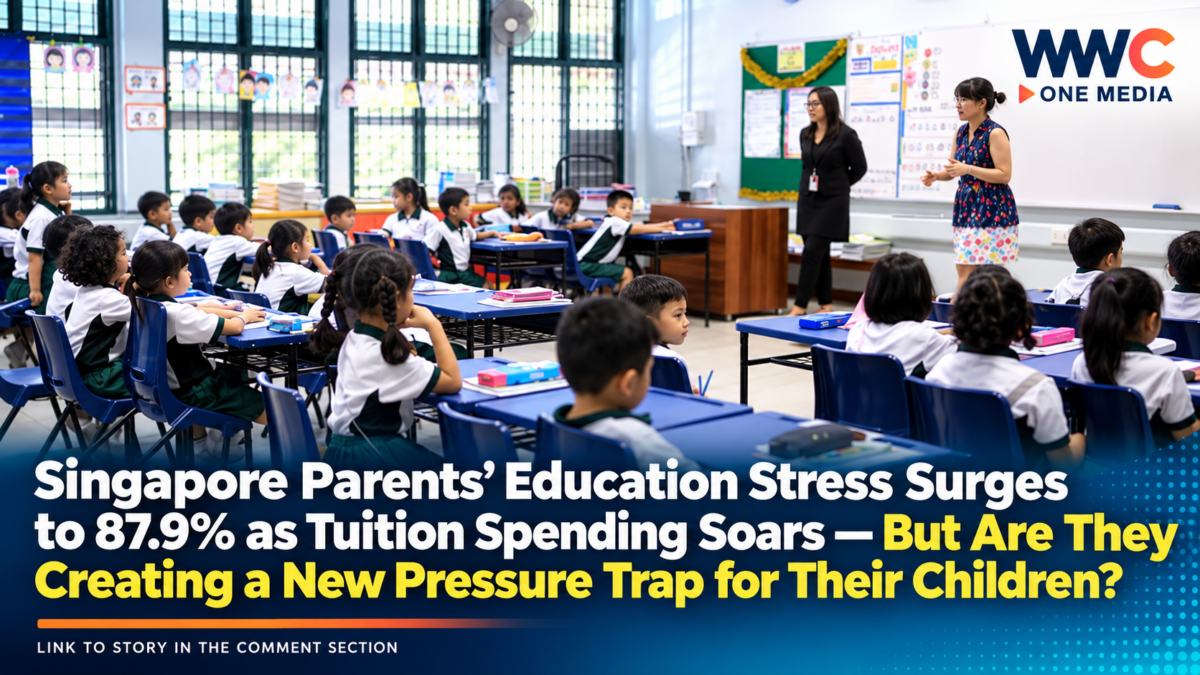
SINGAPORE | October 23, 2026 — Singapore’s decades-long battle against academic pressure is entering a troubling new phase. Even as the country reforms examinations and encourages students to develop beyond the classroom, new research shows that parents are becoming more anxious about their children’s educational futures.
And the pressure may no longer stop at examination results.
From the Primary School Leaving Examination (PSLE) to piano lessons, coding classes, sports and extracurricular activities, Singaporean families face a growing dilemma: Are they helping children discover their potential, or turning every childhood experience into another competition?
A commentary published by Channel NewsAsia on October 23, written by father-of-three Malminderjit Singh, raises concerns that parental anxiety may be undermining efforts to create a healthier education system.
The issue is particularly striking because recent research indicates that many parents support reforms designed to reduce academic competition, even as their own stress and spending continue to climb.
Parents’ Education Stress Climbs to Nearly 88%
A 2026 study by Singapore’s Institute of Policy Studies (IPS), involving 1,500 parents of primary school pupils, reveals a sharp increase in education-related anxiety over the past decade.
The proportion of parents reporting stress about their children’s education rose from 73.1% in 2016 to 87.9% in 2026.
Meanwhile, the percentage of parents who reported arguing with their spouses over their children’s education increased from 42.8% to 59.7%.
The results suggest that academic competition affects more than children’s classroom experiences. It can also shape household relationships, financial decisions and family expectations.
According to the study, more than two-thirds of parents believe Singapore’s education system continues to impose unnecessary pressure on children.
Yet many also remain convinced that strong academic performance is essential for securing future opportunities.
Tuition Spending Rises Despite Efforts to Ease Pressure
The financial dimension of Singapore’s education competition is equally revealing.
The IPS findings show that average monthly tuition spending increased from an inflation-adjusted S$386 in 2016 to S$677 in 2026.
Average monthly enrichment spending also rose sharply, from S$152 to S$355 over the same period, using inflation-adjusted 2016 comparisons.
These expenditures reflect a growing willingness among families to invest in additional academic support and activities intended to develop children’s abilities.
But an apparent contradiction is emerging.
Nearly nine in 10 parents surveyed believe children devote too much time to tuition and enrichment. Nevertheless, 70.2% indicated they would spend even more on these activities if they had the financial resources.
The findings highlight a competitive cycle in which parents may recognise that children are overloaded but still fear that reducing activities could leave them behind.
PSLE Remains Important Despite Mounting Anxiety
Singapore has introduced significant education reforms, including the replacement of the PSLE’s former T-score system with broader Achievement Levels in 2021.
The aim was to reduce excessive competition and place greater emphasis on individual learning rather than small differences between students’ examination marks.
The government has also removed mid-year examinations and introduced greater flexibility in secondary education.
However, the IPS survey found that 85.9% of parents still consider the PSLE a useful educational checkpoint.
This suggests that the examination continues to command considerable public confidence despite concerns about stress.
The bigger problem may therefore involve how families interpret the consequences of examination results.
Parents often view secondary school placement as an important stepping stone toward future educational and career opportunities.
Although Singapore offers multiple educational pathways, some parents remain concerned that missing a preferred school or programme could create a lasting disadvantage.
When Parental Sacrifices Become Children’s Burdens
In his CNA commentary, Singh examines how parents’ well-intentioned sacrifices can unintentionally increase the pressure on children.
Some parents arrange work leave around examination periods, decline professional opportunities or make other significant lifestyle adjustments to help their children prepare.
Although these decisions may reflect genuine care and commitment, children can also interpret them as obligations to deliver strong results.
Singh’s central concern is that a young student may begin to feel responsible not only for personal academic performance but also for the sacrifices made by the family.
Previous CNA reporting involving 20 Primary 5 and Primary 6 pupils found that parents emerged as a major source of examination-related stress among the children interviewed.
Some pupils expressed fears about disappointing their parents, especially when families had invested significant money in tuition.
These observations do not establish that parents are the main source of stress for all Singaporean pupils. They do, however, highlight the emotional consequences that academic expectations can create.
Is Holistic Education Becoming Another Competition?
Singapore’s efforts to promote holistic education encourage children to develop creativity, leadership, character, resilience and interests beyond academic subjects.
In principle, such changes could create opportunities for students whose strengths are not fully reflected in examination results.
However, the expansion of enrichment activities creates another challenge.
If parents begin treating music, sports, coding, volunteering or leadership positions primarily as credentials for school admission, children may face additional competition instead of relief.
A piano lesson intended to encourage creativity could become another performance target.
A sporting activity that should provide enjoyment might instead become part of a long-term school admission strategy.
The risk is not that enrichment activities are inherently harmful. Rather, it is that excessive expectations could transform valuable learning experiences into new sources of pressure.
Singapore’s Education Reforms Face a Bigger Test
The Ministry of Education has taken steps to diversify learning pathways and reduce the weight of academic examinations.
Full Subject-Based Banding, implemented in secondary schools since 2024, provides students with greater flexibility to take subjects at different levels according to their strengths.
Singapore has also expanded opportunities through Direct School Admission, which allows students to seek entry into participating secondary schools based on talents, interests and achievements beyond PSLE scores.
Still, education reform cannot automatically eliminate competition if families continue to judge success through increasingly demanding comparisons.
The challenge is therefore twofold: policymakers must continue building credible pathways for different learners, while parents need confidence that success is not limited to a narrow range of schools or qualifications.
The Bigger Question: What Does Success Really Mean?
Singapore’s latest education findings expose a difficult paradox.
Parents increasingly support the idea that children should develop academically, socially and emotionally. Yet many remain deeply concerned that their children could lose ground in a competitive environment.
Education reforms may reduce pressure from examinations, but they cannot fully solve the problem if competition simply shifts toward extracurricular achievements.
For families, the challenge may be learning to distinguish genuine development from activities pursued mainly out of fear of falling behind.
For policymakers, the task is to ensure that alternative educational pathways are trusted, accessible and genuinely valuable.
The question facing Singapore is no longer just whether students are studying too hard. It is whether an expanding definition of success could unintentionally make childhood even more competitive.
And unless that underlying anxiety changes, the next education arms race may continue long after the PSLE is over.