PARIS, France | October 23, 2026 — France is facing a growing political and social crisis as student-led demonstrations transform into a nationwide protest movement, with hundreds of thousands demanding better public services, affordable living costs and sweeping changes to the education system.
But beyond the burning barricades, tear gas and clashes with riot police, another confrontation is unfolding — a battle over the images, narratives and viral videos shaping how the world understands France’s unrest.
What began in September as protests against overcrowded classrooms, deteriorating school buildings and staff shortages has expanded into a broader challenge to President Emmanuel Macron’s government.
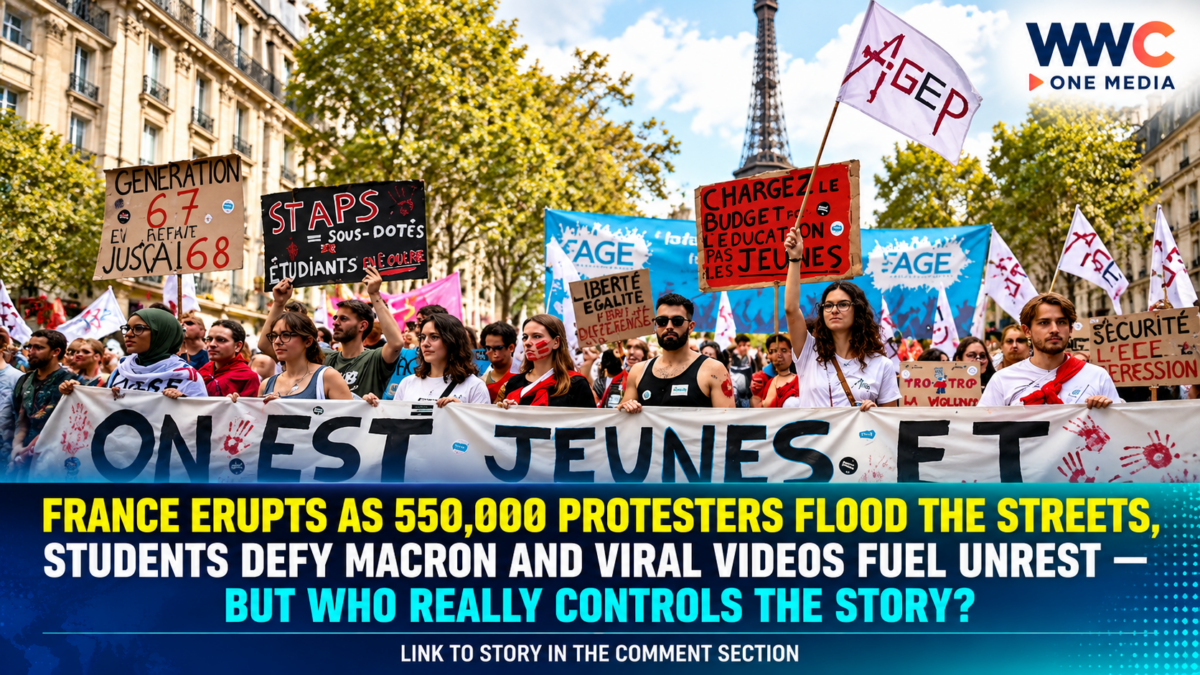
The demonstrations reached a new level on October 17, when approximately 550,000 people joined 110 marches across France, according to the Interior Ministry. Organizers estimated turnout at about 800,000.
While most demonstrators protested peacefully, violent incidents erupted in several cities, including Paris, Lyon, Marseille and Limoges. Police deployed tear gas and water cannons against groups involved in confrontations, while authorities reported approximately 400 arrests that day.
Yet the photographs of burning vehicles and damaged government buildings tell only part of the story.
FROM SCHOOL CLASSROOMS TO A NATIONAL MOVEMENT
The protests began at a high school in Créteil, southeast of Paris, where students complained about insufficient staff and deteriorating learning conditions.
Their demands rapidly spread to other schools, particularly in disadvantaged communities where students argue that educational inequality is undermining their futures.
By early October, demonstrations had expanded nationwide, drawing support from teachers, university students, parents and trade unions.
According to Le Monde, more than 1,000 schools participated in the October 1 mobilization, demonstrating how quickly the movement had gathered momentum.
Students highlighted overcrowded classes, shortages of teachers and concerns about France’s university admissions system.
The protests subsequently attracted people frustrated by rising food, energy and housing costs, bringing education grievances into a wider debate over social inequality and public spending.
VIRAL PROTESTS: WHEN SUPERHEROES AND MUSIC BECOME POLITICAL SYMBOLS
One of the movement’s most striking features is the way young protesters are using popular culture and creative performances to communicate political messages.
At Paris’ Place de la République, musicians from the Orchestre du Nouveau Monde performed familiar music, including Bella Ciao and themes associated with popular films.
In an October 23 commentary published by Channel NewsAsia, academic Sara Garcia Santamaria examined how images of an orchestra performing during demonstrations offered a contrasting narrative to scenes of destruction.
Meanwhile, some student protesters appeared dressed as recognizable fictional characters, including Batman and Chucky, while other demonstrations incorporated symbols associated with anime and internet culture.
Such imagery can travel quickly across social platforms, drawing attention from audiences who might otherwise have little interest in France’s domestic politics.
This creates a new challenge for political authorities and protest organizers alike: controlling how a movement is understood when viral clips often attract more attention than detailed explanations of its demands.
However, visibility does not automatically translate into political success.
MACRON’S GOVERNMENT FACES A GROWING SECURITY AND POLITICAL CHALLENGE
President Emmanuel Macron has condemned attacks on public buildings, businesses and police while maintaining that peaceful demonstrations remain legitimate.
French authorities have attributed significant episodes of violence to radical groups and people seeking opportunities to loot businesses.
Protest organizers, however, argue that the misconduct of some participants should not overshadow the grievances of those demonstrating peacefully.
Human rights concerns have also intensified following injuries during confrontations between demonstrators and security forces.
The government previously suspended the use of certain stun grenades at student-led demonstrations amid scrutiny of police tactics.
The tensions are creating difficult questions for French officials.
How can authorities prevent violence without unnecessarily restricting peaceful protests? And how can the government address demands for education funding and stronger public services while facing fiscal pressures?
PARIS PROTESTERS WIN COURT CHALLENGE AS NEW DEMONSTRATIONS LOOM
The confrontation continued on October 22, when thousands gathered peacefully in Paris after an administrative court overturned a police ban on a planned demonstration.
According to the Associated Press, organizers agreed that the gathering would remain stationary because of security concerns.
The ruling highlighted the tension between public safety restrictions and the right to peaceful assembly.
More demonstrations are expected on October 24, with labor organizations and supporters of France’s yellow vest movement preparing to mobilize.
Prime Minister Sébastien Lecornu has indicated that a major security deployment is planned to prevent renewed violence.
Union representatives also announced another day of mobilization for November 5 after discussions with the prime minister failed to produce concrete proposals.
WHY FRANCE’S UNREST MATTERS BEYOND ITS BORDERS
France’s demonstrations are occurring against a wider European backdrop of public frustration over wages, housing affordability, energy prices and economic insecurity.
Protests have also taken place in Spain, Italy, Belgium, Portugal and Albania, although these movements have distinct domestic causes and should not be treated as one coordinated campaign.
What connects many of these developments is the growing importance of digital communication in modern political activism.
Young demonstrators can now transform a localized dispute into an internationally visible controversy through short videos, recognizable symbols and emotionally compelling images.
But the same digital environment can also spread misleading impressions, particularly when isolated clashes are presented as representative of an entire protest movement.
The distinction matters: peaceful demonstrations and criminal acts must be evaluated separately.
THE BIGGER QUESTION: CAN VIRAL ANGER FORCE REAL CHANGE?
As France approaches its 2027 presidential election, the protests present a serious test of the government’s ability to respond to public dissatisfaction.
Students want improvements in education. Workers are demanding protection against the rising cost of living. Authorities are seeking to maintain order amid the risk of renewed violence.
And millions of online viewers are encountering the conflict through competing images of peaceful crowds, cultural performances, damaged buildings and clashes with security forces.
The challenge for protesters is whether online attention can be converted into meaningful reforms.
For the government, the challenge is whether security measures and promised policy responses can reduce public anger without deepening mistrust.
France’s streets may be the physical battleground, but public perception is becoming increasingly important.
The question now is whether this digitally amplified wave of protest will produce lasting change — or whether its demands will be lost beneath the next viral image.