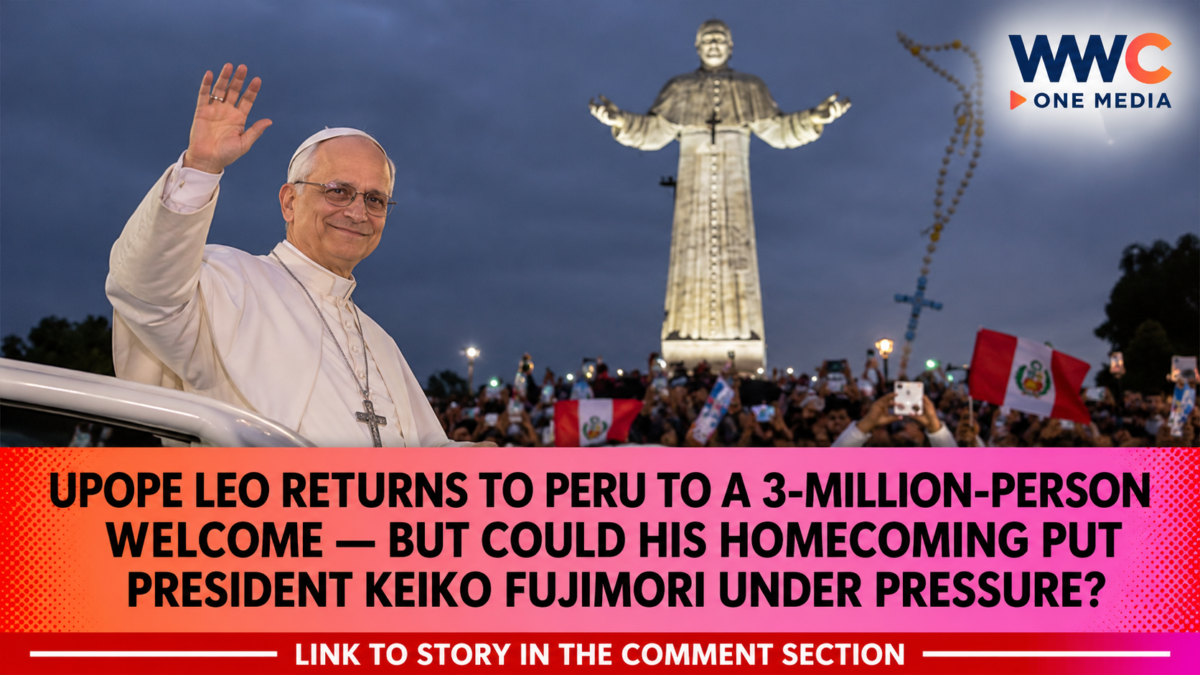
LIMA, PERU — Pope Leo XIV has returned to the country he considers one of his homes, receiving an extraordinary welcome from millions of people as he began the final and most personal stage of his first major South American tour as pontiff.
The Chicago-born pope arrived at Callao Air Base on Wednesday, November 11, marking his return to Peru after spending more than two decades serving as a missionary priest and later as Bishop of Chiclayo.
The Associated Press reported that the Vatican estimated approximately 3 million people lined the route of his motorcade as he travelled toward central Lima. Crowds waved Peruvian and Vatican flags, cheered his arrival and called him home.
President Keiko Fujimori welcomed the pontiff at the airport, where two children presented him with flowers. He embraced the children before proceeding with the official programme.
For Peruvians, this is more than a ceremonial papal visit.
Pope Leo, formerly known as Robert Francis Prevost, became a Peruvian citizen in 2015. His years working among local communities helped shape his pastoral identity and established a personal connection with a country now welcoming him as one of its own.
But the emotional homecoming is unfolding against a difficult national backdrop.
Peru is confronting rising insecurity, political instability, economic inequality and public frustration with government institutions. As Leo returns to familiar communities, his words about the country’s future will be closely watched — particularly by people hoping the Catholic Church can help bring attention to problems that political leaders have struggled to resolve.
WHY PERU IS THE MOST PERSONAL STOP OF POPE LEO’S SOUTH AMERICAN TOUR
Pope Leo’s visit to Peru is the third and final national stop of his 12-day apostolic journey through Uruguay, Argentina and Peru, which runs from November 6 to 17.
Although he was born in Chicago, Illinois, in the United States, his relationship with Peru stretches back decades.
Before becoming pope in 2025, Prevost spent approximately 20 years working as an Augustinian missionary in Peru. He later served as Bishop of Chiclayo from 2015 to 2023.
He also obtained Peruvian citizenship in 2015, making him a dual citizen of the United States and Peru.
The Associated Press reported that Leo has repeatedly credited Peru with teaching him what it means to be a pastor. His return is therefore being treated as a homecoming rather than simply another diplomatic and religious engagement.
The affection is visible across the country.
A 14-metre statue depicting the pope with outstretched arms was installed in Callao ahead of his arrival. Shops in Lima have been selling papal souvenirs, while images of Leo have appeared on murals, shirts and other merchandise.
In Chiclayo, where he previously served as bishop, residents are preparing to welcome the man many still remember as Father Robert.
His connection with the region is also reflected in the communities he is scheduled to visit during the coming days.
For background on his recovery before undertaking the demanding overseas journey, WWC ONE MEDIA previously reported on Pope Leo’s Return to the Vatican After Lung Cancer Surgery as His Surgeon Expressed Confidence in His Latin American Tour.
PRESIDENT KEIKO FUJIMORI WELCOMES THE POPE — BUT THEIR SHARED HISTORY COULD MAKE THE VISIT POLITICALLY SENSITIVE
One of the most closely watched moments of the visit is Leo’s meeting with President Keiko Fujimori.
The Peruvian president personally welcomed him at Callao Air Base before hosting the official welcome ceremony at the Presidential Palace in Lima.
Their meeting carries significance beyond protocol.
Keiko Fujimori is the daughter of former president Alberto Fujimori, whose administration from 1990 to 2000 remains one of the most controversial periods in modern Peruvian history.
Her father was convicted in connection with human rights abuses during the government’s campaign against insurgent groups. He died in 2024.
While serving as Bishop Robert Prevost, Leo publicly criticised the 2017 pardon granted to the former president, arguing that genuine reconciliation required recognition of the suffering experienced by victims.
That history gives the current papal visit a potentially sensitive political dimension.
Reuters reported that observers believe Leo’s personal experience in Peru gives him an unusually deep understanding of the country’s political history.
The pope has not announced a partisan position in the current political debate. Nevertheless, his comments about reconciliation, human rights and the treatment of vulnerable communities are likely to attract attention.
The question is whether he will address the country’s political divisions directly or focus primarily on broader themes of social responsibility and national unity.
PERU’S BIGGEST CHALLENGE: CRIME, POVERTY AND POLITICAL INSTABILITY
The timing of Leo’s return is particularly important because Peru is facing serious social and economic pressures.
According to the Associated Press, approximately 25.7% of Peru’s population lived in monetary poverty in 2025.
The country has also experienced a worsening security situation involving extortion, homicide and organised criminal activity.
The AP reported that Peru’s homicide rate increased from 5.8 to 10.7 per 100,000 people over five years.
Businesses, transportation operators and ordinary families have faced growing concerns over criminal threats and insecurity.
Political instability has added to the frustration.
Peru has experienced nine presidents since July 2016, reflecting years of political conflict and frequent changes in national leadership.
For many citizens, the concern is no longer simply which political party controls the government. It is whether public institutions can provide security, stable leadership and meaningful improvements in everyday living conditions.
The Catholic Church continues to hold an important position in Peruvian society, although its share of the population has declined.
The Associated Press cited Pew Research Center figures showing that the proportion of Peruvians identifying as Catholic fell from approximately 76% in 2013–2014 to around 67% in more recent estimates.
Even amid that decline, the Church retains influence through religious communities, education, charitable activities and social services.
That makes Leo’s visit significant at a time when many people are seeking institutions they believe can speak credibly about the country’s problems.
POPE LEO’S FIRST FULL DAY IN PERU FOCUSES ON THE COUNTRY’S FUTURE
The Vatican’s official itinerary places several important engagements in Lima on Thursday, November 12.
Leo is scheduled to meet Peru’s bishops at the Archbishop’s Residence before participating in a prayer service at the Cathedral Basilica of Saint John the Apostle and Evangelist.
One of the day’s central events is a meeting on the challenges and hopes for the future of the Peruvian people, scheduled to take place in the square outside the cathedral.
The programme also includes an evening prayer vigil with young people and university students at the National Stadium.
These engagements give the pontiff opportunities to meet religious leaders, young people and representatives of the wider community.
The emphasis on the country’s future is particularly relevant given the pressures facing younger Peruvians, including economic insecurity, public safety concerns and uncertainty about political stability.
The Vatican’s programme identifies these events as scheduled engagements. Their inclusion does not, by itself, establish what specific political proposals or policy announcements the pope will make.
CHICLAYO IS EXPECTED TO BE THE EMOTIONAL CENTRE OF THE VISIT
The next major stage begins on Friday, November 13, when Leo travels from Lima to Chiclayo.
The northern city holds special significance because he served as its bishop from 2015 to 2023.
He is scheduled to celebrate Mass in an open area near the Pampas de Pimentel before visiting the San Óscar A. Romero Chapel.
The programme also includes meetings with members of the Catholic community and the university sector.
For residents who remember his years as a local church leader, the visit offers an opportunity to welcome him back in a completely different role.
He left Chiclayo as a bishop. He is returning as the head of the world’s Roman Catholic Church.
The Vatican itinerary also includes a visit to Santa Cruz de Succhabamba and Zaña on November 14, followed by engagements in Cusco and Pucallpa on November 15.
The latter visit is particularly important because the pope is scheduled to meet missionaries and representatives of Amazonian communities.
THE AMAZON AND INDIGENOUS COMMUNITIES ARE ALSO CENTRAL TO THE VISIT
Leo’s planned journey to Pucallpa will bring him into contact with communities facing some of Peru’s most serious environmental and social challenges.
The Amazon region is affected by illegal gold mining, deforestation, land disputes, poverty and threats to Indigenous populations.
These problems are not isolated environmental concerns.
They can affect livelihoods, public health, access to land and the ability of local communities to preserve their cultural traditions.
The Associated Press reported that the pope’s programme includes a meeting with missionaries and representatives of Amazonian peoples.
His visit to the region could therefore provide an important opportunity to draw international attention to communities that often struggle to have their concerns heard by national authorities.
However, the visit should not be confused with the announcement of a new government programme or a specific environmental policy.
It is a pastoral and religious engagement that may help place these issues more prominently in public discussion.
HIS ARGENTINA VISIT ALSO DREW MILLIONS
Before arriving in Peru, Leo completed the Argentine stage of his tour with enormous public gatherings.
Reuters reported that approximately six million people attended events during his three-day visit to Argentina.
An outdoor Mass at the Shrine of Our Lady of Luján on November 11 drew an estimated two million people.
During the visit, Leo urged greater attention to people experiencing poverty, hunger, illness and imprisonment.
He also visited a penitentiary and embraced inmates, while encouraging humane treatment of detainees.
His comments came amid criticism of economic austerity measures in Argentina under President Javier Milei.
The contrast between the countries is notable.
Argentina is facing difficult economic debates over spending and social protection, while Peru is confronting serious security and political challenges.
Yet Leo’s message throughout the journey has consistently emphasised solidarity, human dignity and concern for vulnerable people.
WWC ONE MEDIA previously covered the Uruguay leg of the journey in Pope Leo Draws 140,000 to Historic Uruguay Gatherings Weeks After Lung Cancer Surgery — But Can His Urgent Call to Fight Poverty Unite a Divided South America?.
A DEMANDING INTERNATIONAL TOUR AFTER LUNG CANCER SURGERY
Another reason the journey has attracted international attention is the pope’s health.
Leo underwent surgery in October to remove a cancerous tumour from his right lung.
His recovery raised questions about whether he would be able to complete an itinerary involving multiple cities, flights, large gatherings and meetings with political and religious leaders.
However, he has continued with the scheduled journey and appeared in public throughout the Uruguay and Argentina stages.
Reuters reported that he appeared in good form during the trip, delivering lengthy speeches in a firm and clear voice.
That observation should not be interpreted as a complete medical assessment. His health remains a matter for his medical team and the Vatican.
The fact that he has continued the tour nevertheless represents a significant public milestone following his operation.
WHAT HAPPENS NEXT? POPE LEO IS SCHEDULED TO LEAVE PERU ON NOVEMBER 16
According to the Vatican’s official programme, Leo’s remaining visit includes Chiclayo, Pimentel, Santa Cruz de Succhabamba, Zaña, Cusco and Pucallpa.
On Monday, November 16, he is scheduled to visit staff and residents at a shelter for abandoned elderly people before celebrating Mass at Las Palmas Air Base.
A farewell ceremony is planned at Callao Air Base, followed by his departure for Rome.
He is expected to arrive at Rome’s Fiumicino Airport on November 17, bringing the 12-day apostolic journey to a close.
The schedule makes Peru the final and most personal destination of the trip.
For the country, however, the significance of the visit may extend well beyond the ceremonies and crowds.
President Fujimori’s administration is facing growing public expectations over security, economic conditions and political stability. The pope’s return could increase attention on those issues, especially if he uses his public engagements to speak about justice, reconciliation and the responsibilities of government.
WWC ONE MEDIA has also examined the political pressures surrounding the president in Peru President Keiko Fujimori’s Approval Sinks as Crime and Economic Fears Grow — But a Bigger Battle Over Her Presidency Is Unfolding.
MORE THAN A HOMECOMING: A TEST OF HOPE FOR PERU
Pope Leo XIV’s return to Peru has brought enormous crowds into the streets and revived memories of the years he spent serving local communities.
His dual citizenship and long association with the country have given this visit a deeply personal character.
But the millions who welcomed him are also living with serious national challenges.
Poverty, organised crime, political instability and environmental threats remain major concerns. The president faces pressure to deliver improvements, while many citizens continue looking for institutions they can trust.
The pope’s visit cannot resolve those problems on its own.
What it can do is bring attention to them, encourage public discussion and remind political and religious leaders that the needs of ordinary people cannot be ignored.
As Leo continues his journey through Chiclayo, the Andes and the Amazon, Peru will be watching not only the crowds that greet him but also the messages he delivers.
The historic welcome has already made headlines around the world.
The bigger question is whether his return will leave behind something more lasting than an extraordinary celebration: a renewed national conversation about justice, dignity and the future of Peru.