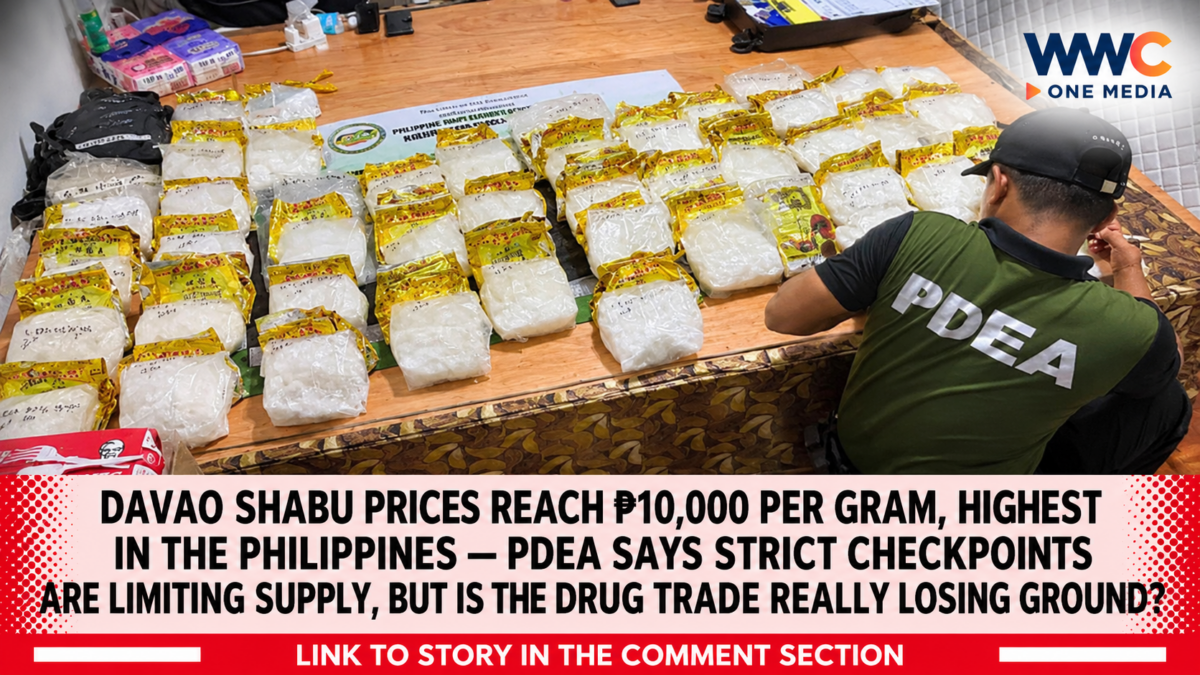
DAVAO CITY, Philippines — Shabu is reportedly selling for as much as ₱10,000 per gram in Davao City, making it the most expensive street-priced shabu market in the Philippines, according to the Philippine Drug Enforcement Agency in the Davao Region (PDEA-Davao).
The unusually high price, PDEA-Davao Regional Director Benjamin Gaspi said, reflects the difficulty of bringing illegal drugs into the city, which he attributed partly to strict checkpoints and security measures.
Speaking at a Davao Peace and Security Press Corps briefing at The Royal Mandaya Hotel on November 11, Gaspi said the price could range from ₱8,000 to ₱10,000 per gram, depending on the difficulty of transporting the drugs into Davao.
He placed the national street price at approximately ₱6,800 per gram, while the price in Zamboanga was reportedly a little above ₱3,000.
The figures paint a striking picture of the illegal drug market: shabu is reportedly more expensive in Davao than in other parts of the country, even as authorities continue to conduct anti-drug operations across the region.
But a higher street price does not, by itself, prove that drug trafficking has been eliminated or that demand has disappeared. It is an indication of reported market conditions, and PDEA’s explanation points to supply constraints as one possible factor.
Why Is Shabu More Expensive in Davao?
Gaspi said the amount of illegal drugs entering Davao is relatively small because of the strict checkpoints maintained by authorities.
According to the PDEA regional director, the difficulty of bringing drugs into the city contributes to the higher price paid in the local market.
He said the price had remained at roughly the same level in previous years and could also reach ₱10,000 per gram, adding that market forces ultimately determine the selling price.
The difference between Davao’s reported maximum of ₱10,000 and the national estimate of ₱6,800 is approximately ₱3,200 per gram. That is nearly 47 percent higher than the national figure.
However, these are reported street-price estimates, not a standardized nationwide price survey. Actual prices can vary according to location, quantity, purity, availability and other market conditions. The figures should therefore be treated as estimates cited by authorities, not as fixed prices applicable to every transaction.
National Shabu Price Has Nearly Doubled Since 2022, Remulla Says
The Davao figures come amid a broader increase in the reported street price of shabu nationwide.
Interior Secretary Jonvic Remulla said on November 4 that the national price had climbed to approximately ₱6,800 per gram, compared with around ₱3,800 under the previous administration.
In a November 5 report, ABS-CBN News quoted Remulla attributing the increase to reduced supply, saying drug networks were having greater difficulty obtaining the substance.
The difference between ₱3,800 and ₱6,800 represents an increase of approximately 79 percent. It is a substantial rise, although the comparison is based on the figures cited by the government official rather than a comprehensive independent market-price index.
Remulla has argued that the higher price indicates a tighter supply of illegal drugs. Other government statements have pointed to large-scale seizures and stronger border enforcement as evidence of intensified anti-drug operations.
But price increases alone cannot establish how much the total supply has fallen, whether demand has changed, or how much trafficking continues undetected. Those questions require broader data on seizures, availability, consumption and enforcement outcomes.
The national price discussion has also been tied to major international drug interceptions, including a shipment of approximately 200 kilograms of suspected shabu worth ₱1.36 billion seized at the Manila International Container Port on November 4.
WWC ONE MEDIA previously reported on the operation in PDEA Seizes ₱1.36 Billion Worth of Shabu at Manila Port in Unclaimed Laos Shipment — Who Was Supposed to Receive the Massive Drug Cargo?.
Davao Region Records 97 Anti-Drug Operations in Nine Months
Despite the high reported street price, anti-drug enforcement operations in the Davao Region have continued.
Gaspi said PDEA-Davao recorded 97 anti-drug operations from January 1 to September 30, 2026, most of them conducted in coordination with the police.
The operations resulted in approximately 146 arrests and the seizure of around three kilograms of assorted illegal drugs.
The seized substances included shabu, marijuana, kush, ecstasy and marijuana oil. The approximately three-kilogram figure covers the assorted drugs collectively; it should not be interpreted as three kilograms of shabu alone.
Gaspi also said the region rarely records drug seizures measured in kilograms of the same scale as those reported in Metro Manila, Central Visayas, Mimaropa and Central Luzon.
The figures show that enforcement activity remains ongoing, even as PDEA describes the volume of drugs entering Davao as relatively limited.
Recent Buy-Bust Operations Show Illegal Drugs Are Still Reaching Communities
Two recent operations cited in the SunStar report illustrate that illegal drugs continue to circulate in parts of the Davao Region.
On October 31, PDEA-Davao reported a buy-bust operation in Monkayo, Davao de Oro, in which a suspected drug den maintainer allegedly sold approximately one gram of suspected shabu to an undercover agent for ₱6,000.
In a separate operation in Davao City, Police Station 17 (Baliok), working with PDEA-Davao, arrested a suspect identified by the alias “Choy” in Purok Santiago, Barangay Indangan, at around 12:25 a.m. on November 10.
Authorities reported seizing approximately 17 grams of suspected shabu, which the Davao City Police Office valued at ₱115,600.
That valuation works out to ₱6,800 per gram, matching the national estimate cited by Remulla. It is important to note, however, that the amount is the police-reported estimated value of the seized substance, not proof of the exact price at which it would have been sold.
These cases underline the difference between a city having a high reported street price and having no illegal drug activity. Even if supply is constrained, local distribution and individual transactions can continue.
PDEA Says No Major Drug Syndicates or Clandestine Laboratories Are Currently Monitored
In a separate report from the same November 11 briefing, Gaspi said PDEA-Davao was not currently monitoring any major drug syndicates, clandestine drug laboratories or narco-politicians in Davao City and the wider Davao Region.
He said the agency’s intelligence gathering and coordination with other intelligence units had not produced reports confirming the presence of clandestine laboratories manufacturing illegal drugs in the region.
Gaspi also described allegations of drug manufacturing in Davao as unverified and said the agency had not identified a large organized drug group in its current monitoring.
On alleged narco-politicians, he said PDEA-Davao had not received reports identifying politicians involved in the illegal drug trade or using drug proceeds to finance political activities.
That assessment should be understood precisely: it describes what the agency says it is currently monitoring based on available intelligence. It is not proof that no organized drug activity, trafficking network or politically connected individual could exist outside the agency’s present findings.
The distinction matters because the region continues to record arrests, drug seizures and drug-affected communities.
International Drug Routes Remain a Concern for Mindanao
Although PDEA-Davao says relatively small quantities of illegal drugs enter the region, the wider Mindanao area remains exposed to cross-border trafficking routes.
The agency has previously pointed to possible sources outside Davao, including Northern Mindanao, as well as routes connected to Malaysia and Indonesia.
The broader regional concern is reflected in recent international drug interdictions.
In October, authorities in Laos seized 521 kilograms of suspected shabu worth approximately ₱3.54 billion at Luang Prabang International Airport. The shipment was reportedly intended for the Philippines and was linked to a planned private-jet flight.
The Philippine National Police and PDEA subsequently investigated possible local connections to the shipment. The seizure and the investigation raised questions about the role of alleged financiers, facilitators and intended recipients, but allegations against individuals must still be established through evidence and due process.
WWC ONE MEDIA has followed the case in ₱3.5-B Shabu Shipment Foiled in Laos — Why Authorities Are Now Pointing to an Ex-Bangsamoro Lawmaker, as well as ₱3.5-B Laos Shabu Haul: CIDG Subpoenas 21 People—What Will Investigators Uncover Next?.
These international cases are separate from the local Davao operations. There is no established evidence in the reports cited here that directly connects the seized Laos shipments to the street-level drug transactions in Davao.
Nevertheless, they demonstrate why authorities continue to emphasize intelligence-sharing, border inspections and coordination with neighboring countries.
Why the ₱10,000 Price Tag Does Not Tell the Whole Story
Davao’s reported shabu price has become a headline because it is significantly higher than the national estimate. But the number raises a more complicated question: does expensive shabu mean the drug trade is being successfully contained?
It may indicate that supply is harder to obtain, as Gaspi and Remulla have suggested. Yet price alone cannot measure the success of an anti-drug campaign.
A more complete assessment would require transparent and comparable data on drug availability, the number and scale of trafficking networks, arrests that lead to convictions, seizures, local drug-use trends and the reach of prevention and rehabilitation programs.
The 97 operations, 146 arrests and approximately three kilograms of assorted drugs seized in the Davao Region during the first nine months of 2026 offer a snapshot of enforcement activity. They do not, on their own, establish how much illegal drug supply remains in circulation.
The same caution applies to large national seizures. Confiscating a major shipment is significant, but investigators must also identify the people who financed, transported and intended to distribute the drugs.
What Happens Next for Davao’s Anti-Drug Campaign?
PDEA-Davao said it has activities planned for Drug Abuse Prevention and Control Week this November, working with other law enforcement agencies and local governments.
These include training activities and lectures for students and barangays on the dangers of illegal drugs.
The challenge for authorities is to sustain enforcement while strengthening prevention, community awareness and support for people affected by substance use.
For Davao residents, the latest figures offer two messages: authorities say strict checkpoints are making it harder for illegal drugs to enter the city, but recent arrests and seizures show that the problem has not disappeared.
Shabu may now reportedly cost as much as ₱10,000 per gram in Davao City. Whether that price reflects a lasting reduction in supply, however, will depend on evidence beyond the street market.
The bigger test is not how expensive illegal drugs become. It is whether authorities can dismantle the networks behind them, prevent new supplies from entering communities and reduce the harm caused by drug use.