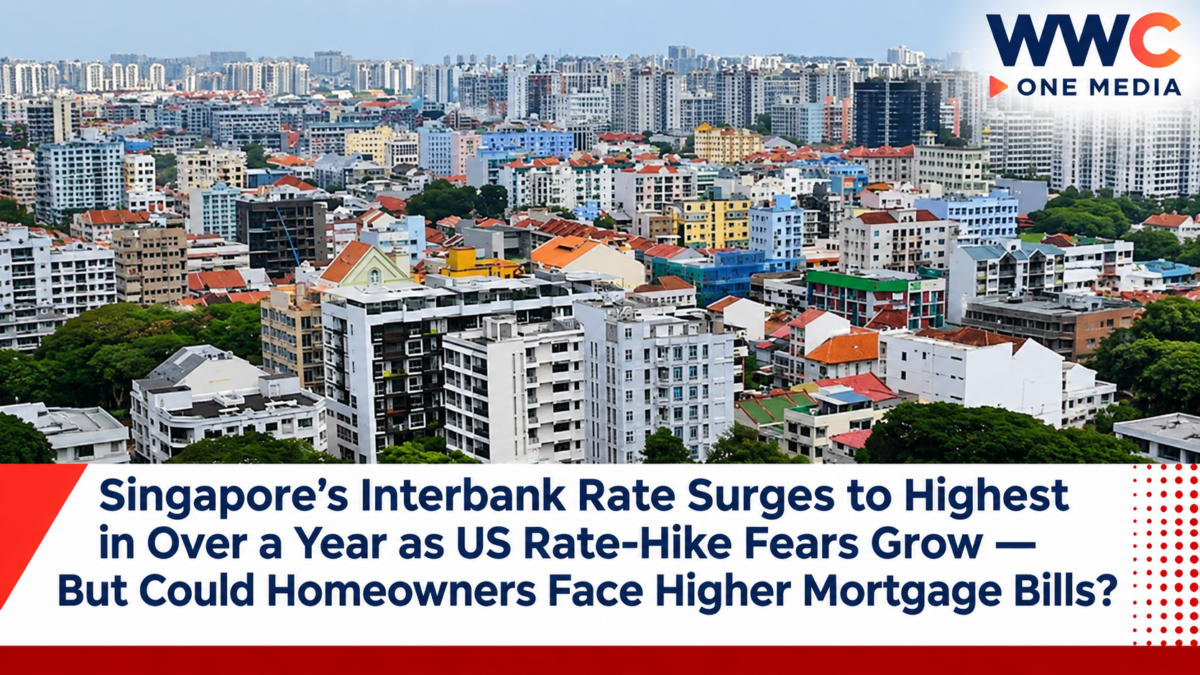
SINGAPORE — November 10, 2026 — Singapore’s borrowing environment is showing signs of renewed pressure as interbank interest rates climb to their highest levels in more than a year, raising questions about whether homeowners, businesses and financial institutions could face another period of rising financing costs.
According to Bloomberg’s November 10 report, tighter domestic liquidity and expectations of further US Federal Reserve interest-rate increases have contributed to the latest rise in Singapore-dollar borrowing costs.
The development comes at a delicate time for Southeast Asia’s financial hub.
Singapore’s economy has benefited from strong technology investment, trade activity and healthy demand for credit. But financial markets are increasingly concerned about inflation, higher global bond yields and the possibility that interest rates could remain elevated for longer than previously expected.
At the center of the discussion is the Singapore Overnight Rate Average (SORA), the country’s principal benchmark for Singapore-dollar overnight borrowing.
Official benchmark observations published by the Monetary Authority of Singapore show that overnight SORA reached 1.6277% on November 5, compared with 1.3668% on November 3.
The three-month compounded SORA stood at 1.3241% on November 5, while the one-month compounded rate reached 1.3652%.
These independently verified benchmark figures illustrate the rise in borrowing costs leading into Bloomberg’s November 10 report. They should not be mistaken for the precise November 10 fixing.
Although the overnight benchmark can move sharply from day to day, compounded SORA rates adjust more gradually.
That distinction is critical because many floating-rate housing loans use compounded SORA rather than the overnight rate itself.
But as Singapore’s financial markets adjust to tighter liquidity and the possibility of additional US rate hikes, a bigger question is emerging: Could the rise in interbank borrowing costs eventually squeeze homeowners, businesses and bank profits—or will the increase prove temporary?
Singapore Interbank Rates Reach Their Highest Levels in More Than a Year
Bloomberg reported that Singapore’s interbank borrowing costs had climbed to their highest levels in more than a year.
The increase reflects changing conditions in the market where financial institutions borrow and lend Singapore dollars.
Interbank rates are influenced by the availability of money in the banking system and the demand for short-term funding.
When liquidity becomes tighter, banks may have to pay more to secure the funds they need.
That can push overnight borrowing rates higher.
Expectations about international interest rates also influence Singapore’s financial markets.
The latest rise comes as investors reassess the outlook for US inflation and Federal Reserve policy.
Higher US rates can affect global funding costs, currency markets and capital flows.
However, Singapore’s domestic borrowing rates do not automatically move by the same amount as US interest rates.
Local liquidity conditions, market demand and exchange-rate movements also matter.
What Is SORA, and Why Does It Matter?
SORA stands for the Singapore Overnight Rate Average.
It measures the volume-weighted average interest rate on eligible unsecured overnight Singapore-dollar borrowing transactions between banks.
The Monetary Authority of Singapore calculates and publishes the benchmark using actual market transactions.
SORA has become central to Singapore’s lending and financial markets following the phaseout of older benchmarks such as the Singapore Interbank Offered Rate, or SIBOR.
The transition helped establish SORA as the principal benchmark for Singapore-dollar interest-rate products.
Several versions of SORA are relevant to borrowers.
Overnight SORA reflects borrowing costs for a single business day.
One-month compounded SORA reflects the compounded average over the preceding month.
Three-month compounded SORA covers a longer historical period and generally moves more gradually.
These rates are not interchangeable.
A sudden increase in overnight SORA does not mean a three-month mortgage benchmark immediately rises by the same amount.
Mortgage Borrowers Could Face Higher Repayments
The biggest concern for many households is the possible impact on mortgage payments.
Singapore banks offer floating-rate housing loans that are commonly priced using compounded SORA plus a bank-specific margin.
For example, a mortgage may charge three-month compounded SORA plus a fixed contractual spread.
If compounded SORA rises, the interest rate on that mortgage may also increase when the loan reaches its next scheduled reset.
Channel NewsAsia previously explained that changes in the US Federal Reserve’s policy rate do not translate automatically into identical changes in Singapore mortgage rates.
The same principle applies to fluctuations in overnight SORA.
The impact depends on the mortgage’s benchmark, reset schedule, remaining loan balance and contractual terms.
Borrowers with fixed-rate packages may not experience an immediate change.
Those approaching the end of a fixed-rate period could face different refinancing conditions.
The latest benchmark movement therefore deserves attention, but it does not establish that every homeowner’s next installment will increase.
Singapore’s Credit Boom Adds Pressure to Funding Markets
The rate increase is occurring against a backdrop of strong credit demand.
Earlier Monetary Authority of Singapore data showed that bank lending had expanded rapidly in 2026.
Nomura reported that total loans and advances increased approximately 12.5% year over year in July, the fastest growth rate since 2014.
Corporate lending rose 13.4%, while consumer loans climbed 10.4%.
Strong lending can support economic activity and bank revenue.
However, if borrowing demand grows faster than available deposits and other funding sources, it can also increase pressure on market liquidity.
As previously reported by WWC ONE MEDIA, analysts have warned that Singapore’s credit expansion could eventually contribute to tighter financial conditions.
Related WWC ONE MEDIA coverage: Singapore Loan Boom Hits Fastest Pace Since 2014 as Corporate and Consumer Borrowing Surge
The latest increase in interbank rates is consistent with concerns about funding conditions.
But the available evidence does not establish that credit growth alone caused the November rate movement.
US Federal Reserve Expectations Complicate Singapore’s Outlook
The international environment is another major factor.
The Federal Reserve raised its benchmark interest-rate range by 25 basis points in September 2026, responding to renewed inflation concerns.
Markets are now considering whether further tightening may be necessary.
Reuters reported on November 10 that investors were pricing a high probability of another US rate increase in December.
However, market probabilities can change quickly as inflation and employment data are released.
Higher US interest rates can influence Singapore through global bond yields, currency markets and bank funding conditions.
As previously examined by WWC ONE MEDIA, Singapore and the United States have both faced pressure to contain inflation, even though their monetary-policy systems differ substantially.
Related WWC ONE MEDIA coverage: US Fed Resumes Rate Hikes as Inflation Shock Brings Washington Closer to Singapore’s MAS
For Singapore, the challenge is balancing financial stability, economic growth and inflation without relying on the same policy instruments as the Federal Reserve.
Why MAS Does Not Set Interest Rates Like the Fed
Singapore’s monetary-policy framework differs from those of many major economies.
The Monetary Authority of Singapore manages policy primarily through the exchange rate of the Singapore dollar against a trade-weighted basket of currencies.
This framework reflects Singapore’s heavy reliance on international trade and imported goods.
Changes in the Singapore dollar’s exchange rate can influence imported inflation.
In April and July 2026, MAS tightened monetary policy by increasing the rate at which its exchange-rate policy band was allowed to appreciate.
However, at its October 14 policy review, MAS unexpectedly left its settings unchanged.
The central bank maintained the prevailing slope, midpoint and width of its exchange-rate policy band.
The decision reflected expectations that inflation pressures would eventually ease.
MAS projected 2026 core inflation of approximately 1.5% to 2% and headline inflation around 2%.
The policy decision does not mean domestic interest rates are frozen.
Interbank rates can continue changing according to market liquidity and broader financial conditions.
OCBC Warns That Funding Costs May Continue Rising
Singapore’s major banks are closely monitoring interest-rate developments.
In a November 8 rates outlook, OCBC said domestic overnight funding costs had been gradually increasing.
The bank maintained its projection that SORA could average approximately 1.4% toward the end of 2026.
OCBC also identified potential corporate demand for interest-rate hedging as a factor that could support swap rates.
Interest-rate hedging allows companies and financial institutions to manage exposure to changes in borrowing costs.
However, hedging does not eliminate every financing risk.
Its effectiveness depends on the contracts used, costs involved and the underlying obligations being protected.
The bank’s outlook suggests that the direction of Singapore rates will depend on a combination of domestic liquidity and international market developments.
What Rising Rates Mean for DBS, OCBC and UOB
Singapore’s three major banks—DBS, OCBC and UOB—could experience mixed effects from higher rates.
Banks generally earn interest from loans and other financial assets.
Higher market rates can improve income from certain new loans and floating-rate assets.
But banks must also pay for customer deposits and wholesale funding.
If deposit costs rise more quickly than lending yields, profit margins can narrow.
That makes the timing of interest-rate changes important.
Higher rates are not automatically good or bad for bank profitability.
As WWC ONE MEDIA recently reported, analysts expect Singapore’s largest lenders to face a more challenging earnings environment in 2027.
Related WWC ONE MEDIA coverage: Singapore Banking Giants DBS, UOB and OCBC Face Tough 2027 After Billions in Profits Fail to Impress Investors — But Could a Bigger Stock Market Selloff Be Coming?
Net interest margins, deposit competition, loan demand and asset quality will be important indicators of how the banks manage the changing environment.
UOB’s Latest Results Highlight the Funding-Cost Challenge
UOB’s third-quarter financial results provide a recent example.
The bank reported approximately S$1.25 billion in net profit.
Although earnings recovered strongly from the previous year, the result fell short of market expectations.
UOB also faced pressure from funding costs and trading performance.
The latest increase in Singapore-dollar interbank rates therefore arrives when investors are already questioning how much additional earnings growth major banks can deliver.
A higher benchmark could improve the pricing of some loans.
But it could also increase costs if banks must pay more to retain deposits or secure financing.
The effect on profitability will depend on how assets and liabilities reprice.
Could Singapore’s Stock Market Face More Pressure?
Changes in borrowing costs can also affect stock-market valuations.
When interest rates increase, companies may face higher financing expenses.
Investors may also demand higher returns before committing money to equities.
That can place pressure on share prices, particularly in sectors sensitive to interest rates.
Singapore’s Straits Times Index is heavily influenced by its three major banks.
As previously reported by WWC ONE MEDIA, bank shares faced selling pressure in October as investors reconsidered earnings expectations and rising bond yields.
Related WWC ONE MEDIA coverage: Singapore Bank Stocks Slide as DBS, UOB and OCBC Face Fresh Pressure
However, a rise in interbank rates does not guarantee that stocks will decline.
Market performance also depends on company earnings, valuations, economic activity and investor sentiment.
Singapore’s major banks remain profitable businesses, and market volatility should not be confused with evidence of a banking-system crisis.
Singapore’s Economic Strength Creates a Complicated Policy Environment
Singapore’s economy has continued benefiting from strong investment in artificial intelligence, electronics and advanced manufacturing.
Preliminary government data showed economic growth of approximately 5.4% year over year in the third quarter of 2026.
The government has projected full-year GDP growth of 4.5% to 5.5%.
That resilience can support demand for commercial financing.
But strong activity may also place additional pressure on funding markets.
Meanwhile, inflation and global energy prices remain important uncertainties.
MAS expects growth to moderate as the exceptional AI investment cycle eventually eases.
The outlook presents a delicate balance.
Singapore wants to sustain economic expansion without allowing inflation or financial risks to accelerate.
What Homeowners and Businesses Should Watch Next
For borrowers, the most useful indicators are not limited to a single day’s overnight SORA fixing.
Homeowners with floating-rate mortgages should monitor the specific compounded benchmark referenced in their loan agreement.
They should also check the bank’s contractual spread and reset dates.
Businesses should assess whether their financing costs are fixed or floating.
Companies with significant short-term refinancing requirements may be particularly sensitive to changing funding conditions.
Investors should monitor the direction of US interest-rate expectations, domestic liquidity and Singapore bank earnings.
Three developments will be especially important: whether overnight SORA remains elevated, whether compounded benchmarks follow it higher, and whether further US monetary tightening changes global financing conditions.
The latest market movement is a warning signal, not proof that a prolonged period of high interest rates has already begun.
The Bigger Picture: Is Singapore Entering a New Borrowing-Cost Cycle?
The rise in Singapore’s interbank rates highlights a potentially important shift in the country’s financial environment.
Strong credit demand, tighter liquidity and changing expectations for US interest rates are creating upward pressure on short-term borrowing costs.
For homeowners, the main concern is whether higher overnight rates eventually feed into mortgage benchmarks.
For businesses, the issue is the cost of financing expansion and refinancing existing debt.
For banks, the challenge is balancing higher lending yields against more expensive deposits and wholesale funding.
Singapore’s financial system remains supported by established institutions and a sophisticated regulatory framework.
But even a resilient economy can face financial pressure when borrowing costs change quickly.
The key question is whether this latest increase proves temporary or develops into a more persistent upward trend.
As Singapore’s interbank rates reach their highest levels in more than a year, the next test will be whether higher funding costs remain contained within financial markets—or begin affecting household budgets, corporate investment and bank profitability.
And with US rate-hike expectations rising while Singapore’s banks navigate tighter liquidity, one question remains: Will the city-state’s borrowing costs stabilize before homeowners feel the impact—or could a new wave of mortgage and financing pressure be approaching?