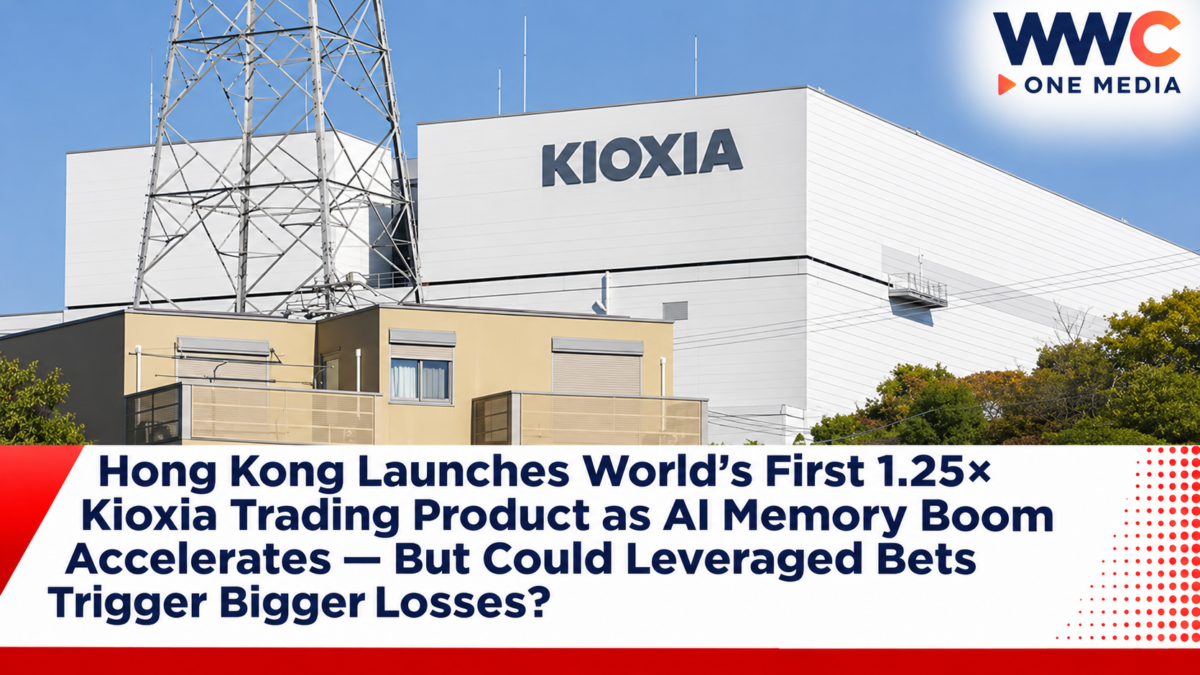
CSOP Asset Management has announced the listing of the CSOP Kioxia Daily Max (1.25×) Leveraged Product, which is scheduled to begin trading on the Hong Kong Stock Exchange on November 10 under stock code 7772.
The launch comes amid renewed attention toward leveraged exchange-traded products following a roughly one-year hiatus highlighted by Bloomberg.
CSOP describes the product as the world’s first leveraged exchange-traded instrument designed to provide amplified daily exposure to Kioxia Holdings, one of Japan’s leading manufacturers of NAND flash memory and solid-state drives.
The timing is significant.
Kioxia recently reported an extraordinary increase in quarterly revenue, driven partly by demand for high-performance storage products used in artificial intelligence infrastructure.
For the July–September 2026 quarter, revenue reached approximately ¥2.48 trillion, up 453.2% from a year earlier.
But the excitement surrounding AI-related semiconductor stocks has also attracted substantial speculative trading.
Japan’s market has already seen a buildup of heavily leveraged positions in Kioxia shares, raising concerns about forced selling if prices fall.
As Hong Kong opens another route for investors seeking exposure to the AI memory boom, one question is becoming increasingly urgent: Will the new leveraged product create opportunities for short-term traders—or amplify losses when semiconductor stocks turn volatile?
CSOP Brings Kioxia Leveraged Trading to Hong Kong
CSOP Asset Management announced its new investment product on November 9.
The instrument is designed to track the daily performance of Kioxia Holdings with a target leverage factor of 1.25 times.
That means it aims to deliver approximately 125% of Kioxia’s daily percentage change, before fees, expenses and tracking differences.
If Kioxia shares rise 4% during a trading session, the product would target a gain of approximately 5%.
But if the shares decline 4%, it would target a loss of approximately 5%.
These are simplified examples, not guaranteed trading outcomes.
Actual returns may differ because of market movements, financing costs, derivative pricing, fees and other factors.
Unlike ordinary shares, the instrument does not give investors direct ownership of Kioxia stock.
It provides synthetic exposure through financial derivatives.
The product is designed for short-term trading rather than long-term investing.
Why Bloomberg’s One-Year Hiatus Matters
Bloomberg’s November 10 report highlighted the significance of Kioxia’s leveraged product arriving after a roughly one-year pause in the relevant Hong Kong product-listing category.
The development suggests renewed willingness among financial-product issuers to offer instruments tied to volatile international technology shares.
However, the hiatus should not be interpreted as meaning that Hong Kong had stopped listing all exchange-traded funds or leveraged products for an entire year.
Hong Kong already has a substantial exchange-traded product market.
The Kioxia launch is distinctive because it provides a new single-stock leveraged exposure to a Japanese semiconductor company.
The new product may help expand Hong Kong’s role as a regional destination for trading international technology themes.
Its commercial success will depend on investor demand, trading liquidity and market conditions.
How Much Does the Kioxia Product Cost?
CSOP announced an indicative initial listing price of approximately HK$7.80 per unit.
The standard board lot contains 100 units.
At the indicative price, one board lot would therefore cost approximately HK$780, excluding trading commissions, levies and other charges.
The product carries a stated annual management fee of 1.6%.
These terms may make the instrument more accessible to traders who cannot conveniently buy a standard board lot of Kioxia’s Tokyo-listed shares.
However, a lower entry amount does not make leveraged trading safer.
Smaller initial capital requirements can encourage investors to take positions without fully understanding the potential losses.
A trader should consider the instrument’s daily objective, volatility, fees and liquidity before making a decision.
What Is Kioxia, and Why Does AI Need Its Chips?
Kioxia Holdings is a Japanese semiconductor manufacturer specializing in flash-memory technology.
Its products include NAND flash memory and solid-state drives used in consumer electronics, enterprise storage systems and data centers.
Flash memory retains stored information even when power is switched off.
Solid-state drives use memory chips to store and retrieve data.
These products are important in large computing facilities, where servers need to manage enormous volumes of information.
Artificial intelligence applications can require extensive storage for training datasets, software, model files and generated outputs.
As technology companies expand their computing infrastructure, demand for suitable high-capacity storage systems can increase.
However, Kioxia primarily specializes in NAND flash and storage products.
It should not be confused with companies whose principal AI-memory products involve high-bandwidth memory, or HBM, used alongside advanced AI processors.
Both categories matter to the semiconductor industry, but they serve different technical purposes.
Kioxia Revenue Jumps 453% as Storage Demand Accelerates
Kioxia’s financial results provide much of the excitement surrounding the new investment product.
For the three months ended September 30, 2026, the company reported revenue of approximately ¥2.48 trillion.
That compares with roughly ¥448.3 billion during the same period in 2025.
Revenue increased 40.3% from the immediately preceding quarter.
Operating profit reached approximately ¥1.99 trillion, compared with ¥85.9 billion a year earlier.
The company attributed its improvement partly to higher selling prices and stronger demand from data-center customers.
According to specialist publication Blocks & Files, Kioxia experienced exceptional growth in SSD-related revenue as AI infrastructure spending supported storage demand.
These financial results are substantial.
But semiconductor businesses can experience pronounced industry cycles.
Strong product pricing and demand during one period do not guarantee similarly high margins in future years.
Investors must consider whether extraordinary earnings growth can continue as manufacturers expand capacity and customers adjust their spending.
AI Memory Demand Is Also Creating a Global Chip Shortage
The broader semiconductor market has experienced pressure as AI infrastructure absorbs increasing amounts of memory-production capacity.
Manufacturers are investing heavily in products serving advanced computing applications.
That has contributed to concerns about the availability and pricing of memory used in consumer electronics.
As previously reported by WWC ONE MEDIA, smaller smartphone and laptop manufacturers have faced difficulties obtaining enough memory components.
Some have responded by changing product configurations, seeking longer-term supply agreements or raising prices.
Related WWC ONE MEDIA coverage: Small Phone and Laptop Makers Are Running Out of Memory Chips — But Paying More May No Longer Be Enough
The shortage provides context for the attention surrounding companies such as Kioxia.
However, tight supply can benefit manufacturers through higher prices while simultaneously hurting their customers.
It also creates the risk of a future correction if supply eventually exceeds demand.
Kioxia Already Faces Heavy Margin-Trading Exposure
One of the biggest concerns is the amount of borrowed money already being used to trade Kioxia shares.
According to Bloomberg reporting carried by The Japan Times on October 19, outstanding leveraged long positions in Kioxia totaled approximately ¥920 billion as of October 15.
That was the largest such balance among companies listed on the Tokyo Stock Exchange at the time.
The buildup suggested that many investors had borrowed funds to increase their exposure to Kioxia’s stock-price movements.
Borrowing can amplify returns when prices rise.
But it can also force investors to sell when markets move against them.
Analysts warned that heavy margin positions could create additional downward pressure if traders were required to liquidate shares.
The new Hong Kong product introduces another form of leveraged exposure, although its swap-based structure differs from buying Kioxia shares directly with borrowed money.
The two should not be treated as identical investments.
Nevertheless, both illustrate the risks associated with leveraged semiconductor trading.
Why Daily Reset Leverage Can Produce Unexpected Returns
A particularly important feature of the new product is its daily reset.
The 1.25× target applies to a single day’s share-price performance, not necessarily to Kioxia’s total return over weeks or months.
Consider a simplified example.
Suppose Kioxia shares rise 10% one day and fall 9.09% the next day.
The stock would finish approximately where it started.
A hypothetical product perfectly achieving 1.25 times the daily movement would first gain 12.5%, then lose approximately 11.36%.
Its value would finish slightly below its original level.
The difference arises because daily returns compound.
Real products also incur expenses and may experience tracking differences.
This effect becomes particularly important during volatile markets.
A product can lose value even when the underlying stock finishes a multiday period close to its starting price.
The 1.25× multiplier is a daily objective, not a promise of a 25% higher long-term return.
Hong Kong Is Trying to Attract More Semiconductor Investors
The new listing also reflects Hong Kong’s efforts to diversify its capital markets.
The city has been attracting semiconductor, robotics and AI-related companies seeking international investment.
But its fundraising environment has become more difficult.
Recent market volatility and valuation concerns have caused some planned public offerings to be delayed or canceled.
As previously reported by WWC ONE MEDIA, approximately one in four Hong Kong IPO deals failed to reach completion during 2026, according to Bloomberg data cited in earlier coverage.
Related WWC ONE MEDIA coverage: Hong Kong IPO Crisis Deepens as 1 in 4 Deals Collapse in Worst Withdrawal Wave Since 2008 — But Is Asia’s Biggest Fundraising Boom About to End?
The Kioxia product is not an IPO.
CSOP is listing a financial instrument linked to existing shares traded in Japan.
Nevertheless, both developments reflect Hong Kong’s efforts to attract investor activity connected to the AI industry.
China’s Semiconductor Companies Continue Raising Capital
Despite difficult market conditions, semiconductor companies have continued seeking funding through Hong Kong.
In late October, several Chinese businesses launched offerings involving AI processors, memory technology and other industrial products.
As previously covered by WWC ONE MEDIA, six companies collectively targeted approximately US$765 million through a group of offerings announced on October 30.
Related WWC ONE MEDIA coverage: Hong Kong Sees $765-Million IPO Rush as Chinese Chip Suppliers Race to Raise Cash — But Can AI Stocks Survive the Market Selloff?
These transactions are separate from CSOP’s Kioxia product.
The distinction is important.
An IPO raises equity capital for the issuing company and its selling shareholders.
A leveraged exchange-traded product gives investors market exposure through a financial structure.
Purchasing the new CSOP product does not directly provide Kioxia with funds for new factories or research.
Global AI Stocks Remain Vulnerable to Sharp Corrections
The Kioxia launch comes during a period of significant volatility across technology markets.
In early November, major semiconductor and AI-related stocks declined sharply as investors questioned the scale of industry spending and the valuations assigned to technology companies.
The correction spread from the United States to Asian markets.
As previously reported by WWC ONE MEDIA, the global AI selloff affected companies in Japan, South Korea, Taiwan and other markets closely connected to the semiconductor supply chain.
Related WWC ONE MEDIA coverage: Wall Street Loses $3.2 Trillion in AI Stock Rout as Investors Search for Safer Bets — But Could the Next Tech Crash Be Even Worse?
The market turmoil illustrates why investors must distinguish strong operating performance from stock-price stability.
A chipmaker may post record revenue while its share price declines because of valuation concerns, profit-taking or changes in expectations.
Leveraged products can amplify those movements.
The launch therefore arrives at a time when risk management is particularly important.
Kioxia Is Also Exploring a Potential US Listing
The Japanese memory-chip manufacturer has separately considered expanding its access to international investors.
In September, Reuters reported that Kioxia was evaluating a potential US listing of American depositary receipts.
Bloomberg reported that the company was considering a transaction that could raise at least $10 billion.
The discussions were preliminary.
A possible US listing should not be described as completed or guaranteed.
An American depositary receipt arrangement could provide another route for US investors to gain exposure to a foreign company’s shares.
However, it is fundamentally different from the leveraged product now being introduced in Hong Kong.
The Hong Kong instrument targets an amplified daily return using derivatives.
An ADR represents an interest connected to shares of the foreign issuer.
These products involve different legal structures and investment risks.
What Investors Should Watch After the Listing
The first important indicator will be trading activity.
A new product can attract attention because of its novelty, but sustained demand depends on whether traders find it useful.
Liquidity will also matter.
Thinly traded products may experience wider bid-ask spreads, increasing transaction costs.
The second indicator will be tracking performance.
Investors should compare the product’s actual daily return with its targeted leveraged exposure, accounting for expenses and market conditions.
The third is Kioxia’s share-price volatility.
Rapid price changes could create substantial short-term gains or losses.
The fourth is the outlook for global NAND flash demand.
Strong data-center spending may continue supporting earnings, but the industry remains vulnerable to pricing cycles.
Finally, investors should consider currency exposure, derivatives counterparty risks and the product’s suitability for their investment objectives.
The Bigger Picture: Is Hong Kong Fueling Another AI Trading Boom?
CSOP’s new Kioxia leveraged product illustrates the growing connection between Asia’s capital markets and the global artificial intelligence industry.
Hong Kong investors can now gain amplified short-term exposure to a Japanese memory-chip manufacturer without directly purchasing its Tokyo-listed ordinary shares.
The product arrives at a time of extraordinary revenue growth for Kioxia and strong interest in semiconductor businesses serving data centers.
But the opportunity comes with significant risks.
Kioxia shares have already experienced volatile trading.
Borrowed positions in the stock have reached substantial levels.
And the wider AI market has suffered sharp corrections as investors reassess valuations.
The 1.25× product offers an additional trading tool, not protection against losses.
The real test will be whether investors understand that amplified exposure works in both directions—and that a strong AI industry does not guarantee profitable short-term trades.
And as Hong Kong welcomes a new leveraged product following a long pause in the relevant listing category, one question remains: Will Kioxia’s explosive earnings turn the product into a new favorite among AI traders—or could daily leverage magnify the next painful semiconductor selloff?